
1542-1621·Feast September 17
St. Robert Bellarmine
Cardinal, Archbishop of Capua, Doctor of the Church
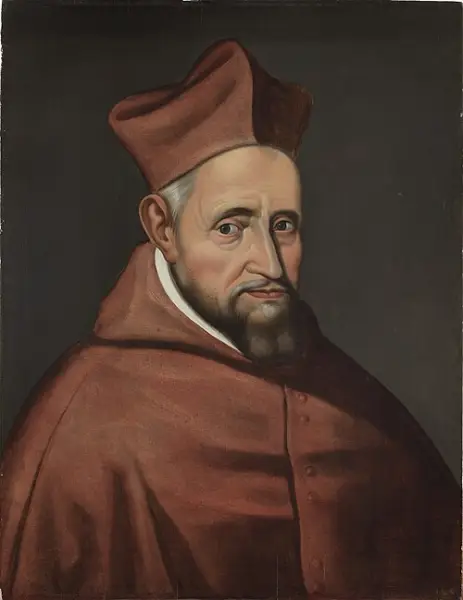
Overview
Roberto Bellarmino was born at Montepulciano in Tuscany on 4 October 1542, a nephew of Pope Marcellus II, into a noble but impoverished house. Boyhood found him memorizing Virgil whole and writing verse in both Italian and Latin; one hymn he wrote on Mary Magdalene entered the Roman Breviary. He entered the Jesuit novitiate at Rome in 1560, studied at Mondovi and Padua, and finished theology at Leuven, where he was ordained in 1570 — the first Jesuit to teach there, lecturing on Aquinas's Summa and contending with Michael Baius over grace and free will. Recalled to Rome in 1576 by Gregory XIII, he taught polemical theology at the Roman College for over a decade; those lectures grew into the Disputationes, the earliest systematic treatment of the controversies between Catholics and Protestants. Rector of the Roman College from 1592, examiner of bishops, and a cardinal from 1599, he sat among the judges at Giordano Bruno's trial. Made Archbishop of Capua in 1602, he applied Trent's reform decrees in his diocese and clashed on principle with King James I over the Oath of Allegiance. In 1616 he admonished Galileo on Paul V's orders and later certified that no abjuration had been demanded. Retired and frail, he wrote small books of devotion for ordinary souls and died at Rome on 17 September 1621.
The Complete Life
Early Life
Roberto Bellarmino was born at Montepulciano in Tuscany on 4 October 1542, a nephew of Pope Marcellus II, into a noble but impoverished house. Boyhood found him memorizing Virgil whole and writing verse in Italian and Latin; one hymn he wrote on Mary Magdalene entered the Roman Breviary. He entered the Jesuit novitiate at Rome in 1560, studied at Mondovì and Padua, and finished theology at Leuven, where he was ordained in 1570 — the first Jesuit to teach there, lecturing on Aquinas's Summa and contending with Michael Baius over grace and free will.
§ Early life
Mission and Ministry
Recalled to Rome in 1576 by Gregory XIII, he taught polemical theology at the Roman College for over a decade; those lectures grew into the Disputationes de controversiis, the earliest systematic treatment of the controversies between Catholics and Protestants, and the most used. Rector of the Roman College from 1592, examiner of bishops, and a cardinal from 1599, he sat among the judges at Giordano Bruno's trial. Made Archbishop of Capua in 1602, he applied Trent's reform decrees in his diocese and clashed on principle with King James I over the Oath of Allegiance, defending the Church's power against both royal absolutism and papal overreach.
§ Introduction
Spirituality and Teaching
Bellarmine's controversial greatness was matched by a small-writing tenderness: his catechism for children, used across the Catholic world for centuries, and his books of devotion for ordinary souls — the mind of a controversialist serving the plain. In 1616, on Paul V's orders, he admonished Galileo that the Copernican opinion could not be held, and later certified that no abjuration had been demanded of the scientist — the document at the centre of the affair's argument ever since.
§ The Galileo case
Trial and Final Years
Retired from Capua and increasingly frail, he spent his last years writing, praying and giving away what he had; he died at Rome on 17 September 1621, leaving, by his own arrangement, so little that his funeral was paid for by alms.
§ Introduction
Canonization
Bellarmine was beatified by Pius XI on 13 May 1923, canonized on 29 June 1930, and declared a Doctor of the Church in 1931. His feast is 17 September.
§ Introduction
Legacy
Bellarmine is the Catholic Reformation's scholar-saint: the systematizer of its controversy, the catechist of its children, and — through the Galileo episode — a permanent figure in the argument over faith and science. His doctrine of the indirect power of the papacy in temporal affairs fed both Catholic and Anglican political theory, and his conviction that a bishop should live poor enough to be buried at the Church's expense remains the sharpest sentence in the Counter-Reformation's mirror.
§ Introduction
Timeline
- 4 Oct 1542
Born at Montepulciano in Tuscany, son of Vincenzo Bellarmino and Cinzia Cervini, sister of Pope Marcellus II.
§ Early life
- 1560
Entered the Jesuit novitiate in Rome, remaining in the city for three years.
§ Early life
- 1569
Sent to finish his studies at the University of Leuven, where he was ordained and gained fame as professor and preacher.
§ Career
- 19 Mar 1570
Ordained a priest on 19 March while teaching at the University of Leuven, the first Jesuit on its faculty.
§ Career
- 1576
Returned to Italy in poor health and was commissioned by Gregory XIII to lecture on polemical theology at the Roman College.
§ Career
- 1581
First volume of his Disputationes de controversiis christianae fidei appeared at Ingolstadt; the series ran until 1593.
§ Dogmatics
- 1589
Chosen by Sixtus V to accompany Enrico Caetani's papal legation to Paris as its theologian, enduring Henry of Navarre's siege.
§ New duties after 1589
- 1592
Made rector of the Roman College.
§ New duties after 1589
- 1598
Appointed examiner of bishops.
§ New duties after 1589
- 3 Mar 1599
Created a cardinal by Clement VIII, then made a Cardinal Inquisitor and judge at the trial of Giordano Bruno.
§ New duties after 1589
- 21 Apr 1602
Consecrated bishop by Clement VIII and installed as Archbishop of Capua, where he applied the Tridentine reforms.
§ Career
- 1614
Seen by Thomas Hobbes at a Rome service on All Saints Day; published The Mind's Ascent to God by the Ladder of Created Things.
§ Devotional works
- 1615
Wrote to the heliocentrist Paolo Antonio Foscarini on Copernicanism and the interpretation of Scripture.
§ The Galileo case
- 1616
On Paul V's orders summoned Galileo, warned him of the coming Index decree, and ordered him to abandon Copernican doctrine.
§ The Galileo case
- 1619
Published the devotional work The Art of Dying Well.
§ Devotional works
- 17 Sep 1621
Died in Rome aged seventy-eight and was buried in the Church of St. Ignatius.
§ Death
- 13 May 1923
Beatified by Pope Pius XI in Rome.
§ Introduction
- 29 Jun 1930
Canonised by Pope Pius XI in Rome.
§ Canonization and final resting place
- 1931
Declared a Doctor of the Church the year after his canonisation.
§ Canonization and final resting place
In Their Own Words
I say that, as you know, the Council forbids exposing the Scriptures contrary to the common consent of the Holy Fathers
Nor can it be answered that this is not a matter of faith, because if it is not a matter of faith ex parte obiecti, it is a matter of faith ex parte dicentis
On the sixth day, God, with a single command, produced all the species of land animals, wild and domestic, and commanded them to multiply; and so they have done, do, and will do until the end of the world.
Finally, on the sixth day, God, wishing to summarise all his works, made man, in whom he placed the qualities of all the elements: the life of plants, the feelings of animals, and the intellect and free will of the angels.
The Record
- Major works
- Disputationes de controversiis christianae fidei (1581-1593)·De ascensione mentis in Deum per scalas rerum creatorum (The Mind's Ascent to God, 1614)·The Art of Dying Well (1619)·The Seven Words on the Cross·De scriptoribus ecclesiasticis (1613)·Commentary on the Psalms
- Patron of
- Canonists and canon lawyers·Catechists and catechumens·Archdiocese of Cincinnati
- Symbols
- Cardinal's red robes·Doctor's biretta·Book of controversies
- Canonization
- Beatified 13 May 1923 by Pope Pius XI; canonized 29 June 1930; declared Doctor of the Church in 1931
Prayer
Bibliography
Profile text adapted from the Wikipedia article, licensed CC BY-SA 4.0.
Pray with this saint every day
Save St. Robert Bellarmine to your favorites, read the full profile, and get feast-day reminders in the Saints app.
Get the Saints AppFree on the App Store for iPhone and iPad