
c. 1000 - 1067·Feast April 17
St. Robert de Turlande
Founder of La Chaise-Dieu and servant of the poor
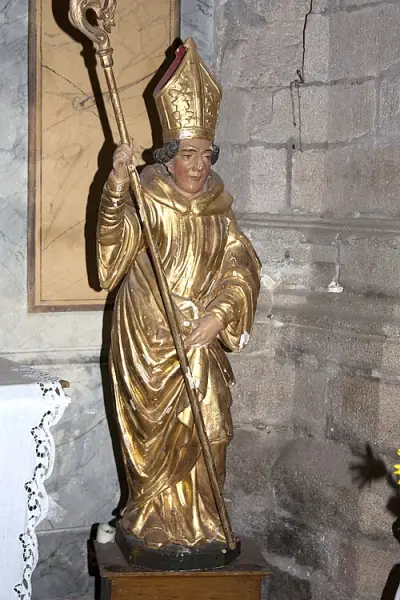
Overview
Robert de Turlande was a French priest and Benedictine monk who founded the celebrated abbey of La Chaise-Dieu, the House of God, on a lonely plateau of his native Auvergne and was remembered above all for his total commitment to the poor. Born about 1000 into a noble family related to Saint Gerald of Aurillac, he was educated at the church of Saint-Julien in Brioude, where he became a canon after his ordination in 1026 and founded a hospice for the destitute of the region. Seeking a stricter life he entered Cluny under Saint Odilo, then travelled to Rome and Monte Cassino to study the Rule of Saint Benedict at its source. On 28 December 1043 he settled with two companions on vacant land around a ruined chapel; in 1046 Pope Gregory VI authorized their hermitage and their service of the poor, and by 1050 the community had raised a convent that won the endorsement of the Bishop of Clermont and a decree of protection from King Henry I. Some fifty churches in his region were built or restored under his care. He died on 17 April 1067 with three hundred monks around him, and was canonized at Avignon in 1351 by Pope Clement VI, whose own religious life had begun at La Chaise-Dieu.
The Complete Life
Born in the Forest
Robert de Turlande came into the world around the year 1000, the last child of the nobles Geraud de Turlande and Raingarde, a woman of equal rank who was sister to Bishop Rencon. Through his family he was connected to Saint Gerald of Aurillac, the saintly count whose memory blessed the Auvergnat nobility with an ideal of Christian lordship. The circumstances of his birth were read at once as an omen: his mother's labour began amid the woods close by the family's castle, and the child arrived there, far from hall and hearth. The people who told the story afterwards saw in that woodland birth a sign of what the boy would become, a hermit, a man of God at home in solitudes where other men feared to dwell. Nothing else is recorded of his earliest years, but his family's standing secured him the best of educations: his schooling was overseen at the Church of Saint-Julien in Brioude, one of the great collegiate churches of the Auvergne, whose canons represented the established order of the local church. There, among clergy and books rather than knights and hunts, the son of the Turlande nobles grew toward the ecclesiastical vocation his birth in the wild had seemed to promise.
§ Life
Canon, Cluniac, and Pilgrim to Monte Cassino
In 1026 Robert was ordained to the priesthood and received into the chapter of canons at Saint-Julien in Brioude, the church of his education. Even as a canon of a prosperous collegiate church his heart inclined to the poor: at Brioude he founded a hospice for the destitute of the region, an undertaking that marked him early as a man who would spend rank and revenue on those who had nothing. The canonical life, however, could not hold him. He withdrew to Cluny, the abbey whose reformed observance was transforming Western monasticism, and placed himself under the direction of its abbot, Odilo, one of the most influential churchmen of the age. Still he was not content with second-hand monastic wisdom. He made the pilgrimage to Rome, and from there to Monte Cassino in the Papal States, the mother house where Benedict of Nursia had written the Rule that governed the Benedictines, in order to drink the Benedictine spirit at its fountain. The journey tells its own story: a noble's son, an ordained canon, a Cluniac monk, he was assembling every resource of the reforming church before committing himself to the work he had not yet begun, the founding of a house that would join contemplation to the service of the poor.
§ Life
The House of God on the Empty Plateau
On 28 December 1043 Robert acted. In the company of two knights, Stephen Chaliers and Dalmas, he made his way to an unoccupied tract surrounding a ruined chapel, a spot as desolate as the forest of his birth, and there resolved to build the house that would become the Benedictine convent of La Chaise-Dieu, the Home of God. In 1046 the three men received from Pope Gregory VI permission to establish a hermitage and to bind themselves to a life of commitment to the poor. It was the Pope himself who directed the shape of the foundation, suggesting that the contemplative life would be the greater means to their end of providing for the needy; on that counsel Robert moved into Auvergne and made the plateau his permanent home. His reputation drew followers faster than he could house them. Around 1049 the donations of the faithful enabled him to begin a proper convent, construction of which was finished in 1050. The new house received the endorsement of the Bishop of Clermont, and Robert then travelled to the court of King Henry I to obtain a royal decree of protection and approval, securing his foundation against every predatory neighbour. Under his care some fifty churches in the region were built or restored, so that the wilderness round La Chaise-Dieu filled with the sound of bells.
§ Life
A Week of Farewell
Robert governed La Chaise-Dieu for the better part of two decades and died there on 17 April 1067, aged about sixty-seven. The affection of the people for the old founder showed itself in the singular circumstances of his burial. His funeral could not be held until 24 April, a full week after his death, because the crowds who wished to see his remains and take their leave of him kept arriving; the community waited for the region to finish its farewell before committing him to the tomb. In those same days the reports began that would never cease: hundreds of miracles were said to have been worked through his intercession at his grave. The local cultus that grew from this visitation made him, in effect, the saint of the Auvergne within a generation of his death. He was interred in the convent he had founded, among the three hundred monks who now filled the cloisters he had raised from emptiness, the plain arithmetic of a life's fruitfulness. Later centuries dealt harshly with his remains, for most of his relics were burnt when the Huguenots sacked the abbey in the wars of religion, but the house and the devotion outlived even that destruction.
§ Life
Proclaimed a Saint at Avignon
The cultus that formed around Robert's tomb in the years after 1067 never died, and in time it pressed for the Church's formal judgement. The occasion came through an extraordinary admirer. Clement VI, the fourth of the Avignon popes, had begun his own religious life as a monk at La Chaise-Dieu, and the founder of his house remained for him a spiritual inspiration and father. On 19 September 1351, nearly three centuries after Robert's death, the Pope proclaimed him a saint in a solemn celebration at Avignon, where the papal see then resided, presiding in person over the elevation of the Auvergnat abbot to the calendars of the Church. The canonization bound the abbey and the papacy together in a final act of gratitude. Clement's attachment to La Chaise-Dieu shaped the last arrangements of his own life: he expressed the desire to be buried in the abbey church among the monks of Robert's rule, and when he died in 1352, a year after raising its founder to the altars, that desire governed his remains. Few founders have been honoured by a pope so personally indebted to their work, and few canonizations have so plainly crowned a single community's unfailing memory of its father.
§ Canonization
The Abbey That Remembers Its Father
La Chaise-Dieu grew from Robert's ruined chapel into one of the great abbeys of France, and his memory remained woven into its stones. The house he opened with two companions in 1043 numbered three hundred monks at his death, and the abbey church later raised on the plateau kept his tomb at its heart, a destination for pilgrims of the Auvergne for centuries. His cult, nourished by the hundreds of miracles reported from the week of his funeral onward, received its papal seal in 1351 and carried his name through the liturgical books as Saint Robert of Chaise-Dieu. Destruction touched the relics but not the devotion: when the Huguenots burned most of his remains, the abbey and its daughter houses preserved his memory in choir, calendar, and custom. His patronage has remained attached to the classes of men his life exemplified, abbot and hermit, and to the abbey itself, Chaise-Dieu, whose very name, the House of God, is his most permanent monument. He is invoked as a spiritual inspiration to those who would join the contemplative life to care for the poor, the twofold counsel that Gregory VI gave him and that he kept, as his hospice at Brioude and his fifty churches still testify, to the end.
§ Canonization
Timeline
- 1000
Born the last child of the nobles Geraud de Turlande and Raingarde; his mother gave birth to him in the forest near the family castle.
§ Life
- 1026
Ordained to the priesthood and made a canon of the Church of Saint-Julien in Brioude, where he founded a hospice for the poor.
§ Life
- 28 Dec 1043
Travelled with the knights Stephen Chaliers and Dalmas to a vacant tract around a ruined chapel, the site of his future convent.
§ Life
- 1046
Received from Pope Gregory VI permission to establish a hermitage and devote himself to the poor; on the Pope's counsel he embraced the contemplative life and moved to Auvergne.
§ Life
- 1049
Having gathered numerous followers, began construction of a new Benedictine convent funded by the donations of the faithful.
§ Life
- 1050
Saw the convent finished and won the endorsement of the bishop of Clermont before going on to seek the King's.
§ Life
- 17 Apr 1067
Died at La Chaise-Dieu, leaving three hundred monks in the community he had founded.
§ Life
- 24 Apr 1067
His funeral took place, put off for a week as the crowds kept coming to view his body; reports spoke of hundreds of cures granted at his intercession.
§ Life
- 19 Sep 1351
Proclaimed a saint by Pope Clement VI in a celebration at Avignon, where the papal see then resided.
§ Canonization
The Record
- Major works
- La Chaise-Dieu, the Benedictine convent founded 1049-1050·Hospice for the poor at Brioude·Around fifty churches built or restored in his region
- Patron of
- Abbots·Hermits·Chaise-Dieu
- Symbols
- Benedictine habit·Staff
- Canonization
- Canonized 19 September 1351 by Pope Clement VI at Avignon
Prayer
Bibliography
Show 5 sources
- "Saint Robert of the House of God". Saint Robert's. Archived from the original on 19 June 2016. Retrieved 20 June 2016.
- "Saint Robert of Chaise-Dieu". Saints SQPN, 5 September 2009. Retrieved 20 June 2016.
- "St. Robert of Chaise Dieu". Catholic Online. Retrieved 20 June 2016.
- "St. Robert of La Chaise-Dieu". Santi e Beati. Retrieved 20 June 2016.
- "St. Robert de Turlande". FaithND.
Profile text adapted from the Wikipedia article, licensed CC BY-SA 4.0.
Pray with this saint every day
Save St. Robert de Turlande to your favorites, read the full profile, and get feast-day reminders in the Saints app.
Get the Saints AppFree on the App Store for iPhone and iPad