
c. 1160 - 1218·Feast September 24
St. Robert of Knaresborough
Hermit of the Nidd caves who ransomed prisoners
Overview
Robert of Knaresborough, born Robert Flower around 1160, was a Yorkshire hermit whose cave beside the river Nidd became one of the great shrines of medieval England. Son of Touk Flower, mayor of York, he abandoned the wealth of his family for a life of solitude, beginning as a novice at the Cistercian Newminster Abbey before settling in a hermit's cave at Knaresborough. Driven from one refuge to another, first by bandits and then by the castle's constable, William de Stuteville, on a charge of giving shelter to robbers and outlawed men, he finally returned to the cave and kept it for the rest of his life. He lived on herbs, roots, and water, won a reputation for wisdom and prophecy, and practised a charity as daring as it was characteristic: his favourite work was ransoming men from prison. Pilgrims came to him for guidance and healing, his following grew into a community that gave rise to the Trinitarian house at Knaresborough, and King John himself sought him out. He died on 24 September 1218, forewarning his followers that the monks of Fountains would come to claim his remains for their own church. An oil flowed from his tomb, making him a myroblyte saint, and he is celebrated on 24 September, never formally canonized, yet kept as a saint by popular devotion in the Anglican and Roman Catholic communions alike.
The Complete Life
The Mayor's Son Who Walked Away
Robert Flower was born in York around 1160, a child of the civic elite of the greatest city of the North. His father, Touk Flower, served as mayor of York, and the family's wealth and standing guaranteed the boy a place in the world of commerce, office, and property that his father governed. Robert refused the inheritance. Very early in life he turned toward the church, becoming a sub-deacon and a novice at Newminster Abbey, the Cistercian house in Northumberland founded in the reforming wake of Fountains. The choice of the Cistercians, the most austere order of the age, announced the direction of his soul, yet even the cloister proved too populated for him: he remained at Newminster only a few months. Something in him required a solitude more radical than even the white monks allowed. Yorkshire offered a model close at hand, for the county was dotted with hermits, and the youth who had abandoned a mayor's household went looking for a cave. The pattern of his whole life was already visible in this first withdrawal, a man who could not be at home anywhere that grace and silence were crowded out, and who would spend his days circling closer and closer to the rock above the river Nidd.
§ Life
From Cave to Cell and Back
Robert's search for solitude led him to a knight-hermit living in a cave by the river Nidd at Knaresborough, a former man of arms in hiding from King Richard the Lionheart. From him the young Robert learned the hermit's trade in the rough school of example. When the king died, the knight returned to his family and left the cave to Robert alone. Around the grotto stood a small chapel dedicated to St. Giles, the seventh-century hermit whose patronage watched over lepers and outcasts, and there Robert settled for several years. His peace was repeatedly broken. A wealthy widow named Juliana offered him a cell at St. Hilda's Chapel in nearby Rudfarlington, and there his reputation as a wise and holy friend of the poor began to spread; but after a year bandits destroyed his hermitage. Dispossessed, he sheltered for a while against the church wall at Spofforth, then sampled the common life at Hedley near Tadcaster, and found those monks too easygoing for his discipline. When the district grew calmer he returned to Rudfarlington, only to be uprooted again, this time by the law itself. Through every expulsion he moved, remarkably, in the same orbit, each return bringing him nearer to the cave that was his true cell.
§ Life
Charity at the Castle Gate
The charity for which Robert was best known was as dangerous as it was merciful: his favourite work was redeeming men from prison, paying the price that set captives free. In an age when gaols filled with debtors and men detained at the will of the powerful, the hermit who arrived with ransom money was a threat as well as a marvel. For a season Robert prospered in the world's terms, keeping four servants and cattle, until William de Stuteville, constable of Knaresborough castle, accused him of harbouring thieves and outlaws, and forces of law and order destroyed his hermitage for the second time. The charge contained its own testimony: the outlaws and hunted men of the district knew where mercy lived. Robert returned permanently to the cave at Knaresborough, and the persecution that dispossessed him could not dislodge the crowds that sought him out. During his years at Spofforth his fame had first gathered its multitudes, and at Knaresborough the following grew into a small community of hermits, attested for miracles and prophecies. King John visited him, Trinitarian friars venerated him, and his brother Walter, now mayor of York like their father before him, came and financed a group of new structures, among them a chapel honouring the Holy Cross beside the cave, the floorplan of which survives to this day.
§ St Robert's Cave
Herbs, Roots, and the Harnessed Deer
As a hermit Robert kept a body and a soul disciplined to the barest minimum, living on nothing beyond herbs, roots, and the water of the spring near his cave. His asceticism, however, was never a flight from the poor but its reverse: the less he needed, the more he had to give, and the gifts of land and goods that benefactors pressed upon him flowed out again in alms and ransoms. The stories told of him preserved this union of austerity and gentleness in images that the North of England never forgot. In one, Robert complained that the King's deer were eating his crops; Sir William, the lord of the chase, mocked the hermit and invited him to catch the offenders if he could. Robert herded the wild deer into his barn as tamely as a flock of sheep, harnessed them to his plough, and set them to work, a parable enacted rather than spoken, in which the virgin forest itself submitted to the man who had made peace with creation. Crowds who gathered to praise him during his Spofforth years frightened him at first, so much that he fled to Headley Priory, but he learned to let the crowds come, for they came to a man whose empty table and open heart said the same thing.
§ Life
The Warning and the Oil
Before his death Robert gave his followers a warning worthy of his prophetic reputation: when his time came, he told them, Fountains Abbey would covet his remains and endeavour to remove them to its own church, and his followers must stand against them. The prophecy proved exact. He died on 24 September 1218, aged about fifty-eight, and when the white monks of Fountains came for the prize, the community defended his remains as he had commanded, and Robert was buried where he had lived, in the chapel his brother's money had built, cut into the steep rocky crags above the river. From the sepulchre, it was said, an oil began to issue, and the sick travelled long distances to be anointed with it and cured. The fragrant grease that marked his grave made Robert a myroblyte, one of the small company of English saints whose bodies exuded healing unguents, and it confirmed the shrine his cave had already become. He had lived the last years of his life as the centre of a pilgrimage, sought out for spiritual guidance and the cure of bodily ailments; in death, as in life, the man who had renounced everything found himself unable to escape the crowds, only now they came to the rock itself.
§ Life
A Saint Claimed by Two Orders
Robert was never canonized, and the absence of a papal decree tells only half the truth, for in everything that matters to popular religion he was a saint from the hour of his burial. The earliest order to venerate him was likely the Cistercians, whose claim on him was preserved in the thirteenth-century manuscript Harley 3775; they had a genuine memory to draw on, since he had begun his religious life in one of their houses. The Trinitarians, whose community at Knaresborough Priory grew from his following, took over the management of his cult and recorded his life three times over, in Latin prose, in Latin verse, and in Middle English verse. Each order shaped the saint to its own tradition, the Cistercians emphasizing the hermit's solitude, the Trinitarians his charisma and, above all, his charity; and the Trinitarians themselves framed two versions of his life, one for internal circulation that minimized his care of the poor and exalted his spirituality, another for the outside world that held up his charity for imitation. Neither the Church of England nor the Roman Catholic Church has formally canonized him, but he is celebrated as a saint by popular acclaim in both communions, his feast kept on 24 September, the day of his death.
§ Veneration
The Cave That Remains
Robert of Knaresborough has never left his town. He is numbered among the most influential Knaresborians, ranked alongside the prophetess Ursula Southeil, better known as Mother Shipton, and the civil engineer John Metcalf, the blind road-builder. The cave of St Robert, hollowed out of the limestone of the Nidd Gorge, now enjoys Grade II* listed status and is open to the public, where visitors may still see the small chapel, the traces of the living area, and the site of the tomb from which the healing oil flowed. The spring nearby kept its own cult as St Robert's Well: described in 1844 as an open well two feet deep near the York Road, it was roofed over with bathing facilities in 1791 as a cold bath, marked on the Ordnance map of the 1850s, and finally built over by the Monkswell business park, though the well shaft that fed it still preserves the spring, and visitors still drop coins through its grid. A small number of Yorkshire churches bear his dedication, among them the fourteenth-century parish church at Pannal and the Roman Catholic church of Our Lady Immaculate and St Robert in Harrogate. At St Matthew's Church in Morley, Derbyshire, seven stained-glass panels depicting his life, brought there originally from Dale Abbey, are still in place, so that the hermit's story glows in glass beyond the county borders he never sought.
§ Legacy
Timeline
- 1160
Born Robert Flower in York, son of Touk Flower, mayor of the city.
§ Life
- 24 Sep 1218
Died at Knaresborough aged about fifty-eight and was buried in the chapel cut from the rock beside his cave, where a healing oil began to flow from the tomb.
§ Life
The Record
- Major works
- Trinitarian community at Knaresborough Priory, which grew from his following·Chapel of the Holy Cross at Knaresborough, built beside his cave through his brother Walter
- Symbols
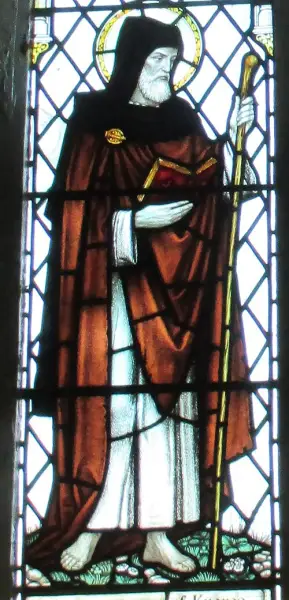
- A bearded monk holding a book
- Canonization
- Pre-congregation; acclaimed as a saint by popular acclaim in the Anglican and Roman Catholic traditions, never formally canonized, feast on 24 September
Prayer
Bibliography
Show 7 sources
- Hayward, John. "St. Robert of Knaresborough". Wilfrid.com, Parish Church of St. Wilfrid, Bognor. Archived from the original on 4 March 2016. Retrieved 22 September 2020.
- Goulding, Brian (23 September 2004). "Robert of Knaresborough". Oxford Dictionary of National Biography (online ed.). Oxford University Press.
- Clay, Rotha Mary (22 September 1914). The Hermits and Anchorites of England. London: Methuen.
- Hunter Blair, Hazel J. (June 2021). "Trinitarian Hagiography in Late Medieval England: Rewriting St Robert of Knaresborough in Latin Verse". Studies in Church History. 57: 77-95.
- Calvert, Michael (1844). The History of Knaresbrough, Etc. [With Plates.]. W. Parr, pages 104-105.
- Wheater, William (1907). Knaresburgh and Its Rulers. Kegan Paul, Trench, Trubner and Co., page 304.
- Council, Harrogate Borough (6 October 2023). "St Roberts Cave, Knaresborough".
Profile text adapted from the Wikipedia article, licensed CC BY-SA 4.0.
Pray with this saint every day
Save St. Robert of Knaresborough to your favorites, read the full profile, and get feast-day reminders in the Saints app.
Get the Saints AppFree on the App Store for iPhone and iPad