
1028 – 1111·Feast April 17
St. Robert of Molesme
Abbot of Molesme and founder of Cîteaux
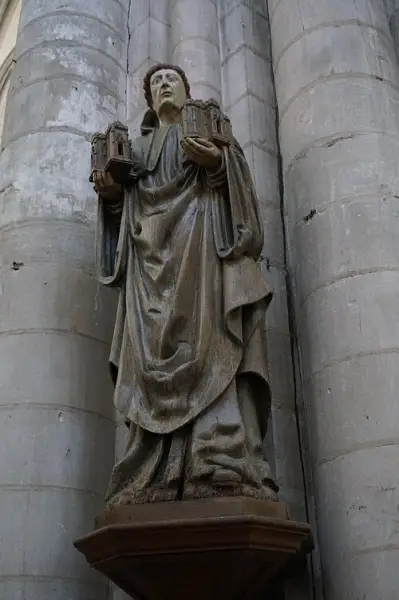
Overview
Robert of Molesme was a Burgundian abbot whose longing for stricter monastic observance helped bring forth the Cistercian Order. Born near Troyes into the noble Champagne family of Thierry and Ermengarde, he joined the Benedictines at Montier-la-Celle, a house near Troyes, at the age of fifteen, and in time advanced to prior. Made abbot of Saint Michel-de-Tonnerre around 1070, he found the monks there too quarrelsome to reform and withdrew to his former community. When two hermits from Collan petitioned Pope Gregory VII to appoint Robert their superior, the pope granted the request, and by 1074 Robert led the group, soon resettling it at Molesme in the valley of Langres in Burgundy. From huts of branches gathered around a forest chapel dedicated to the Holy Trinity, Molesme won renown for piety and sanctity, attracting donors, scholars, and eventually wealth that dulled the community's fervor and divided the brethren. Twice Robert tried to leave and was ordered back by the pope. In 1098 he departed with twenty-one monks for a desolate wooded valley given by Viscount Renaud of Beaune, where they founded Cîteaux Abbey, the cradle of the Cistercians. Recalled in 1099 by the monks of Molesme and their bishop, he returned and made the abbey a major center of Benedictine life, governing it until his death on 17 April 1111. Pope Honorius III canonized him in 1222.
The Complete Life
A Noble Son of Champagne
About 1029, in the neighborhood of Troyes, Robert was born as one of the younger sons of Thierry and Ermengarde, members of the Champagne nobility. Little is recorded of his childhood beyond the family into which he was born, but his parents' standing placed him where monastic education and advancement were within reach. At fifteen he joined the Benedictine community of Montier-la-Celle, close to his native city, and within its walls he passed the years that shaped his religious life. In that community he advanced steadily until he held the office of prior, a position that entrusted him with the discipline and daily order of the monastery. His early career thus unfolded entirely within the established Benedictine world of northern France, formed by the Rule of Saint Benedict and by the customs of one of Champagne's religious houses. The habits of observance and governance he acquired at Montier-la-Celle shaped everything that followed: his troubled abbacy at Tonnerre, his leadership of the hermits of Collan, and ultimately the two foundations, Molesme and Cîteaux, that fixed his place in the history of Western monasticism.
§ Life
Abbot Against His Inclination
Around the year 1070 Robert was made abbot of Saint Michel-de-Tonnerre, but the appointment brought him grief rather than harvest. He discovered that the monks of that house were quarrelsome and disobedient, and rather than preside over a community he could not reform, he returned to Montier-la-Celle. Retirement did not end his trials. Two hermits of the monastic group settled at Collan made the journey to Rome, where they petitioned Pope Gregory VII to set Robert over them; their request was granted. By 1074 Robert stood at the head of this small band. Soon afterward he moved the community to Molesme in the valley of Langres in Burgundy, where the first settlement consisted of nothing more than huts of branches surrounding a forest chapel dedicated to the Holy Trinity. There the monastery acquired a reputation for piety and sanctity, and Robert's own fame for holiness spread with it. In 1082 that renown drew Bruno of Cologne, who sought Robert's counsel, lived for a time among his monks, and afterwards established the Grande Chartreuse, origin house of the Carthusian order. Even before Cîteaux, Robert's leadership was shaping the reforming currents of his age.
§ Life
The Founding of Cîteaux
Molesme prospered to the point of peril. By 1098 the abbey counted thirty-five dependent priories, other annexes, and houses of nuns, and donors from the surrounding country vied in enriching it. Wealth brought slackness: the monks had more than they needed, benefactors' children crowded the cloister for schooling, and vast landholdings demanded a great number of employees. Men began to seek entry for the wrong reasons, division arose among the brothers, and Robert's severity was challenged. Twice he attempted to leave, and twice the pope ordered him back. At last, in 1098, Robert departed with twenty-one of his brethren, resolving that Molesme should see him no more. Renaud, Viscount of Beaune, gave them a desolate valley in a deep forest, and there they founded Cîteaux Abbey. Two of Robert's Molesme monks, Stephen Harding and Albéric, proved pivotal in establishing the new house. Hugh of Die, Archbishop of Lyons, secured the patronage of Odo I, Duke of Burgundy, who paid for the buildings, financed the monks' expenses, and granted them substantial land and cattle, while the Bishop of Châlons gave the monastery formal standing as an abbey.
§ Cîteaux
Return to Molesme
Robert's departure did not end his bond with the abbey he had first built. In 1099 the monks of Molesme requested his homecoming, consenting to accept his reading of the Rule of Saint Benedict without reservation, and their bishop added his own pressure. Robert consented, and under his hand Molesme was restored as one of the great houses of Burgundian monasticism. At Cîteaux, Albéric took his place as abbot, with Stephen Harding as prior, so that the fledgling reform continued under the men he had trained. Robert governed Molesme through the final decade of his life, dying there on 17 April 1111 at about eighty-two years of age. The story of his foundations thus came full circle: the restless abbot who had left wealth and tepidity behind at Molesme was recalled to renew the same house in rigor, while the daughter foundation at Cîteaux grew into the mother house of the Cistercian Order. His memory was committed to writing soon after his death, when Guy, who took his place as abbot of Molesme, wrote the Vie de saint Robert de Molesme, the earliest account of his life.
§ Life
Honored by the Church
Robert's sanctity was formally recognized little more than a century after his death. Pope Honorius III canonized him in 1222, confirming the reputation that had gathered around Molesme and Cîteaux alike. In the Roman Catholic Church his feast is kept on 17 April, the anniversary of his death, while the Benedictines celebrate him on 26 February together with Alberic of Cîteaux and Stephen Harding, the two companions of his Cistercian foundation. This joint commemoration reflects his standing as one of the founding figures of Cîteaux: modern icons of the abbey's founders show Saints Robert, Albéric, and Stephen Harding together venerating the Blessed Virgin Mary. The cult of the saint rested not only on his institutional achievement but on the testimony of those who knew him, preserved by his successor Guy in the Vie de saint Robert de Molesme and by the liturgical books of the orders he served. Through these observances Robert has been honored for eight centuries as a man whose refusal to accept a lukewarm religious life reshaped Western monasticism. Behind the formal decree stood a long tradition of devotion at the two abbeys he had governed, where his memory passed from the brothers' recollection into the Church's official calendar.
§ Life
Father of Two Reformations
Robert's legacy runs along two lines that converged in the monastic renewal of the eleventh and twelfth centuries. At Molesme he built a house whose reputation for piety drew hermits, nobles, and benefactors, and whose network eventually embraced dozens of priories and convents. At Cîteaux he planted the seed of the Cistercian Order, carrying twenty-one monks into a Burgundian forest to live the Rule of Saint Benedict in its full severity; under his successors Albéric and Stephen Harding that settlement became the mother house of an order that transformed European monastic life. His influence reached beyond his own foundations. The visit of Bruno of Cologne, who sought his counsel at Molesme in 1082 before founding the Grande Chartreuse, placed Robert near the origin of the Carthusian reform as well. The account of his life written by Guy of Molesme preserved his memory for the orders that claimed him, and his canonization in 1222 gave his example lasting authority. Abbot of two monasteries, restorer of one and founder of another, he remains a model of reform pursued through obedience, poverty, and perseverance.
§ Cîteaux
Timeline
- 1028
Born near Troyes, a younger son of the nobles Thierry and Ermengarde of Champagne.
§ Life
- 1070
Appointed abbot of Saint Michel-de-Tonnerre, but soon returned to Montier-la-Celle over the monks' disobedience.
§ Life
- 1074
Serving by this year as superior of the hermits of Collan by appointment of Pope Gregory VII.
§ Life
- 1082
Bruno of Cologne sought his counsel and lived with the Molesme community before founding the Grande Chartreuse.
§ Life
- 1098
Left Molesme with twenty-one monks and founded Cîteaux Abbey in a forest valley given by Viscount Renaud of Beaune.
§ Cîteaux
- 1099
Returned to Molesme at the request of its monks and the local bishop; Albéric succeeded him at Cîteaux.
§ Cîteaux
- 17 Apr 1111
Died at Molesme after leading the abbey as a major center of Benedictine life.
§ Life
- 1222
Canonized by Pope Honorius III.
§ Life
The Record
- Major works
- Molesme Abbey·Cîteaux Abbey
- Canonization
- Canonized in 1222 by Pope Honorius III
Prayer
Bibliography
Show 8 sources
- Staley, Tony. "Robert of Molesme wanted a rigorous monastic life", The Compass News, Diocese of Green Bay, Wisconsin, April 24, 2010
- Maurists (1900). Acta Sanctorum. Vol. April 3. pp. 676–683.
- Gildas, Marie. "St. Robert of Molesme." The Catholic Encyclopedia. Vol. 13. New York: Robert Appleton Company, 1912.
- Butler, Alban. "St. Robert, Abbot of Molesme, Founder of the Cistercians", The Lives of the Saints, Vol. IV, 1866
- Deborah Vess. "Brief Introduction to the Cistercians". Georgia College & State University
- Britannica, The Editors of Encyclopaedia. "St. Robert of Molesme". Encyclopedia Britannica
- Martyrologium Romanum (in Latin) (2 ed.). Administrationem Patrimonii Sedis Apostolicae in Civitate Vaticana. 2004. p. 239.
- Proper Masses for the Use of the Benedictine Confederation. Collegeville, Minnesota: The Liturgical Press. 1975. p. 9.
Profile text adapted from the Wikipedia article, licensed CC BY-SA 4.0.
Pray with this saint every day
Save St. Robert of Molesme to your favorites, read the full profile, and get feast-day reminders in the Saints app.
Get the Saints AppFree on the App Store for iPhone and iPad