
c. 1100 – 1159·Feast June 7
St. Robert of Newminster
Cistercian abbot and founder of Newminster
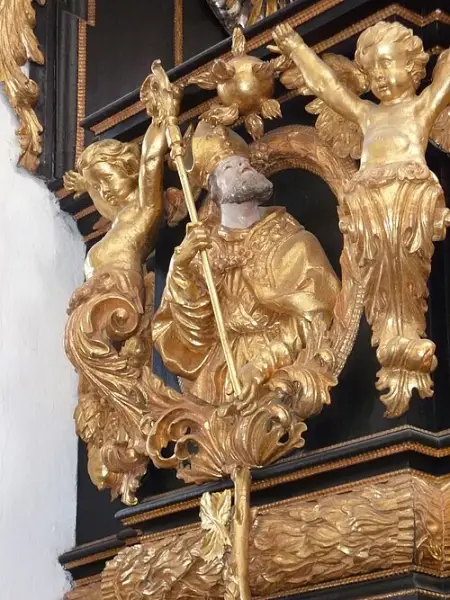
Overview
Robert of Newminster was a Yorkshire priest who became a Benedictine monk, a founder of Fountains Abbey, and the first abbot of Newminster. Born around 1100 at Gargrave, a village near Skipton, he carried his studies to the University of Paris, where tradition credits him with a commentary on the Psalms that has since disappeared; afterwards he went home to serve as rector of the parish of his birth. Drawn to the stricter life of Saint Mary's Abbey in York, he joined the Benedictines there, and in winter 1132 he was among the monks expelled from York who founded Fountains Abbey in the valley of the River Skell on land given by Archbishop Thurstan. The community endured two years of acute poverty before Hugh, Dean of York, brought his wealth and joined them, and the house adopted the Cistercian reform introduced by Bernard of Clairvaux. About 1138 Robert led a colony of monks from Fountains to Northumberland, where he established Newminster Abbey near Morpeth under the patronage of Ralph de Merlay and his wife Juliana. Favored, it was said, with prophecy and miracles, he governed Newminster for twenty-one years and dispatched further colonies to found Pipewell, Roche, and Sawley. He died at Newminster on 7 June 1159, and his tomb became a center of pilgrimage.
The Complete Life
From Gargrave to Paris
Robert was born around 1100 in what is now the Craven District of North Yorkshire, probably in the village of Gargrave near Skipton. Paris received him for his higher studies, and tradition credits him there with a commentary on the Psalms — long since vanished, but remembered as proof of his learning. On completing his studies he returned to Yorkshire and took up pastoral work, becoming rector of Gargrave, the parish of his birth. A parish cure, however, could not contain his aspirations for long. He became a Benedictine, joining the community of Saint Mary's Abbey in York, one of the wealthiest religious houses in the north of England. There he came to share the convictions of a group of monks who longed for a stricter observance of the Rule than the abbey allowed. Their desire for reform set them on the path that led, in the winter of 1132, to expulsion from York and to the founding of a new monastery in a lonely valley near Skeldale, on land granted them by Archbishop Thurstan of York. The Craven country of his birth lay in the West Riding, and from it he carried into religious life the loyalties of a Yorkshire family.
§ Early life
The Hard Winter of Fountains
The first two years at the new foundation were years of severe trial. Poverty pressed hard upon the brethren in those first seasons: they sheltered in a rough structure beside the waters of the Skell, and what sustained them was the repute for holiness, austerity, and strict keeping of the Benedictine Rule that clung to the community. The abundance of springs in that valley gave the new house its name: Fountains Abbey. Deliverance arrived in an unexpected form: Hugh, Dean of York, moved by the community's reputation, relinquished all his wealth to the monks and joined them as a novice, providing means to build more suitable facilities. Under the influence of Bernard of Clairvaux, Fountains affiliated with the Cistercian reform, binding the young Yorkshire house to the most dynamic monastic movement of the age. Robert had taken his place among the founders of what would become one of the great abbeys of England, and the discipline forged in that hard beginning prepared him for the office of abbot that he would exercise for the rest of his life. Beginnings so hard were not rare in the reforming age, but few houses began so poor or rose so quickly to fame.
§ Early life
Abbot of Newminster
In about 1138 Robert was placed at the head of a colony sent out from Fountains into Northumberland to plant a new monastery. It stood west of Morpeth beside the castle of Ralph de Merlay and of Juliana, his wife, herself a daughter of Gospatric II, Earl of Lothian; from this couple the new foundation received its patronage, and from the settlement it took the name Newminster. Robert governed the community for twenty-one years and proved an abbot whose houses begot houses. Three colonies of monks went out from Newminster during his abbacy to found new monasteries: Pipewell in Northamptonshire in 1143, Roche in South Yorkshire in 1147, and Sawley in Lancashire in 1148. His tenure was not without trial. Capgrave's narrative tells of a charge of misconduct levelled at Robert by brethren of his own house, asserting that he had shown an interest toward a woman of a nearby village. Robert traveled to defend himself before Bernard of Clairvaux in 1147 or 1148, and Bernard, who had received a heavenly sign of Robert's virtuous conduct, never doubted his innocence. Later writers have doubted the story itself, suspecting it arose from a wish to associate Robert personally with the greatest of the Cistercians.
§ Cistercian and abbot
The Gentle Abbot
What his contemporaries recorded of Robert was a man devout and prayerful, of gentle temper, judging others mercifully and proving a warm, considerate companion, even as he kept his own vow of poverty with zeal. The combination of tenderness and rigor was the mark of his governance at Newminster: he ruled and directed the monks there for twenty-one years, binding austerity to kindness. Tradition credited him with the gift of prophecy and with miracles. One story tells of a monk who fell from a ladder while working on the abbey buildings and descended unhurt, a preservation attributed to Robert's holiness. His closest friendship belonged to the hermit Godric of Finchale, a union of the cenobitic and eremitical ideals that colored northern spirituality in the twelfth century. The account of his passing bound the two friends together one last time: when Robert breathed his last, Godric beheld that night what he took for his friend's soul — a globe of flame carried upward by angels along a radiant road, a voice bidding it enter at heaven's gates. These memories of gentleness, prophecy, and friendship shaped the devotion that gathered at his tomb.
§ Miracles
Death and the Vision at Finchale
Robert completed his earthly course at Newminster, dying there on 7 June 1159 after two decades of quiet governance. The abbey he left was small, numbering only seventeen monks at his death, yet it had already fulfilled its purpose as a mother of monasteries through its foundations at Pipewell, Roche, and Sawley. The vision his friend Godric of Finchale reported that very night became the tale most cherished of his passing: Godric watched a globe of fire — Robert's soul — borne heavenward by angels along a shining road, and at the gates above he heard the words of welcome spoken. Robert's body was laid to rest in the church of Newminster, and his tomb soon became an object of pilgrimage for the faithful of the north. The Church keeps his feast on 7 June, the day he died. The abbey itself did not long survive the age that made it: the small monastery of seventeen monks was among the first houses dissolved in 1535 under Henry VIII, and its site has remained in private hands ever since. The abbey that received his body outlived his reform by less than four centuries, yet the devotion paid at his grave did not die with the house.
§ Miracles
A Name Carried Forward
The memory of Robert of Newminster has endured long after the disappearance of his abbey. His tomb at Newminster drew medieval pilgrims, and his feast on 7 June kept his name alive in the liturgy. In later centuries that name passed into the institutional life of the Catholic Church in England and far beyond. Parishes dedicated to St Robert of Newminster stand in Morpeth, the town nearest his abbey, and in Fenham, Newcastle upon Tyne; the saint's cult crossed the Atlantic in parishes at Ada, Michigan, and Shorewood, Wisconsin. Catholic schools likewise honor him: St Robert of Newminster Catholic School in Washington, Tyne and Wear, a St Robert of Newminster Parish and Primary School in Aberkenfig in South Wales, St. Robert School in Sacramento, California, and St. Robert Catholic School in Ada, Michigan, which opened in August 2018 with preschool and kindergarten classes and grew grade by year toward a full elementary program. In church art he is depicted as an abbot holding a church, the emblem of the houses he founded and of the order he served. Taken together, these parishes and schools show how an abbot of a small Northumbrian monastery could gather namesakes on both sides of the Atlantic.
§ Legacy
Timeline
- 1100
Born around this year in Gargrave in the West Riding of Yorkshire.
§ Early life
- 1132
Winter: expelled with his brethren from Saint Mary's Abbey, York, he helped found Fountains Abbey on Archbishop Thurstan's land in Skeldale.
§ Early life
- 1138
About this year he led monks from Fountains to found Newminster Abbey west of Morpeth in Northumberland.
§ Cistercian and abbot
- 1143
Sent a colony of Newminster monks to found Pipewell Abbey in Northamptonshire.
§ Cistercian and abbot
- 1147
Founded Roche Abbey in South Yorkshire; in 1147–1148 he defended himself before Bernard of Clairvaux against a false accusation.
§ Cistercian and abbot
- 1148
Founded Sawley Abbey in Lancashire, the third daughter colony sent out from Newminster.
§ Cistercian and abbot
- 7 Jun 1159
Died at Newminster Abbey after twenty-one years as its abbot; the hermit Godric of Finchale reported a vision of his soul that night.
§ Miracles
The Record
- Major works
- Newminster Abbey·A commentary on the Psalms (now lost)·Daughter foundations at Pipewell, Roche, and Sawley
- Symbols
- depicted as an abbot holding a church
- Canonization
- Pre-congregation; venerated as a confessor from the twelfth century
Prayer
Bibliography
Show 6 sources
- Butler, Rev. Alban. The Lives or the Fathers, Martyrs and Other Principal Saints, Vol. 6, D. & J. Sadlier, & Company, 1864
- Sankovitz, Margaret. "Our Patron" St. Robert Parish, Shorewood, Wisconsin
- Webster, Douglas Raymund. "St. Robert of Newminster." The Catholic Encyclopedia. Vol. 13. New York: Robert Appleton Company, 1912.
- St. Robert of Newminster, Morpeth
- St. Robert of Newminster RC Church, Fenham
- St. Robert of Newminster Parish, Ada, Michigan
Profile text adapted from the Wikipedia article, licensed CC BY-SA 4.0.
Pray with this saint every day
Save St. Robert of Newminster to your favorites, read the full profile, and get feast-day reminders in the Saints app.
Get the Saints AppFree on the App Store for iPhone and iPad