
c. 1561-1595
St. Robert Southwell
Jesuit Priest, Poet and Martyr
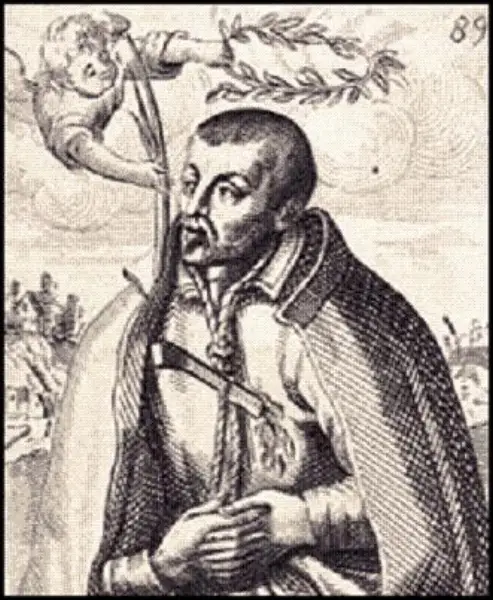
Overview
Robert Southwell, born around 1561 at Horsham St Faith in Norfolk, was a gentry son in a family with Catholic sympathies that had nonetheless profited from the dissolution of the monasteries. Schooled at Douai and Paris, he walked to Rome in 1578 and was admitted to the Jesuit probation house of Sant'Andrea that October, entering the Society of Jesus in 1580. After philosophy and theology studies, ordination and his degree in 1584, he served the Venerable English College in Rome as tutor and then prefect of studies. In 1586 he slipped into England with Henry Garnet on the clandestine Jesuit mission, moving between Catholic households under the assumed name of Cotton and studying the language of sport to pass unnoticed in Protestant society. From 1589 he acted as domestic chaplain to Anne, Countess of Arundel, whose husband lay imprisoned in the Tower. Arrested at Uxenden Hall near Harrow after Anne Bellamy betrayed his movements, he endured the manacles in Topcliffe's house, further torture by the Privy Council's men, and three years of solitary confinement in the Tower. Tried in 1595 before Chief Justice Popham, he admitted being a priest but denied any treason; he was hanged, drawn and quartered at Tyburn on 21 February 1595. Paul VI canonized him among the Forty Martyrs of England and Wales in 1970.
The Complete Life
Early Life
Robert Southwell was born around 1561 at Horsham St Faith in Norfolk, the youngest of eight children of a gentry family with firm Catholic sympathies. The Southwells had nonetheless profited considerably from Henry VIII's suppression of the monasteries, a compromise with the new order that Robert's generation would pay for. He was sent in 1576 to the English college at Douai in the Spanish Netherlands, and moved to Paris after the war scare of that year, studying with the Jesuits at Anchin. In 1578, aged about seventeen, he walked to Rome and was admitted to the Jesuit probation house of Sant'Andrea on 17 October; he entered the Society of Jesus in 1580. His letters from these years, appealing against a superior's initial refusal of him, contain his most quoted words — that he found himself disjoined from that company wherein lay all his life, his love, his whole heart and affection.
§ Enters the Society of Jesus
Formation
Southwell completed the long Jesuit formation in Rome: philosophy and theology, ordination to the priesthood, and his degree in 1584. He then served the Venerable English College as tutor and later prefect of studies, forming the seminarians who would themselves go to the English mission and, in many cases, to execution. His superiors at first judged his health too weak for England; his persistence overcame them. In 1586, in his mid-twenties, he crossed to England with Henry Garnet on the clandestine Jesuit mission — the enterprise, technically treasonous under the Elizabethan statutes, of sustaining the Catholic faith in England by priests who moved in disguise from house to house.
§ Enters the Society of Jesus
The English Mission
In England Southwell moved between the Catholic households of the gentry under the assumed name of Cotton, and — a detail his biographers love — studied the language of hawking and hunting so that he could pass unnoticed in Protestant society. From 1589 he acted as domestic chaplain to Anne, Countess of Arundel, in London, ministering to a household whose head, Philip Howard, lay imprisoned in the Tower. His six years of mission produced not only sacraments administered in secret but a body of writing: the Epistle of Comfort for the recusant community, devotional works such as Mary Magdalen's Funeral Tears, St Peter's Complaint, A Short Rule of Good Life, Triumphs over Death, and the Humble Supplication to Queen Elizabeth, an appeal against the persecution that could not, of course, be delivered.
§ Works and legacy
Arrest, Torture and Execution
In June 1592 Southwell was arrested at Uxenden Hall near Harrow after Anne Bellamy, a young woman of the household taken by the priest-hunter Richard Topcliffe, betrayed his movements. He was hung by the wrists in the manacles at Topcliffe's house, tortured further by the Privy Council's men, and then held for three years in solitary confinement in the Tower of London, in conditions designed to break him. His father, allowed one visit, found him so altered that he petitioned Elizabeth either to condemn him or to restore him to his college. Tried in February 1595 and convicted of treason — in reality for refusing the Oath of Supremacy and maintaining the pope's authority — he was hanged, drawn and quartered at Tyburn on 21 February 1595. Witnesses recorded his composure and his declaration at the ladder.
§ Introduction
Canonization
Southwell was beatified in 1886 among the English martyrs, and canonized by Pope Paul VI on 25 October 1970 as one of the Forty Martyrs of England and Wales, the representative company of priests and laypeople killed under the Elizabethan and Stuart persecutions. He is honored with the Forty on 25 October. His cause benefited from the extraordinary documentation of his life: the treason files themselves preserved his letters, his writings and the record of his torture, so that he is among the best-documented of the martyrs.
§ Introduction
Legacy
Southwell has a double afterlife: as martyr and as poet. His devotional poems and prose, written for a hunted community, were among the most widely read Catholic works of the age, and modern criticism has claimed him as a major English poet — a possible influence on the young Shakespeare, whose reading of Catholic devotional verse is now an established subject of study. His verse of tears, blood and inward martyrdom is read in universities as literature as well as devotion. For the Church he remains the model of the scholar-missionary: the prefect of studies who chose the gallows, and who, in the Tower, wrote that his only grief was separation from his Society.
§ Enters the Society of Jesus
Timeline
- 1561
Born at Horsham St Faith, Norfolk, youngest child of Richard Southwell and his first wife Bridget Copley
§ Early life in England
- 1576
Sent to board at the English college at Douai while studying at the Jesuit College of Anchin
§ Enters the Society of Jesus
- 15 Jun 1577
Returns to Douai after an interruption of his studies caused by advancing French and Spanish forces
§ Enters the Society of Jesus
- 17 Oct 1578
Admitted to the Jesuit probation house of Sant'Andrea in Rome after appealing his initial refusal by letter
§ Enters the Society of Jesus
- 1580
Admitted to full membership of the Society of Jesus after completing his two-year novitiate
§ Enters the Society of Jesus
- 1584
Granted his BA in Rome and ordained a priest, then made tutor at the Venerable English College
§ Enters the Society of Jesus
- Jul 1586
Landed on the east coast of England as a clandestine Jesuit missionary sent alongside Henry Garnet
§ On the English mission
- 1589
Became domestic chaplain to Anne Howard, Countess of Arundel, at Arundel House in the Strand
§ On the English mission
- 1591
Published the popular poem Mary Magdalen's Funeral Tears openly while devoting most of the year to writing
§ Works and legacy
- 1592
Arrested at Uxendon Hall near Harrow after Anne Bellamy revealed his movements to Topcliffe
§ Arrest and imprisonment
- 21 Feb 1595
Tried for treason and hanged, drawn and quartered at Tyburn after three years in the Tower
§ Trial and execution
- 15 Dec 1929
Beatified in Rome by Pope Pius XI
§ Introduction
- 25 Oct 1970
Canonized by Pope Paul VI in Vatican City as one of the Forty Martyrs of England and Wales
§ Introduction
In Their Own Words
How can I but wast in anguish and agony that find myself disjoined from that company, severed from that Society, disunited from that body wherein lyeth all my life my love my whole hart and affection.
Not guilty of any treason whatsoever.
My faultless breast the furnace is, the fuel wounding thorns; ... Love is the fire and sighs the smoke, the ashes shame and scorns; ... The fuel Justice layeth on, and Mercy blows the coals; ... The metal in this furnace wrought are men's defiled souls.
My conscience is my crown, ... Contented thoughts my rest; ... My heart is happy in itself, ... My bliss is in my breast.
I feel no care of coin, ... Well-doing is my wealth; ... My mind to me an empire is, ... While grace affordeth health.
No joy so great but runneth to an end, ... No hap so hard but may in fine amend.
Grant me grace, O God! that I ... My life may mend, sith I must die.
The Record
- Major works
- Epistle of Comfort·Mary Magdalen's Funeral Tears·St Peter's Complaint with other poems·A Short Rule of Good Life·Triumphs over Death·A Humble Supplication to Queen Elizabeth
- Canonization
- Canonized in 1970 by Pope Paul VI as one of the Forty Martyrs of England and Wales
Bibliography
Show 12 sources
- 1 2 3 4 5 "Southwell, Robert (1561?–1595)" . Dictionary of National Biography . London: Smith, Elder & Co . 1885–1900.
- 1 2 3 4 5 6 Brown, Nancy P. Southwell, Robert [St Robert Southwell] (1561–1595), writer, Jesuit, and martyr Oxford Dictionary of National Biography.
- ↑ Encyclopædia Britannica . "Southwell, Robert". 2008. Encyclopædia Britannica Online.
- ↑ Pollard, Albert Frederick (1911). "English History" . In Chisholm, Hugh (ed.). Encyclopædia Britannica . Vol. 09 (11th ed.). Cambridge University Press. pp. 466– 587, see p 517 & p 531. VII. The Reformation and the Age of Elizabeth (1528–
- 1 2 3 4 5 6 7 8 9 10 Jokinen, Anniina. The Works of Robert Southwell 9 October 1997. 26 September 2008.
- ↑ David Colclough (2003). John Donne's professional lives . DS Brewer. p. 41. ISBN 978-0-85991-775-9 .
- ↑ Waterfield John Waterfield (2009). The Heart of His Mystery: Shakespeare and the Catholic Faith in England Under Elizabeth and James . iUniverse. p. 19. ISBN 978-1-4401-4343-4 .
- 1 2 "Robert Southwell (c. 1561–1595)". 2003. MasterFILE Premier
- ↑ Brownlow, F.W. Robert Southwell . Twayne Publishers, 1996, p. 15.
- ↑ Thurston, Herbert. "Venerable Robert Southwell." The Catholic Encyclopedia Vol. 14. New York: Robert Appleton Company, 1912
- ↑ Robert S. Miola (ed.). Early Modern Catholicism. An anthology of primary sources. Oxford: University Press, 2007, pp. 301 f.
- 1 2 Gary M. Bouchard (2018), Southwell's Sphere: The Influence of England's Secret Poet , St. Augustine's Press . Pages 187-210.
Profile text adapted from the Wikipedia article, licensed CC BY-SA 4.0.
Pray with this saint every day
Save St. Robert Southwell to your favorites, read the full profile, and get feast-day reminders in the Saints app.
Get the Saints AppFree on the App Store for iPhone and iPad