
c. 1295 – 1327 (trad.; also given as c. 1348 – 1376/79)·Feast August 16 (August 17 for the Third Order of Saint Francis)
St. Roch
Pilgrim Confessor Against the Plague
Overview
Roch, called Rock in English, San Rocco in Italian, and Sant Roc in Catalan, is the great plague saint of the Christian West. Born at Montpellier, traditionally around 1295, to the noble governor of the city, he was said to carry from birth a red cross miraculously printed upon his breast. When his parents died in his twentieth year, he gave his inheritance away, entered the Franciscan Third Order, and took the road as a begging pilgrim toward Rome, though his father had named him governor of Montpellier. Coming into Italy amid an epidemic, he nursed the plague-stricken in the hospitals of Acquapendente, Cesena, Rimini, Novara, and Rome, healing many through prayer and the sign of the cross, until he caught the disease himself at Piacenza. Driven into the forest, he was kept alive by a dog that brought him bread and licked his wounds. Arrested at Voghera as a spy on the orders of his own uncle, he languished five years in prison and died there, traditionally on August 16, 1327, without revealing his name. His cult spread from Italy across Europe, and in 1590-91 Pope Gregory XIV added him to the Roman Martyrology.
The Complete Life
The Marked Child of Montpellier
The chronology of Roch's life is uncertain and thick with legend, but the story his Acta and the Golden Legend tell begins at Montpellier, a city that then stood upon the border of France, in the household of its noble governor. His birth was accounted a miracle: his mother had been childless until her prayers to the Virgin Mary were answered. The boy carried the evidence of heaven's favor on his own body, carrying on his breast a red cross, printed there from the cradle, which grew along with him. Piety showed itself in him almost from infancy. His mother, a devout woman, fasted twice each week, and the child, the old legend records, would nurse only once on those days, abstaining in his own small way alongside her. As he grew toward manhood his asceticism and devotion deepened, setting him apart from the expectations of his rank. His father destined him for the governorship of Montpellier, but destiny had other designs. When his parents died in his twentieth year, the young heir resolved at once the question of his inheritance: he gave all his possessions away to the poor, refused the office his father's deathbed will had reserved for him, and set out from the city of his birth as a mendicant pilgrim, a member of the Franciscan Third Order, with Rome for his goal.
§ Traditional biography
Pilgrim and Tertian
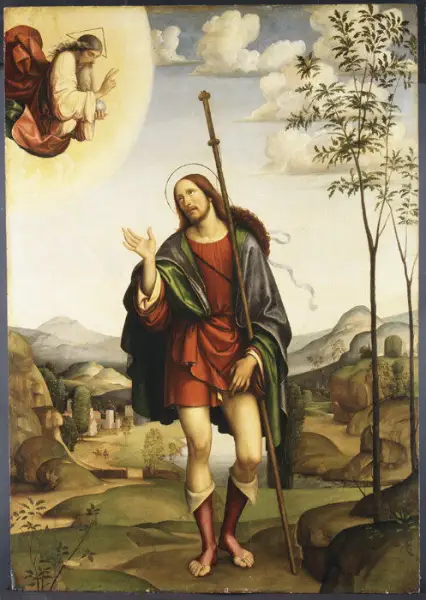
Roch's vocation took the shape the Franciscan movement had made familiar in the thirteenth and fourteenth centuries: voluntary poverty, the road, and service of the least. As a member of the Third Order of Saint Francis he wore no solemn vows but bound himself to penance and charity in the world, and he is conventionally portrayed in the garb such pilgrims wore — the wide-brimmed hat, the staff, and the purse. Traveling toward Rome as a beggar, he arrived in Italy at the very moment an epidemic of plague was laying waste its cities. Where other travelers fled, Roch stopped. The hospitals of Acquapendente, Cesena, Rimini, Novara, and Rome received him not as a patient but as a nurse, and there he gave himself with extraordinary diligence to the care of the sick abandoned in the public wards. The legend credits him with many cures wrought through prayer, the sign of the cross, and the laying on of his hand. At Rome, the Golden Legend relates, he preserved the cardinal of Angleria in Lombardy by signing the man's forehead with the cross, a mark that miraculously stayed. His pilgrimage had become something more than devotion: it was a mission of mercy conducted in the very face of death.
§ Traditional biography
Stricken at Piacenza
The climax of Roch's ministry came at Piacenza, where he served in the hospital of Nostra Signora di Betlemme. There, at last, the disease he had confronted in others claimed him. He himself fell ill of the plague, and the marked man became the outcast his patients had been. Rather than burden the city, he withdrew into the forest, built himself a shelter of branches and leaves, and waited. A spring of water rose miraculously at the spot to supply his need, but he would have perished of hunger had not a hunting dog belonging to a nobleman named Gottardo Pallastrelli found him out. The dog brought him bread from his master's table and licked his wounds, healing them — the deed that fixed the dog forever at the saint's side in Christian iconography. Count Pallastrelli, following the animal that carried the bread, discovered the hidden pilgrim and brought him home to recover. Restored to health, Roch resolved to return incognito to Montpellier, still concealing the name he had renounced. The disguise that had shielded his charity now delivered him to disaster: passing through Voghera, he was arrested as a spy — by orders, the tradition says, of his own uncle, who did not know him — and thrown into prison, where he would languish five years.
§ Traditional biography
Five Years in a Forgotten Cell
Roch's last years were spent not in triumph but in obscurity, a prisoner accused of espionage in the town of Voghera. He told no one who he was. The nobleman's son who had given away a governorship, the healer of the plague hospitals, the man whose breast bore the cross of his miraculous birth, languished five years in chains without revealing his name, and so passed from the world: he died there on August 16, in the year 1327 by the traditional reckoning. The Golden Legend supplies the revelation that the prisoner withheld in life. At his death, an angel came down from heaven bearing a tablet written over with letters of gold and laid it beneath his head, declaring that God had granted his prayer — that whoever called meekly upon Saint Roch would suffer no harm from any plague. The townspeople, the story continues, recognized him at last by the birthmark on his breast, the sign that had marked him from the cradle. The recognition came too late for the man but not for his memory: popular devotion soon declared him a saint, and a great church rose in his veneration. Later critics observed that the date of 1327, asserted by Francesco Diedo, would precede the Black Death's arrival in Europe; medieval writers, however, used the word plague for a whole array of epidemics, and the saint's story has never been reduced to the dates of a single outbreak.
§ Traditional biography
The Saint Who Showed His Wound
Roch's spiritual power over the imagination of later centuries lay in his wounds. After the Black Death, and especially during the Italian plague epidemic of 1477–79, a new art of the plague saints emerged, and Roch stood at its center. Painters showed him as a pilgrim lifting his tunic to display the plague-bubo in his thigh, the sore that proved he had suffered what his petitioners suffered. In the art that followed 1477 the saint displays his wound without visible pain: he welcomes his disease, as one modern interpreter has put it, as heaven-sent license to reproduce in his own body the sufferings of Christ, endurance of such pain a kind of martyrdom. To plague-ridden crowds the image carried a promise as blunt as it was consoling — here was a man who had caught the pestilence and lived, literal proof that survival was possible. The plague votive, a distinct genre of painting commissioned by towns, governments, confraternities, and orders, portrayed Roch and his fellow intercessors as channels between a wounded community and a merciful God, acts of confidence rather than despair. The abundance of means by which the faithful invoked heaven's aid — processions, altarpieces, prayers, statues — expressed a renaissance conviction that even an apocalyptic disaster could be set within the secure and benevolent plan of God.
§ Saint Roch in art
From Popular Fervour to the Martyrology
Roch was never subjected to the ordinary processes of canonization before his cult had overwhelmed them. The Roman Church did not officially canonize him until the seventeenth century, yet the Mass had already been offered in his memory for two hundred years before any formal act. Venice became the guardian of his fame: his body, known for certain to have been carried from Voghera rather than Montpellier, was translated there in 1485, and a confraternity raised the Scuola Grande di San Rocco and its adjacent church in his honor, its halls covered by Tintoretto's great sequence of paintings, among them the ceiling canvas of Roch in glory painted in 1564. Popes honored him piecemeal: Alexander VI built a church and hospital under his name; Paul III instituted a confraternity of St. Roch, raised to an archconfraternity by Paul IV in 1556, which still thrives. In 1590 the ambassador of Venice at Rome wrote home that Pope Sixtus V, a stickler for process, was urging presentation of the witnesses and documentation of San Rocco's life and miracles, being resolved either to enroll him among the saints or to strike him from their number; the envoy warned of the general scandal if so widely venerated a figure were impugned as an impostor. Sixtus let the matter rest. His successor Gregory XIV entered Roch in the Catholic Church Martyrology in 1590-91 and established August 16 as the feast kept everywhere; the Third Order of Saint Francis, which claims him as its own, keeps his feast on August 17.
§ Veneration
The Saint of Every Epidemic
Born in the center and north of Italy and at Montpellier, devotion to Roch traveled through Spain, France, Lebanon, the Low Countries, Germany, Argentina, and Brazil, and he was frequently slipped into the company of the Fourteen Holy Helpers, whose cult spread in the Black Death's aftermath. The Adriatic and Balkan world honors him as sveti Roko, with eponymous churches from Petrovaradin in Serbia across Croatia and Bosnia; in India, Kerala's Thrissur Archdiocese raised a twenty-four-foot statue of the saint, the first and only one of its size in Asia; and in the Philippines he is patron of Pateros, Cavite City, Caloocan, and towns across Laguna, Nueva Ecija, and Cebu. Numerous brotherhoods have been instituted in his honor, and his patronage reaches surgeons and apothecaries, tile-makers and grave-diggers, dogs and diseased cattle, bachelors and the falsely accused. When epidemics return, so does Roch: during the COVID-19 pandemic the faithful turned again to the confessor who had nursed the plague-stricken of Italy. His story has entered literature and film from Chevallier's Clochemerle to Camus's The Plague, where the worshippers of Oran gather about his statue — the pilgrim with the wound and the dog still standing, seven centuries on, beside every bed of contagion.
§ Veneration
Timeline
- 1295
Born, by the traditional reckoning, at Montpellier, then on the border of France, the son of the city's noble governor; his birth was accounted a miracle after his mother's prayers to the Virgin.
§ Traditional biography
- 16 Aug 1327
Died in the prison of Voghera after five years' confinement, held there as a suspected spy on the orders of his own uncle, without ever revealing his name.
§ Traditional biography
- 1414
When the Council of Constance was threatened with plague, public processions and prayers for Roch's intercession were ordered, and the outbreak ceased — an episode recorded by Francesco Diedo.
§ Traditional biography
- 1477
Roch's cult gathered force as the bubonic plague crossed northern Italy in 1477–79.
§ Traditional biography
- 1478
Francesco Diedo, Venetian governor of Brescia, published his Vita Sancti Rochi, fixing the traditional chronology of the saint's life.
§ Traditional biography
- 1485
Roch's body was carried from Voghera, not from Montpellier as previously believed, to Venice, where its translation was triumphantly inaugurated.
§ Veneration
- 1556
Pope Paul IV raised the confraternity of St. Roch, instituted by Paul III, to an archconfraternity, which still thrives today.
§ Veneration
- 1564
Tintoretto painted Roch in glory on a ceiling canvas for the Scuola Grande di San Rocco at Venice.
§ Veneration
- 1590
Pope Gregory XIV entered Roch of Montpellier in the Catholic Church Martyrology and established August 16 as the feast kept everywhere.
§ Veneration
- 2020
Devotion to Roch revived strongly during the COVID-19 pandemic.
§ Veneration
In Their Own Words
anon an angel brought from heaven a table divinely written with letters of gold into the prison, which he laid under the head of S. Rocke
The Record
- Major works
- The healing ministry in the plague hospitals of northern and central Italy·The Scuola Grande di San Rocco at Venice, raised by the confraternity that guarded his relics
- Patron of
- invoked against cholera, epidemics, knee problems, plague, and skin diseases·patron of bachelors, dogs, invalids, the falsely accused, surgeons, apothecaries, grave-diggers, tile-makers, second-hand dealers, and pilgrims·Dolo, Parma, Casamassima, Cisterna di Latina, and Palagiano in Italy·the region of Kociewie in Poland·Istanbul·Pateros, Cavite City, Caloocan, and other towns in the Philippines
- Symbols
- a wound or plague-bubo on his thigh·a dog offering bread·a pilgrim's hat·a pilgrim's staff
- Canonization
- Canonized by popular fervour; added to the Roman Martyrology by Pope Gregory XIV (1590–91), fixing August 16 as his feast
Prayer
Bibliography
Show 10 sources
- "Patron Saints Index: Saint Roch". Saints.sqpn.com. Archived from the original on 2013-11-05. Retrieved 2012-02-22.
- "The Church of Santa Croce, what to see a Casamassima". Borghi magazine. Archived from the original on 18 April 2018. Retrieved 17 April 2018.
- Lewicka-Ritter, Krystyna (7 November 2021). "Kociewska kultura wraca … „pod strzechy"". Tygodnik Bydgoski (in Polish).
- "Saint Roch", The Met.
- Legenda Aurea, William Caxton's translation, 1483.
- Tucci, Filippo. "San Rocco", Italy Heritage.
- Marshall, Louise (1994). "Manipulating the Sacred: Image and Plague in Renaissance Italy". Renaissance Quarterly. 47 (3): 485–532.
- Boeckl, Christine M. (2000). Images of Plague and Pestilence: Iconography and Iconology. Kirksville, MO: Truman State University Press.
- "St. Roch", Catholic Encyclopedia. New York: Robert Appleton Co. 1913.
- "Coronavirus draws prayers to saints who cared for plague victims". Catholic Sun. May 17, 2020. Retrieved 22 August 2021.
Profile text adapted from the Wikipedia article, licensed CC BY-SA 4.0.
Pray with this saint every day
Save St. Roch to your favorites, read the full profile, and get feast-day reminders in the Saints app.
Get the Saints AppFree on the App Store for iPhone and iPad