
c. 1100 – 1158·Feast August 20
St. Rögnvald Kali Kolsson
Earl of Orkney, pilgrim and skaldic poet
Overview
Rögnvald Kali Kolsson, remembered in Orkney as Saint Ronald, was a Norwegian earl who ruled the northern isles, built their cathedral, sailed to Jerusalem and died by the sword, in that order. Born around 1100 in Norway to the lendmann Kolr Kalisson and Gunnhildr Erlendsdottir, sister of the slain Earl Magnus Erlendsson of Orkney, he inherited through his mother a claim to half the earldom. King Sigurd I of Norway named him Earl of Orkney and Shetland in 1129, giving him at that time the name Rögnvald for luck, after the ablest of the island's former rulers.Blocked from his inheritance by his cousin Paul Haakonsson, he was hailed as jarl in 1136 and ruled thereafter with the young Harald Maddadsson at his side. In 1137 he began the building of St Magnus Cathedral at Kirkwall, the great monument of his rule. In 1151 he led a celebrated pilgrimage to the Holy Land, recorded in five chapters of the Orkneyinga saga and celebrated in his own surviving verses. While he was overseas his footing gave way, and in August 1158 Thorbjorn Klerk, an outlawed onetime friend, struck him down in Caithness. Buried in his cathedral, credited with miracles at his grave, he was canonized in 1192.
The Complete Life
A Norwegian Childhood and a Mother's Claim
Rögnvald was born around the year 1100 in Norway, the son of Kolr Kalisson, a lendmann or king's landed retainer, and of Gunnhildr Erlendsdottir, sister of Magnus Erlendsson, Earl of Orkney, the sainted ruler whose death at the hands of his cousin Haakon Paulsson had split the island dynasty. It was through his mother that Rögnvald held whatever claim he had to the Orkney earldom, and the ambition of his life flowed from that maternal inheritance. Where exactly he first saw the light is uncertain. A tradition places his birth at Jæren, but scholars find this unlikely, since his family resided in Agder while Jæren lies in Rogaland; other researchers favor a site near the medieval Fjære Church in the present Grimstad Municipality, and the king's estate at Lista has also been proposed as both birthplace and childhood home. What is clear is that the family owned several farms in Agder, and it was among those farms that the boy who would bear two names, Kali at his birth and Rögnvald by royal gift, grew up in the world of shipyards, courts and sagas that formed a Norwegian nobleman of his generation.
§ Family and education
A New Name and a Contested Earldom
In 1129 King Sigurd I of Norway appointed Kali Earl of Orkney and Shetland. With the title came a new name: at his mother's request he took the name Rögnvald, after Earl Rögnvald Brusason, whom Gunnhildr judged the ablest of all the earls of Orkney, for it was thought the borrowed name would bring her son luck. Fortune, however, needed more than a name. Rögnvald ought to have taken over one half of Orkney, the share his uncle Magnus had once possessed, but Paul Haakonsson, a second cousin, had lately set himself up as the islands' only ruler and would not part with any of them. For years the appointed earl remained in Norway, serving as one of the leading men of King Harald Gille and waiting on events in the islands. Only in 1136 was he hailed as jarl in his own right. The long apprenticeship shaped the ruler he became: a lord who combined Norse legitimacy with Norwegian backing, who knew how to share power rather than gamble everything on seizing it, and who would place his mark on Orkney not chiefly in battle but in the stones of the cathedral he raised to his martyred uncle.
§ Acquisition of Orkney
The Cathedral at Kirkwall and a Shared Rule
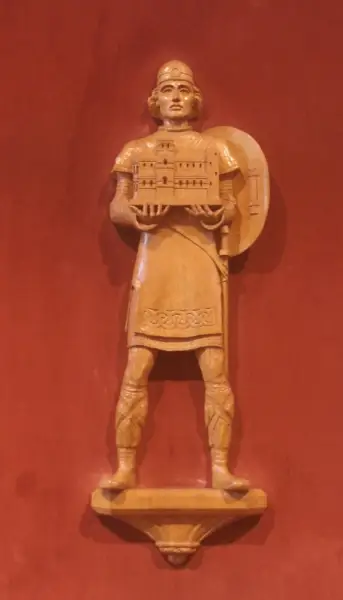
Rögnvald's rule over Orkney took its permanent shape in the year 1137, when he initiated the building of St Magnus Cathedral at Kirkwall, dedicating it to his uncle Magnus Erlendsson, whose cult was growing in the islands. The cathedral became the center of Orkney's Christian life and the monument by which the earl is known to this day; his carved likeness may be seen there still. In the same years he took charge of the dynasty's future. He became guardian to the boy Harald Maddadsson, Paul Haakonsson's five-year-old nephew, and in 1138 he appointed the child earl alongside himself, knitting the rival lines of the family into a joint rule. Harald had inherited Caithness on the Scottish mainland, and Rögnvald thus became master over that country as well. The arrangement gave the earldom a generation of relative stability in place of the feuds that had destroyed his uncle. Two islands of the group, North Ronaldsay and South Ronaldsay, bear his name down to the present, a rare form of commemoration for a Norse ruler and evidence of how deeply his government impressed itself on the memory of the islanders.
§ Acquisition of Orkney
The Road to Jerusalem and Death in Caithness
In 1151 Rögnvald set out on the pilgrimage to the Holy Land that the Orkneyinga saga judged worthy of five complete chapters. The impulse came from a distant relative, Eindridi Ungi, who spoke plainly of prestige as a motive for so large an expedition; the saga's account dwells less on devotion than on the fighting and feasting of a great fleet voyage, and Rögnvald himself, a skilled skald, set its hardships into verse, from the five mired weeks at Grimsby to a swim across the River Jordan. While he was abroad, politics turned against him. King David I of Scotland granted half of Caithness to Erlend Haraldsson, cousin of Harald Maddadsson, disturbing the settlement Rögnvald had built. Earl Harald displaced Erlend, who was killed in 1156, but the disorder was not spent. In August of 1158 the earl and the eight men around him were struck down by Thorbjorn Klerk, formerly the closest friend and counselor of Harald, whom Rögnvald had outlawed for a killing done in Kirkwall after a string of violent deeds. The earl died in Caithness on the twentieth of August, far from the cathedral whose towers he had raised.
§ Death
Burial, Miracles and Canonization
Rögnvald's body was carried back to Kirkwall and buried in St Magnus Cathedral, the church he had founded almost within sight of the harbor from which his fleets had sailed. There, the tradition relates, alleged miracles began to occur, both at his grave and on the stone where he fell in Caithness, the two places his blood had touched. Recognition followed: Rögnvald was canonized in 1192 by Pope Celestine III, little more than a generation after his death, and his cult took its place beside that of his uncle Magnus in the devotion of the northern isles. He is remembered in Orkney as Saint Ronald, and his feast is kept on August 20, the day of his death. Yet a shadow rests on the record, for some doubts exist about the validity of his sainthood: no existing papal register seems to confirm the decree, and historians have had to rely on saga and liturgical tradition for what the archives no longer show. Whether or not every document is secure, the veneration of the pilgrim earl endured for centuries at Kirkwall, and the cathedral that houses his bones still stands as the chief witness to his life.
§ Death
Islands, Cathedral and Verse
Rögnvald's afterlife in the north is unusually rich for a man of the twelfth century. The two Orkney islands named after him, North Ronaldsay and South Ronaldsay, keep his name sounding in the geography of the archipelago itself. St Magnus Cathedral, begun at his command in 1137, remains in use as Britain's northernmost cathedral, a Norse Romanesque building that still dominates Kirkwall and still holds the remains of its founder, making him one of the few Norse earls whose grave can be visited today. A modern carving of him in the cathedral keeps his likeness before pilgrims and visitors. To historians of literature he is also a poet: the verses he composed on the Jerusalem voyage, translated in modern collections such as Ian Crockatt's Crimsoning the Eagle's Claw, give a rare first-person voice to the crusading-age aristocracy, earthy, self-mocking and vivid, whether describing the stinking mud of Grimsby or the pride of the ship that finally bore him free. The Orkneyinga saga's five chapters on his expedition preserve the memory of the enterprise that rounded out his life, and his feast on August 20 keeps the pilgrim earl in the calendar of the north.
§ Poetry
Timeline
- 1100
Born in Norway around this year to Kolr Kalisson and Gunnhildr Erlendsdottir, sister of Earl Magnus Erlendsson of Orkney
§ Family and education
- 1129
King Sigurd I of Norway appointed him Earl of Orkney and Shetland, giving him the name Rögnvald for luck
§ Acquisition of Orkney
- 1136
Hailed as jarl, having remained in Norway among the leading men of King Harald Gille
§ Acquisition of Orkney
- 1137
Initiated the building of St Magnus Cathedral in Kirkwall, Orkney
§ Acquisition of Orkney
- 1138
Appointed the five-year-old Harald Maddadsson as Earl alongside himself
§ Acquisition of Orkney
- 1151
Set out on a celebrated pilgrimage to the Holy Land at the urging of his kinsman Eindridi Ungi
§ Pilgrimage to the Holy Land
- 1156
Erlend Haraldsson, granted half of Caithness by King David I while Rögnvald was abroad, was killed after being displaced by Earl Harald
§ Death
- 20 Aug 1158
Slain in Caithness along with the eight companions of his retinue by the outlaw Thorbjorn Klerk; his remains were carried to Kirkwall for burial in St Magnus Cathedral
§ Death
- 1192
Canonized by Pope Celestine III after reported miracles at his grave and on the stone where he died
§ Death
In Their Own Words
Muck, slime, mud. We waded for five mired weeks, reeking, silt-fouled bilge-boards souring in Grimsby bay. Nimbly now, our proud-prowed, Bergen-bound Sea-Elk pounds over wave-paved auk-moors, locks horns with foam-crests, bows booming.
The Record
- Major works
- Skaldic verses composed on the expedition to the Holy Land, including the famous lines on the mud of Grímsbœ
- Symbols
- Carved portrait in St Magnus Cathedral, Kirkwall
- Canonization
- Canonized 1192 by Pope Celestine III, though some doubt the validity of the decree
Prayer
Bibliography
Show 6 sources
- Thuesen, Nils Petter (29 September 2014), "Ragnvald Kolsson", Norsk biografisk leksikon (in Norwegian), retrieved 30 September 2018.
- "Rognvald Schools Pack". Orkney Library (PDF). Archived from the original (PDF) on 31 January 2017. Retrieved 18 August 2022.
- Crawford, Barbara E., "Harald Maddadson, earl of Caithness and earl of Orkney (1133/4–1206)", Oxford Dictionary of National Biography, Oxford University Press, 2004.
- Ian Crockatt (trans.), Crimsoning the Eagle's Claw: The Viking Poems of Rǫgnvaldr Kali Kolsson, Earl of Orkney (Arc 2014).
- Anon., Orkneyinga Saga: The History of the Earls of Orkney, tr. Hermann Pálsson and Paul Edwards. Penguin, London, 1978. ISBN 0-14-044383-5.
- Riant, Paul (1865–1869). Expéditions et pèlerinages des Scandinaves en Terre sainte au temps des croisades, 2 volumes, pp. 260–261.
Profile text adapted from the Wikipedia article, licensed CC BY-SA 4.0.
Pray with this saint every day
Save St. Rögnvald Kali Kolsson to your favorites, read the full profile, and get feast-day reminders in the Saints app.
Get the Saints AppFree on the App Store for iPhone and iPad