
died 3 February 1285·Feast February 3
St. Roman of Uglich
Pious prince and church-builder of Uglich
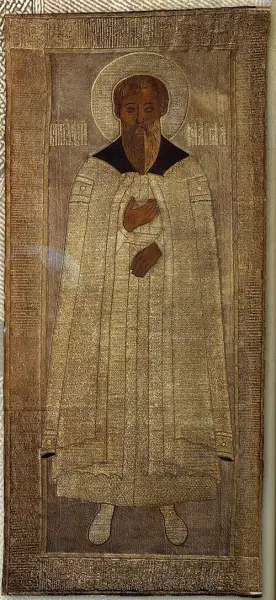
Overview
Roman Vladimirovich ruled the principality of Uglich from 1261 to 1285 and is honored today as a local saint. Of the two sons born to Vladimir Konstantinovich — Uglich's first appanage prince — and his wife Nadezhda Ingvarevna, herself of the princely house of Ryazan, Roman was the younger; since his name is absent from the roll of 1238 recording princes who lived through the Mongol invasions, he must have been born after that year, probably before 1249. Medieval Russian chronicles supply what is reliably known of him; the eighteenth- and nineteenth-century redactions of the Uglich Chronicler, with their store of local legend, are later in date and doubtful in authority. Andrey's death in 1261 brought the Uglich principality to Roman. He earned a reputation for piety and philanthropy, building fifteen churches in the course of his reign, and his closing years were given over to prayer, fasting, and the giving of alms. On 3 February 1285 he died, leaving no children; the throne passed thereafter to Dmitry of Rostov. His burial was in the Transfiguration Cathedral at Uglich; his relics, when examined, were found incorrupt, and in 1595 they were translated into a new stone church raised to receive them.
The Complete Life
A Son of the House of Uglich
Roman Vladimirovich belonged to the Rurik dynasty, the ruling house of the Rus' principalities. Of Vladimir Konstantinovich — Uglich's first appanage prince — and his wife Nadezhda Ingvarevna, who came from the princely house of Ryazan, Roman was the second-born son. Neither the year nor the setting of his birth is recorded, but the chronicles permit an estimate: absent from the roll of 1238 that named the princes who lived through the Mongol invasions, he can only have been born after it, probably before 1249. He thus grew up in a Russia still reeling from the devastation of Batu's campaigns, in an appanage principality on the Volga that his father had made a distinct holding. As the younger son he stood second to his brother Andrey in the succession, and the basic outline of his childhood is lost to the sources; what the medieval chronicles preserve of him begins with his accession to rule. He grew up a prince of the Rurikid house in an appanage his father's generation had newly made distinct, with an elder brother, Andrey, destined to rule Uglich before him.
§ Reign
Twenty-Four Years of Pious Rule
When his elder brother Andrey died in 1261, the Uglich principality passed to Roman, and he held it for the twenty-four years of life remaining to him. The chronicles record a prince whose rule was marked by piety and philanthropy: over the course of his reign he built fifteen churches, dotting his small principality with houses of prayer at a time when resources were scarce and the memory of the Mongol destruction still fresh. Beyond his building, he cultivated the personal disciplines of an ascetic. In his last years he withdrew increasingly into prayer, fasting, and the giving of alms, devoting to charity what a prince might otherwise have spent on display. The later Uglich Chronicler, set down in the eighteenth and nineteenth centuries, gathered local legends about him, and these must be read with caution against the soberer medieval chronicles; but on the central point all the sources agree — a ruler remembered less for power than for mercy and devotion. The churches he raised gave his capital its Christian shape, and the chroniclers who recorded them had no war or treaty to set beside them.
§ Reign
Death Without Heirs
Roman died on 3 February 1285 without leaving heirs, the childless end of a twenty-four-year reign. His death severed the direct line of the appanage: with no son to succeed, the throne of Uglich passed out of his family, and Dmitry of Rostov took the principality. Roman was buried in the Transfiguration Cathedral in Uglich, the principal church of his city, among the rulers of the house he had governed. For a medieval prince the manner of death and burial carried religious weight, and the sources present his passing as the close of a life oriented toward God — the praying, fasting prince laid to rest in the cathedral whose fabric his church-building had enriched. The chronicle entry is brief, but its brevity belongs to the kind of man it records: a provincial ruler whose reign produced no wars to narrate, only churches built, alms distributed, and a reputation for holiness that outlasted the dynasty itself. In the practice of the Rus princes a childless death meant the passing of a whole principality, and Uglich left Roman's line together with him.
§ Reign
Incorrupt Relics and Local Veneration
Three centuries after his death, Roman's memory received the testimony his church-building reign had earned. When his relics were examined they were discovered to be incorruptible, a traditional sign of sanctity in the Orthodox East, and in 1595 his remains were transferred from their place in the Transfiguration Cathedral to a newly built stone church raised to receive them. He is venerated as a local saint, honored within the region of Uglich whose prince and builder he was. The veneration has never rested on a formal act of canonization but on the continuous devotion of the faithful of his city — the same devotion that produced the legends of the Uglich Chronicler alongside the sober chronicle facts. Prince, church-founder, and ascetic, Roman stands among the Russian saints of the appanage age: rulers of small thrones whose holiness was worked out in almsgiving, prayer, and the quiet Christian ordering of the lands God had given them. The stone church of 1595 was the work of a city that had long prayed at the prince's grave and now honored him openly as its own.
§ Reign
Timeline
- 1261
Succeeded to the principality of Uglich when his elder brother Andrey died.
§ Reign
- 3 Feb 1285
Died at Uglich without heirs; Dmitry of Rostov succeeded to the throne.
§ Reign
- 1595
His incorrupt relics were translated to a new stone church built for them at Uglich.
§ Reign
The Record
- Major works
- Fifteen churches built during his reign
- Canonization
- Pre-congregation; venerated as a local saint of the Russian Orthodox Church
Prayer
Bibliography
Show 5 sources
- Boguslavsky, Vladimir V.; Kuksina, Elena I. (2001). "Роман Владимирович". Славянская энциклопедия. Киевская Русь — Московия. Т. 2: Н—Я (in Russian). Moskva: ОЛМА Медиа Групп. p. 256. ISBN 978-5-224-02251-9.
- Kuzmin, A. V. (2020). "Роман Владимирович". Православная энциклопедия. Т. LX: Рипсимия, Гаиания и 35 святых дев. Moscow: Православная энциклопедия. pp. 117–123. ISBN 978-5-89572-067-7.
- Feldbrugge, Ferdinand J. M. (2 October 2017). A History of Russian Law: From Ancient Times to the Council Code (Ulozhenie) of Tsar Aleksei Mikhailovich of 1649. BRILL. ISBN 978-90-04-35214-8.
- Fennell, John (13 October 2014) [1983]. The Crisis of Medieval Russia 1200-1304. Routledge. ISBN 978-1-317-87314-3.
- "Роман, русские князья". Brockhaus and Efron Encyclopedic Dictionary (in Russian). 1906.
Profile text adapted from the Wikipedia article, licensed CC BY-SA 4.0.
Pray with this saint every day
Save St. Roman of Uglich to your favorites, read the full profile, and get feast-day reminders in the Saints app.
Get the Saints AppFree on the App Store for iPhone and iPad