
late 5th century – after 555·Feast October 1
St. Romanos the Melodist
Byzantine hymnographer, the Pindar of rhythmic poetry
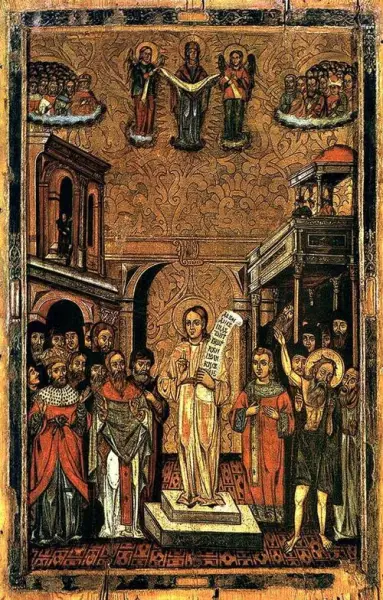
Overview
Saint Romanos the Melodist was the foremost composer of the Byzantine kontakion and a central figure in the history of Byzantine music, honoured as the patron saint of musicians in the Eastern Orthodox Church. Born late in the fifth century at Emesa in Syria, into a Jewish family, he was baptised as a boy, ordained deacon at Berytus in the Church of the Resurrection, and passed the rest of his life in Constantinople, where his death came after the year 555, and his tomb was made in the church of the Virgin. Tradition remembers him as a humble reader whose first attempt at chanting ended in humiliation — and in a vision: during the vigil of the Nativity at Blachernae, about the year 518, the Mother of God appeared to him in sleep and commanded him to eat a scroll, and on waking he mounted the ambo and sang the famous Kontakion of the Nativity, the first of its kind. Called the Pindar of rhythmic poetry, he is credited by the Synaxarion of Constantinople with more than a thousand hymns; eighty-nine survive under his name, some sixty of them widely accepted as genuine. His masterpiece is still sung, and his feast is kept on 1 October.
The Complete Life
From Emesa to Berytus
Romanos was born late in the fifth century at Emesa in Syria, the city known today as Homs. His family was Jewish, and the abundant Semiticisms in his later verse corroborate that origin; he was baptised as a young boy, though whether his parents followed him into the church remains uncertain. The main source for his life is the Menaion for October, the liturgical book of his feast; outside it he appears only in the mention made by Germanus I of Constantinople in the eighth century and in the tenth-century Souda, which calls him Romanos the melodist. From Emesa he moved to Berytus, the great law-city of the Levant known today as Beirut, and there he was ordained deacon in the Church of the Resurrection. His ministry thus began in a bilingual, borderland world — a Jewish-born Christian of Syrian speech, formed in a Greek-speaking city of the eastern empire, ordained to serve a church built over the memory of the Resurrection itself. From Berytus the road led to the capital, and the rest of his life belonged to Constantinople, where he would sing, compose, die and be buried in the church of the Virgin.
§ Life
The Night at Blachernae
The legend of his vocation is the best-known story in the history of Byzantine hymnody. Romanos, it tells, was at first thought neither a gifted reader nor a singer; but the Patriarch of Constantinople loved him for his great humility. Around the year 518, serving in the church of the Panagia at Blachernae during the All-Night Vigil of the Nativity, the kathisma verses of the Psalter were assigned to him — and he rendered them so poorly that a second reader had to step in and take over. The lesser clergy ridiculed him, and he sat down in a choir stall, humiliated; overcome by weariness and sorrow, he fell asleep. In sleep the Theotokos appeared to him holding a scroll and commanded him to eat it, and no sooner had he done so than he woke. He received the Patriarch's blessing, mounted the ambo, and chanted extemporaneously the famous hymn that begins with the Virgin giving birth to Him who is above all being. Emperor, patriarch, clergy and people were amazed at the depth of its theology and at the clear, sonorous voice that carried it. Tradition counts this the very first kontakion ever sung; the Greek word names the shaft about which a scroll was rolled, which is why the command to swallow one carries such meaning. The scene of that first performance appears ever after in the lower register of Pokrov icons.
§ Legend
The Craft of the Kontakion
Romanos wrote in an Atticised literary koine — a popular but elevated style — and his verses are marked by arresting imagery, sharp metaphor and simile, bold comparisons, memorable maxims and vivid dramatisation. The form he perfected was, by the ninth century, called the kontakion: a versified sermon set to music, built of stanzas that share one refrain, after a prelude in another metre, its beat resting on the stress of speech rather than on classical quantity. A full kontakion ran to between eighteen and thirty verses, or ikoi, each with its refrain, all united by an acrostic — often, it is thought, the poet's own name; when it was set to a melody of its own it bore the name idiomelon. His contemporaries knew these pieces simply as psalms, odes or poems. His masterpiece was the Kontakion of the Nativity, which until the twelfth century was performed every year at the imperial banquet for that feast by the combined choirs of Hagia Sophia and of the Holy Apostles, and which carries forward a conversation between the Mother of God and the Magi. Another beloved hymn, the self-examining lament of the sleeping soul, is still chanted in the Great Canon of Andrew of Crete during Lent; and although many have credited him with the Akathist Hymn to the Theotokos, most recent scholarship denies him its authorship, amid significant dissent.
§ Kontakion
Patron of Music and the Poets' Verdict
The death of Romanos came in Constantinople after 555; his tomb stood in the church of the Virgin, and his influence outlasted the empire that heard him. The Eastern Orthodox Church keeps his feast on 1 October and honours him as the patron saint of music. The Armenian Apostolic Church, though non-Chalcedonian, keeps his memory on a Saturday — the one that comes before the third Sunday after the Exaltation of the Cross — a remarkable tribute across the Chalcedonian divide, and a witness to how deeply his music shaped Armenian hymnography. The Synaxarion of Constantinople credits him with over a thousand hymns; the surviving manuscripts attribute eighty-nine works to him, nearly sixty accepted as genuine, and the oldest complete manuscripts, like those of his successors Andrew of Crete and Kassia, date from centuries after his life, though papyri of the sixth and seventh centuries preserve fragments close to his own day. When Karl Krumbacher published chants recovered from the monastery of Patmos, he found that in poetic gift, in fire of inspiration, in depth of feeling and in loftiness of language, no other melodist came near him, and ventured that literary history might one day acclaim him the greatest ecclesiastical poet of all ages. New editions and translations — from Pitra's Analecta Sacra to the Dumbarton Oaks Songs about Women of 2024 — keep the Pindar of rhythmic poetry in print.
§ Legacy
Timeline
- 518
Around this year, received the vision of the Theotokos at Blachernae during the Nativity vigil and chanted his first kontakion before the emperor, patriarch and people.
§ Legend
- 555
Died in Constantinople after this year; laid to rest in the church of the Virgin.
§ Life
- 1876
John Pitra's Analecta Sacra published twenty-nine of his poems, followed in 1888 by three more hymns from the monastery of Patmos.
§ Editions and translations
- 1899
Karl Krumbacher published his studies of Romanos in Munich, hailing him as surpassing all other melodists.
§ Editions and translations
- 1963
Paul Maas and Constantine Trypanis began publication of the complete scholarly edition of his cantica at Oxford.
§ Editions and translations
- 2024
Eighteen of his kontakia appeared in English in the Dumbarton Oaks Medieval Library as Songs about Women, edited and translated by Thomas Arentzen.
§ Editions and translations
In Their Own Words
Today the Virgin gives birth to Him Who is above all being…
In poetic talent, fire of inspiration, depth of feeling, and elevation of language, he far surpasses all the other melodes. The literary history of the future will perhaps acclaim Romanos for the greatest ecclesiastical poet of all ages.
The Record
- Major works
- Kontakion of the Nativity of Christ·The Martyrdom of St Stephen·The Last Judgment·The Prodigal Son·The Raising of Lazarus·Adam's Lament·The Treachery of Judas·The Death of a Monk·Kontakion "My soul, my soul, why sleepest thou..."·Akathist Hymn to the Theotokos (attribution disputed)
- Patron of
- Music
- Symbols
- Young deacon on a raised platform in a church, holding a scroll of the Nativity kontakion·Deacon holding a censer and a small model of a church·Shown on Pokrov icons beneath the Mother of God
- Canonization
- Pre-congregation; venerated in the Eastern Orthodox, Catholic, and Armenian Apostolic Churches
Prayer
Bibliography
Show 6 sources
- Engberg, Gudrun (2001). "Romanos the Melodist". Grove Music Online. Revised by Alexander Lingas. Oxford: Oxford University Press
- Levy, Kenneth (2001). "Byzantine Chant". Grove Music Online. Revised by Christian Troelsgård. Oxford: Oxford University Press
- Schork, R. J. (1962). "Typology in the Kontakia of Romanos". Studia Patristica, 6. Berlin: Akademie-Verlag, 210–220
- Mellas, Andrew (2020). Liturgy and the Emotions in Byzantium: Compunction and Hymnody. Cambridge: Cambridge University Press
- Porter, Wendy J. (2024). Worship, Music, and Interpretation: Exploratory Essays. Wipf & Stock Publishers
- Chisholm, Hugh, ed. (1911). "Romanos". Encyclopædia Britannica, Vol. 23 (11th ed.). Cambridge University Press, p. 576–577
Profile text adapted from the Wikipedia article, licensed CC BY-SA 4.0.
Pray with this saint every day
Save St. Romanos the Melodist to your favorites, read the full profile, and get feast-day reminders in the Saints app.
Get the Saints AppFree on the App Store for iPhone and iPad