
died c. 303·Feast November 18
St. Romanus of Caesarea
Deacon and martyr of the Diocletianic Persecution
Overview
Saint Romanus of Caesarea — also called Romanus of Antioch, or Raymond in some traditions — was a deacon and martyr of the great persecution of Diocletian. A Syrian, he served as deacon in Caesarea in Palestine but was living at Antioch when the persecution broke out in 303 or 304, and there he strengthened the trembling Christians to stand firm. During a pagan festival he openly rebuked the worshippers of idols; seized and condemned to death by fire, he was bound to the stake, but rain quenched the flames. Brought then before the emperor Galerius, who was staying in Antioch, he had his tongue cut out at the emperor's command, yet went on confessing Christ; in prison he endured one torture after another, until the end came by strangling. The church historian Eusebius records his martyrdom in his book on the Palestinian martyrs, and the poet Prudentius, a century later, wove around it a hymn of 1,140 lines and gave him a child companion in martyrdom, the boy Barulas, whipped and beheaded at his side. Some historians have therefore posited two martyrs of the same name at Antioch, though the likelier reading is the single deacon whom Eusebius knew. His feast is kept on 18 November.
The Complete Life
Deacon of Caesarea
Romanus served the church of Caesarea in Palestine as a deacon — one of the sevenfold ministers set over the works of charity and the service of the altar in the ancient church. Caesarea itself was a place of consequence for Palestinian Christianity, a city where bishops taught and synods met, and its deacons were men of proven character entrusted with the church's daily life. In the year 303, when the edicts of Diocletian turned the full weight of the empire against the Christians, Romanus was not at Caesarea but at Antioch, whether by residence or by circumstance the sources do not say; the persecution found him in the great Syrian capital, and there he made his stand. He is remembered as a Syrian Christian, and the names by which he travels — Romanus of Caesarea, Romanus of Antioch, and in some later traditions Raymond — mark the two cities that claimed his ministry and his blood. The church has never doubted his office or his order: he is the deacon martyr, a minister of the sacramental life who paid with his body for the faith he had served at the altar.
§ Introduction
A Voice in the Persecution
When the persecution broke out at Antioch, Romanus did what deacons are for: he strengthened the fearful. The sources tell how, when the storms of persecution broke over Antioch, he moved among its believers and urged them to hold their ground, going among a people tempted to apostasy with words of courage. His open defiance came at a pagan festival, when, in the height of the celebration, he upbraided the participants for their worship of idols. The crowd seized him; the authorities condemned him to death by fire, and he was bound to the stake — and then, as the tradition tells, rain fell and put out the flames. The God whom the festival honoured with idols answered with water. Romanus did not go free. He was brought before the emperor Galerius, who was then staying in Antioch, and in the emperor's presence his confession continued; at the imperial command his tongue was cut out, the silencing of the mouth that had rebuked idolatry. Even then, the accounts insist, he confessed — the mutilated preacher still declaring the faith — and he was returned to prison to be tortured in various ways until his tormentors ended the contest by strangling him.
§ Life
Martyr of the Undivided Church
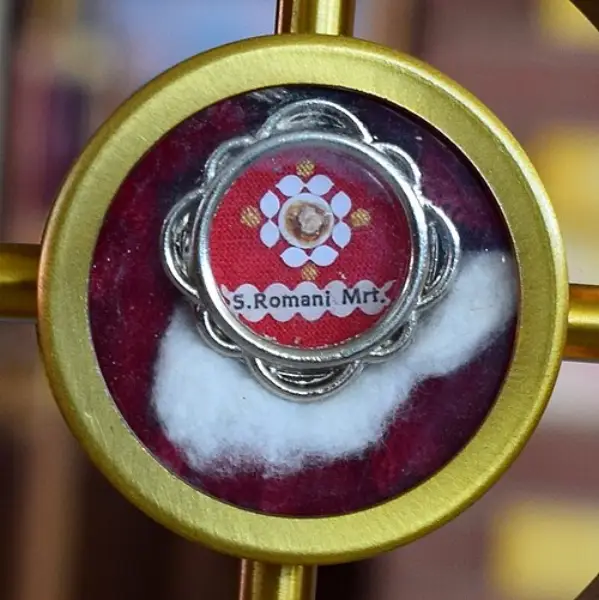
Romanus was honoured as a martyr from the first, without any process of canonisation, for the church of the persecutions reckoned its saints by the blood they shed. His feast is observed on 18 November. The memory of his passion was carried by the earliest and most authoritative of witnesses: Eusebius of Caesarea, the father of church history, who described the martyrdom in his work on the Palestinian martyrs, De martyribus Palaestinae. A century later the poet Prudentius took up the story and gave it a place in his crown of martyrs, the Peristephanon, where the tenth hymn — the Romane Christi fortis, running to 1,140 lines — sings the deacon's combat. Through the ages he has been honoured across the divided families of Christianity: the Roman Catholic, Eastern Orthodox, Oriental Orthodox and Maronite churches all keep his memory. A relic of the saint is venerated at St. Raymond Maronite Cathedral in St. Louis, Missouri, a church that bears his name in the form Raymond, and in Spain the church of San Román in Seville stands dedicated to him, a token of the devotion the hymns of Prudentius spread through the Latin West.
§ Introduction
The Poet, the Historian, and the Child
Two literary monuments kept the deacon's memory alive, and their disagreement shaped his legend. Eusebius gives the martyrdom as history, brief and terrible. Prudentius, writing in the spirit of poetry, adds particulars and gives Romanus a companion in his passion: Barulas, a boy of seven years, who stood beside the saint and was whipped and beheaded with him by the order of Galerius for their Christian belief. The child is honoured as a martyr in his own right, venerated like the young Quiricus among the child-martyrs of the church, with his own feast on 18 November, and he stands beside Romanus in Francisco de Zurbarán's great painting, the open book in the picture bearing in Latin the words of the martyr's prayer that the Lord show his might and glorify his holy name. On the authority of Prudentius, several historians — Baronius among them — judged that two martyrs named Romanus suffered at Antioch; but the more probable conclusion, and the one scholarship favours, is that there was but a single deacon, the one whom Eusebius mentions, and that the poet embroidered his account with legendary features, joining the child Barulas to the martyr by an invention of devotion rather than of record.
§ Life
Timeline
- 303
At the outbreak of the Diocletianic Persecution, encouraged the Christians of Antioch, where he was then living, to stand firm.
§ Life
- 303
Arrested after rebuking the worshippers of idols during a pagan festival at Antioch.
§ Life
- 303
Condemned to death by fire and bound to the stake; rain fell and extinguished the flames.
§ Life
- 303
Brought before Emperor Galerius at Antioch, who ordered his tongue to be cut out.
§ Life
- 303
Tortured in prison in various ways and finally strangled.
§ Life
- 303
Barulas, a seven-year-old boy, was whipped and beheaded alongside Romanus by order of Galerius, as Prudentius relates.
§ Barulas
In Their Own Words
Lord Jesus Christ, show thy might, that thy holy name may be glorified, which is blessed forever.
The Record
- Canonization
- Pre-congregation; recognised as a martyr by the undivided early Church
Prayer
Bibliography
Show 7 sources
- "Faith from the Mountains", www.straymond-mc.org, St. Raymond Maronite Cathedral
- "Martyr Romanus the Deacon of Caesarea", Orthodox Church in America
- Dumitraşcu, Iulian. "Martyrs Platon of Ancyra, Romanus the Deacon of Caesarea, and Zacchaeus the Deacon of Caesarea in Palestine", Biserica Ortodoxă Română
- Kirsch, Johann Peter. "Sts. Romanus." The Catholic Encyclopedia, Vol. 13. New York: Robert Appleton Company, 1912
- Prudentius, Peristephanon, X, in P.L., LX, 444 sqq.
- Tycner, M. "Liber Peristephanon, Poem X", The Cult of Saints in Late Antiquity, Oxford University Press
- Monks of Ramsgate. "Barulas". Book of Saints, 1921. CatholicSaints.Info
Profile text adapted from the Wikipedia article, licensed CC BY-SA 4.0.
Pray with this saint every day
Save St. Romanus of Caesarea to your favorites, read the full profile, and get feast-day reminders in the Saints app.
Get the Saints AppFree on the App Store for iPhone and iPad