
died c. 640·Feast October 23
St. Romanus of Rouen
Bishop of Rouen and tamer of the Gargouille
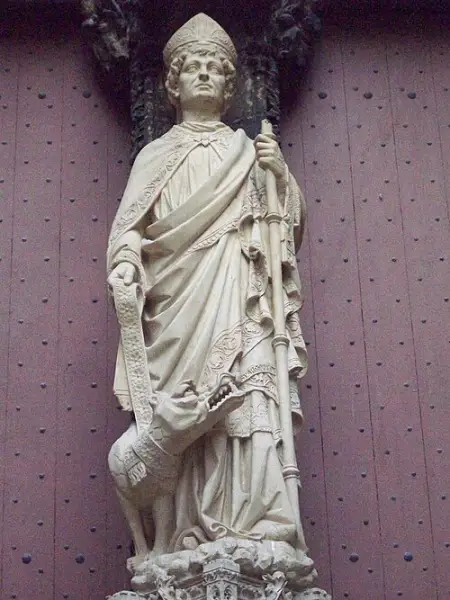
Overview
Saint Romanus of Rouen — Romain in French, from a reconstructed Frankish *Hruomann — was bishop of Rouen and one of the great figures of Merovingian legend, dying around the year 640 after serving under King Dagobert I. Tradition calls him a scribe and clerical sage, and gives him the highest offices of the Frankish state, Lord Chancellor and Référendaire of France, before the canons of Rouen chose him for their episcopal seat. His life comes down in legend rather than chronicle: the stained glass of Rouen Cathedral from about 1521, the south gate of the same church, and the windows of the église Saint-Godard from 1555 all narrate it in colour and stone. The legend tells of pagan temples collapsing at his word, of a broken vessel of chrism restored at his prayer, of floods driven back, of a demon cast into the pit, and — most famously — of the Gargouille, the dragon of the Seine marshes, which he bound with his stole and led into the city. From that dragon came the bishops' privilege of pardoning one condemned prisoner each year, kept until 1790. His feast, 23 October, gave Rouen its autumn fair.
The Complete Life
The Child Promised to Heaven
The story of Romanus begins before his birth. His mother Félicité had wept over her barrenness until, one night, an angel came to her husband with the promise that their house would be given a child — a promise that marks the boy out from the first as Heaven's gift. As a very young man he was sent to the king's court, as the sons of good families then were: such youths, called nourris, performed domestic service at court in return for an education, and were afterwards sent back to the provinces to serve as counts or bishops. The court was thus a school of government, and Romanus passed through it in the company of two boys who would themselves become great saints of the Frankish church, Eligius and Audoin, whom he met there. The friendship of that generation of courtiers-turned-saints — the goldsmith bishop of Noyon, the counsellor bishop of Rouen — shaped the Christianity of Neustria for a generation. Whatever the historical value of these details, and the learned are clear that his legend carries little of it, they set Romanus where the tradition wanted him: among the educated servants of the crown whom God took for the service of the altar.
§ Birth and youth
Chancellor and Bishop
Tradition dresses Romanus in the highest civil honours before it clothes him in the pallium: he is remembered as Lord Chancellor of France and Référendaire of France, the keeper of the king's petitions and the draftsmen of the royal will — offices that in the Merovingian state demanded learning, drafting skill and unshakable discretion. The tradition calls him a scribe and clerical sage, and it was from the service of the palace that he passed to the service of a see. When the see of Rouen became empty, its canons cast their votes for Romanus, the king gave his approval, and the monarch presented the bishop-elect with a cross, the emblem of the office he was to bear. From that moment the legend follows him along the Seine, and every episode it tells has the same shape: the power of the courtier placed, without hesitation, at the service of the Gospel. He would have lived under Dagobert I, whose reign from 629 to 639 is the last great age of the Merovingian kings, and it is in that world — of royal chapels, provincial cities and pagan countryside — that his miracles are set.
§ Birth and youth
Temples, Chrism, and Floods
The legend gives Romanus a ministry of signs across the diocese of Rouen. Before he wore the mitre, the faithful asked him to cause the shrine of Venus, raised within the old Gallo-Roman amphitheatre on the city's northern side, to vanish together with the altar dedicated to the goddess; he went in, stripped the dedication from the altar, and the whole building fell. Setting out later to evangelise the surrounding countryside, he came upon a pagan temple built like a fortress, with demons dancing upon it; he cursed the demons, provoked their chief, and the building fell. Gentler marvels belong to the same account. Preparing to consecrate baptismal fonts one day, he found the holy chrism forgotten; the deacon sent hurrying for it dropped and broke the vase, and the oil spilled into the earth — but Romanus, praying without pause, gathered the pieces, and the vessel rebuilt itself with its contents restored. When the Seine's floods threatened catastrophe, as they often did in that age, the bishop's word made the river fall. Each story marks the same conviction: that the bishop of Rouen carried into the city and its fields an authority over stone, water and evil spirits alike.
§ Legendary miracles
The Hermitage and the Ecstasy
Between the public combats, the legend shows Romanus at prayer. Near the end of his life he withdrew to a hermitage to pray and meditate, in the pattern of the bishops of his age who closed their labours in solitude. There a demon came against him in disguise, appearing as a poor woman asking alms; Romanus, hesitant to receive a woman yet unwilling to fail in the duty of hospitality, let her in — and the pretended beggar undressed and unbound her hair to entrap him. The bishop called upon the Lord, and an angel intervened, hurling the demon into a bottomless pit. The story is a meditation on hospitality and peril, on the charity that does not calculate and the prayer that guards it. A last marvel closes his earthly course: as he was offering Mass, shortly before his death, he entered an ecstasy, his body rising from the ground while God announced to him the day of his death. In these scenes the legend gives the bishop an inner life — the hospitality of the Gospel kept under spiritual attack, the liturgy as the place where heaven speaks — and it presents his whole career as sustained, from the court to the grave, by intercession.
§ Legendary miracles
The Gargouille and the King's Pardon
No story of Romanus is more famous than that of the Gargouille — the name comes from a word for throat, the same root that gives the gargoyle its name. Among the pathless marshes along the Seine's left bank a monstrous serpent had raged, destroying human beings and the cattle of the countryside alike. Romanus resolved to hunt it, and could find only one companion: a prisoner already under sentence, for whom the risk meant nothing. Once they reached the beast's domain, the bishop signed it with the cross; it lay down at his feet and let him put his stole upon it as a leash, and in this manner he led it into the city, where it was sentenced to death and burnt before the cathedral — or, in other tellings, cast into the Seine. The tale first appears in writing in 1394, absent from the older lives, and from it grew the celebrated privilege of St Romain: the right of the bishops of Rouen to pardon one condemned prisoner each year, the pardoned man or woman carrying the saint's reliquary in procession — a custom observed until 1790. The dragon became the bishop's emblem, carved in stone and blown in stained glass, and the city's autumn foire Saint-Romain keeps the memory of both.
§ Legendary miracles
A Cult Settled in 1090
Romanus was never canonised by process; he belongs to the ranks of the pre-congregation saints, raised to the altars by the devotion of his city. Within the archdiocese of Rouen his feast falls on 23 October, traditionally ranked as a Triple Feast of the First Class, though in later times the celebration has often been transferred to the following Sunday, against the date decreed by Archbishop Guillaume Bonne-Ame around 1090. That year is the hinge of the cult: it was then that the archbishop fixed the city's autumn fair, the foire Saint-Romain, to the eve of the feast — the tenth day of the Kalends of November in the old reckoning — and spread the saint's veneration to the whole diocese of Rouen. The learning of later centuries has been cool about the material: the Catholic Encyclopedia judges his legend to be of little historical worth, with little authentic information. Yet the memory proved stronger than the criticism. Four Lives of the saint were written, one in Latin verse of the eighth century and others in prose, kept today in the municipal library of Rouen and the Bibliothèque nationale in Paris, and the cathedral itself preaches him in glass and stone.
§ Festival
Timeline
- 629
Served as bishop of Rouen in the reign of King Dagobert I, holding the offices of Lord Chancellor and Référendaire of France.
§ Introduction
- 640
Died around this year in the Kingdom of the Franks.
§ Introduction
- 1090
Archbishop Guillaume Bonne-Ame set the foire Saint-Romain to the saint's feast of 23 October and spread his cult to the whole diocese of Rouen.
§ Introduction
- 1394
The legend of the Gargouille, the dragon subdued by the saint, was recorded for the first time.
§ Legendary miracles
- 1521
The saint's life was shown in the stained glass windows and on the south gate of Rouen Cathedral.
§ Introduction
- 1555
The windows of the église Saint-Godard were painted with scenes from his life.
§ Introduction
- 1790
The bishops' privilege of pardoning one condemned prisoner each year, born of the dragon legend, came to an end.
§ Legendary miracles
The Record
- Patron of
- Archdiocese of Rouen·City of Rouen
- Symbols
- Depicted with a Gargouille (dragon)
- Canonization
- Pre-congregation; cult spread to the whole diocese of Rouen around 1090
Prayer
Bibliography
Show 8 sources
- Husenbeth, Frederick Charles. Emblems of Saints: By which They are Distinguished in Works of Art. Longman, Green, Longman, and Roberts, 1860, p. 147
- Herbermann, Charles, ed. (1913). "Sts. Romanus". Catholic Encyclopedia. New York: Robert Appleton Company.
- "Acta Sanctorum", October, X, 91 sqq.
- "Analecta Bollandiana", 23 (1904), p. 337
- Shuker, Karl (1995). Dragons: A Natural History. Simon & Schuster, New York. ISBN 0-684-81443-9
- Cipa, Shawn (2008). Carving Gargoyles, Grotesques, and Other Creatures of Myth. Petersburg, PA: Fox Chapel Publishing Inc. ISBN 978-1565233294
- Beaufreton, Jean-Patrick. La Seine Normande. Éditions Alan Sutton, 2001
- Alexandre, Alain. Saint Romain, de la légende à la foire. Collection histoire(s) d'agglo n°4, January 2001
Profile text adapted from the Wikipedia article, licensed CC BY-SA 4.0.
Pray with this saint every day
Save St. Romanus of Rouen to your favorites, read the full profile, and get feast-day reminders in the Saints app.
Get the Saints AppFree on the App Store for iPhone and iPad