
died c. 550·Feast May 22
St. Romanus of Subiaco
Hermit who clothed and sheltered the young Benedict
Overview
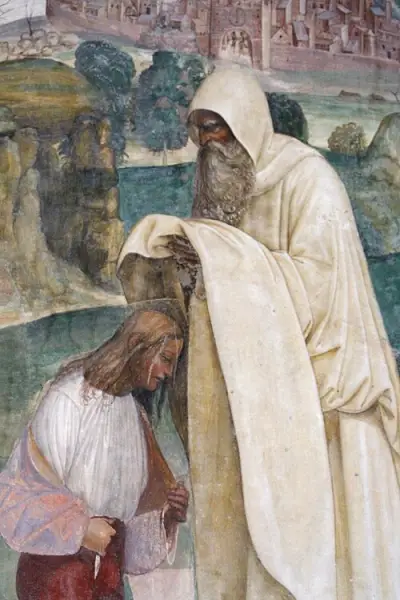
Romanus was a hermit living in the hill country around Subiaco, in central Italy, at the moment when a young Roman named Benedict of Nursia was first feeling his way into the eremitical life. Seeing the beginner's need, Romanus supplied what he lacked: the religious habit that marked his new station, the food that sustained his body, and shelter in a cave overlooking the river Anio, where Benedict would spend three years before his name became known far beyond the valley. Without this quiet assistance, one of the most consequential vocations in the history of monasticism might have faltered at its start. In his own later years Romanus crossed the Alps into Gaul and established a small monastery at Dryes-Fontrouge, close to Auxerre; there he died about the year 550. He was buried at the monastery he had established and honored as a saint soon after. His relics were later dispersed among churches at Auxerre, Sens, and Vareilles. The Eastern churches venerate him on May 22, and some writers have identified him with a Romanus of Auxerre whose episcopal feast was kept in October. Painters of the Benedictine legend, notably Il Sodoma in the early sixteenth century, preserved the image of the older monk robing the young stranger by the waters of the Anio.
The Complete Life
The Hermit of Subiaco
In the steep country above the Anio valley, not far from the ruined nymphs' gardens that gave Subiaco its name, Romanus had withdrawn from ordinary society to live as a hermit. The eremitical life he embraced was one of radical simplicity: prayer, fasting, and solitude in a landscape of cliffs and caves, where a man possessed little beyond what charity brought him. It was in this setting that he encountered Benedict of Nursia, a young Roman who had fled the schools of the city and had only just resolved to try the hermit's path. Romanus recognized in the newcomer a soul in earnest, and he did what the solitary life rarely allows — he let another into his care. He clothed Benedict in the religious habit that signified his new commitment, he brought him food in secret, and he pointed him to a cave above the river where the young man could take shelter. Benedict lived in that rocky dwelling for three years, unknown to nearly everyone, while the village children who carried his bread grew used to an unseen master. For Romanus the arrangement cost him something dear to a hermit, his solitude, yet he bore it gladly, and the valley of Subiaco thus became, through his quiet charity, the nursery of a vocation that would shape centuries of Western monastic life.
§ Romanus of Subiaco
A Father to Benedict
The service Romanus rendered to Benedict was small in outward show and immense in consequence. A beginner in the eremitical life stood in danger not merely of hunger but of confusion, for the solitary path had no visible rule and no teacher at hand in the deserted valley. Romanus filled that absence. The clothing he provided — the religious habit — gave the young man an outward identity in his new life; the food he carried sustained him through years of severe fasting; and the cave above the river Anio gave him a fixed place of prayer and combat, where he dwelt for three years before emerging into public notice. Tradition remembers this as an act of assistance and influence at the precise moment when Benedict had only begun his life as a hermit, and later generations understood that the great things associated with Benedict's name had needed this obscure patron at the start. The scene fixed itself in the imagination of the Benedictine world: in the fresco cycle of the Life of St. Benedict painted by Il Sodoma at Monte Oliveto Maggiore between 1505 and 1508, the fourth scene shows the monk Romanus clothing Benedict with the habit, preserving in paint the memory of the older hermit's gift. A friendship of that kind, hidden in a mountain cave, outlived both of its participants by a thousand years.
§ Romanus of Subiaco
Gaul and the Monastery at Dryes-Fontrouge
After the years at Subiaco, Romanus left Italy and traveled north into Gaul, taking up once more the wandering that the eremitical vocation sometimes demanded of its devotees. Near the city of Auxerre he founded a small monastery at a place remembered as Dryes-Fontrouge, identified with Druyes-les-Belles-Fontaines, where springs break from the limestone country south of the town. There he gathered a community and passed the final span of his life in the observance he had long practiced, directing others in the discipline he had learned in the solitudes of Italy. He died at the monastery about the year 550, closing a life that had stretched from the valleys near Rome to the uplands of Burgundy. His monks buried him among them, and the tomb at Dryes-Fontrouge became the first center of his cult. In time his remains were divided and carried to other churches: his relics are now venerated at Auxerre, at Sens, and at Vareilles, so that the geography of his last years is still legible in the places that keep portions of his body. A saint who had given away his goods in Italy ended his days as the father of a monastery in Gaul, and both lands preserved his memory with gratitude.
§ Romanus of Subiaco
Relics and Continuing Veneration
The churches of East and West both kept Romanus on their calendars, a rare double testimony for a hermit of whom so little was written. His feast is observed on May 22 in the Eastern Orthodox Church, and his cult was never confined to one rite or one region. In Gaul a complication arose in his memory: some writers identified him with a Romanus of Auxerre who was venerated locally as a bishop of that city, with a feast kept on October 8 or, in other reckonings, October 6. Whether the hermit of Subiaco and the bishop of Auxerre were one man or two, the mingling of the traditions shows how deeply his name had struck root in the country where he died. The physical evidence of his cult survived in the dispersion of his relics across three towns of the former heartland of his monastery — Auxerre, Sens, and Vareilles — each of which preserved a share of the saint. Meanwhile the scene of his greatest service was enshrined in the art of the Benedictine tradition, for the robes he placed on the young Benedict became an emblem of every spiritual fatherhood exercised quietly and without reward. He stands in the memory of the Church as the man who was present at the beginning and was content to remain little known.
§ Romanus of Subiaco
The Record
- Major works
- Monastery of Dryes-Fontrouge near Auxerre
- Canonization
- Venerated as a saint from an early period; no formal canonization recorded
Prayer
Bibliography
Show 5 sources
- Ὁ Ὅσιος Ρωμανὸς ὁ Ἀσκητής. 22 Μαΐου. ΜΕΓΑΣ ΣΥΝΑΞΑΡΙΣΤΗΣ.
- Gregory the Great, Dialogi, II, I.
- Kirsch, Johann Peter. "Sts. Romanus." The Catholic Encyclopedia. Vol. 13. New York: Robert Appleton Company, 1912.
- Otros Santos y Beatos del 6 de octubre.
- Holweck, Frederick George (1924). A Biographical Dictionary of the Saints: With a General Introduction on Hagiology. Vol. 1. B. Herder. p. 864.
Profile text adapted from the Wikipedia article, licensed CC BY-SA 4.0.
Pray with this saint every day
Save St. Romanus of Subiaco to your favorites, read the full profile, and get feast-day reminders in the Saints app.
Get the Saints AppFree on the App Store for iPhone and iPad