
died 653·Feast December 10
St. Romaric
Frankish nobleman who founded Remiremont Abbey
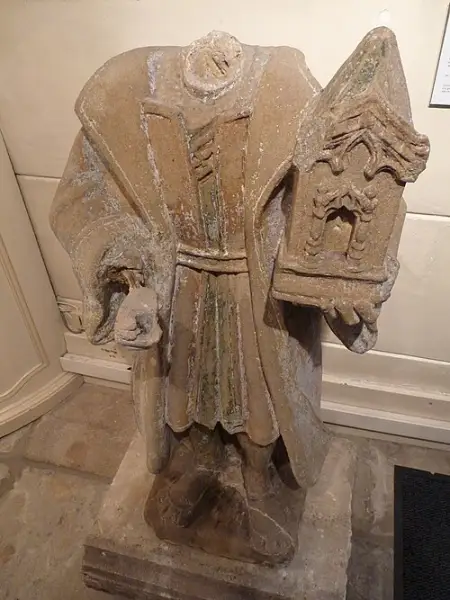
Overview
Romaric was a Frankish nobleman of Austrasia who lived from the close of the sixth century into the middle of the seventh, and whose life moved from the turbulence of the Merovingian court to the quiet of a monastery he himself founded. As a young man he served as Count Palatine at the court of King Theodebert II, but his family was caught in the vendettas of the age: Queen Brunhilda had his parents killed, and the enmity left him a wanderer without a home. Only with the queen's fall did he recover his position, being received at the court of Chlothar II and restored to his lands. Disenchanted with courtly life, he underwent a religious conversion under the preaching of Amatus of Grenoble, a monk of Luxeuil Abbey, and entered that community and trained in the monastic life. With Abbot Eustace's blessing, Romaric joined with Amatus to establish a double monastery for men and women on Romaric's own land, a foundation that took the name Remiremont, from Romariki Mons, the mountain of Romaric. Around 625 he succeeded Amatus as abbot and guided the house for nearly three decades, directing several members of his own family into religious life there. He died in 653, was canonized by Pope Leo IX on December 3, 1049, and is commemorated on December 10.
The Complete Life
A Count Palatine in the Merovingian Storm
Romaric belonged to the Frankish aristocracy of Austrasia, the eastern division of the Merovingian realm, and he grew to maturity in a court where favor and ruin followed one another with dizzying speed. He rose to the office of Count Palatine, serving at the side of King Theodebert II in the highest administrative circle of the kingdom. Yet his family's standing made it a target. Queen Brunhilda, whose struggles with the Austrasian nobility marked the politics of the age, had Romaric's parents killed, and the hatred between the queen and his house drove the young courtier into homelessness; for a time he wandered without a settled place in the world of which he had been an ornament. Fortune turned only when Brunhilda herself fell. With the queen's downfall Romaric was received at the court of Chlothar II, the king who reunified the Frankish realms, and his confiscated lands were given back to him. He thus knew both extremes of Merovingian life — the summit of office and the desolation of exile — and the experience left him disenchanted with the whole business of courts. The man who returned to his estates was no longer the ambitious courtier who had left them, and the restlessness of his heart was waiting for a different kind of preaching to give it direction.
§ Biography
Conversion at Luxeuil
The turning in Romaric's life came not through a court chaplain but through the missionary zeal of a monk. Amatus of Grenoble, a member of the community at Luxeuil Abbey, the great monastery founded by Columbanus in the Vosges, preached to the nobleman and became the instrument of his conversion. Disenchanted with the life of a courtier, Romaric listened, and the values of the palace lost their grip on him. He did what the converts of Luxeuil's tradition so often did: he entered the monastery himself, submitting to the training of a monk under Abbot Eustace, the third successor of Columbanus in that rigorous school of prayer and discipline. The contrast with his former life could hardly have been sharper. The count palatine who had commanded the business of a kingdom now learned obedience, manual labor, and the ordinary rhythm of a psalm-singing community. Yet Luxeuil did not merely absorb him; it prepared him for something further. The abbey's tradition joined contemplation to enterprise, sending its monks out to plant new houses across the Frankish world. Eustace watched his noble novice with approval, and when the moment came he blessed a project that would carry the Luxeuil spirit into a wilder corner of the Vosges and put Romaric's own restored lands to a purpose greater than any he had imagined at court.
§ Biography
Founding Remiremont
The work for which Romaric is remembered took shape in partnership with the very monk who had converted him. Together with Amatus of Grenoble, and with the approval of Abbot Eustace of Luxeuil, he founded a double monastery — a community comprising both men and women — in the Vosges mountains of Austrasia. The site was Romaric's own property, land he had held in his days as count palatine, so that the estates restored to him by King Chlothar II became the patrimony of a religious house rather than of his family line. The foundation came to be called Remiremont, a name drawn from the Latin Romariki Mons, the mountain of Romaric, fixing the founder's name into the geography of Lorraine for good. Among the early monks of the new community was Arnulf, Romaric's friend, whose own name would be honored in the Church's calendar. The partnership of the two founders did not last long in earthly terms: in due course Romaric succeeded Amatus as abbot, around the year 625, and took upon himself the direction of the house. As abbot he became the spiritual father not only of strangers but of his own blood, for several members of his family embraced religious life at Remiremont under his guidance, making the monastery in a true sense the continuation and the conversion of his house.
§ Biography
Abbot and Father of a Monastic Family
Romaric led Remiremont from about 625 until his death in 653, a period of nearly thirty years in which the character of the young foundation was set. The abbot who had once directed the affairs of a kingdom now directed a community of monks and, in the double monastery's arrangement, exercised care over the women's side of the house as well. His leadership had a family dimension that the sources record with unusual detail: two of his daughters, Ozeltruda and Zeberga, embraced religious life at Remiremont under their father's authority, and the next generation followed them, for his granddaughter Gebetruda and his grandson Adelphus likewise gave themselves to God within the walls he had built. The man whose parents had been slaughtered by a vengeful queen thus saw his household transfigured, its violence answered by vows, its lost honors replaced by a deeper nobility. He died in 653, at the abbey that bore his name, after an abbacy long enough to ensure that the community would outlive him. The monastery of Remiremont endured as one of the celebrated religious houses of the Vosges, and the memory of its founder remained green among the canonesses and monks who kept his tomb, waiting for the day when the Church would confirm formally what the valley had always believed.
§ Biography
Honored by Pope and Martyrology
Four centuries after his death, the holiness of Romaric received the Church's solemn recognition. On December 3, 1049, Pope Leo IX canonized the founder of Remiremont — a fitting act from a pope whose own roots lay in the upper Moselle country near the abbey he honored. The Roman Martyrology, the official register of the Church's saints, commemorates him on December 10, while another strand of tradition assigns his feast to December 8, and both dates testify to the affection with which his memory was kept. He is honored as a saint in the Roman Catholic Church and named also among the saints of the Eastern Orthodox churches, a doubling that reflects the antiquity of his cult. The record of his life depends in part on the witnesses gathered by later compilers, including the Nominis directory of saints and the modern Catholic calendars that carry his feast, and the older scholarship of Alban Butler's Lives of the Saints, revised by Thurston and Attwater, preserved his story for the English-speaking world. What the Church confirmed in 1049 was already visible in the facts of his life: a nobleman who traded a palace for a mountain, armed enmity for the monastic vow, and a murdered family for a spiritual one gathered from his own descendants.
§ Biography
Timeline
- 625
Succeeded Amatus of Grenoble as abbot of Remiremont.
§ Biography
- 653
Died at Remiremont Abbey in the Vosges.
§ Biography
- 3 Dec 1049
Canonized by Pope Leo IX.
§ Biography
The Record
- Major works
- Remiremont Abbey, a double monastery for men and women
- Canonization
- Canonized 3 December 1049 by Pope Leo IX
Prayer
Bibliography
Show 4 sources
- "Saint Romaric", Nominis.
- Martyrologium Romanum. Libreria Editrice Vaticana, 2001. ISBN 88-209-7210-7.
- Catholic Online (2011-12-08). "St. Romaric - Saints & Angels - Catholic Online". Catholic.org. Retrieved 2011-12-13.
- Alban Butler's Lives of the Saints, edited, revised and supplemented by Thurston and Attwater. Christian Classics, Westminster, Maryland.
Profile text adapted from the Wikipedia article, licensed CC BY-SA 4.0.
Pray with this saint every day
Save St. Romaric to your favorites, read the full profile, and get feast-day reminders in the Saints app.
Get the Saints AppFree on the App Store for iPhone and iPad