
died c. 4th century·Feast January 15
St. Romedius
Hermit of the Val di Non who tamed a bear
Overview
Romedius, honored in Trentino as San Romedio, came of noble stock, born at Thaur in the province of Raetia Secunda, near a Roman military station in the hills above the Inn, in what is today Austria. Though heir to wealth, in his youth he retreated to a rocky cave to give himself to meditation; once his parents had died he distributed everything he owned and made his home as a hermit in the grottoes of the Val di Non in Trentino, taking with him two disciples, Abraham and David. The legend of his bear fixed his image in the memory of the Alps: setting out to visit his friend of youth, Vigilius, Bishop of Trento, he found his horse torn apart by a wild bear, whereupon he ordered his disciple David to bridle the beast, and the docile animal carried the old hermit on its back to Trento. He died in his retreat, tradition says in the fourth century, though some scholars have argued that he belongs to the first decades of the eleventh. His disciples cut his tomb into the rock beside his grotto, pilgrims came, and the little church raised over the site grew into the Sanctuary of San Romedio, one of the most beloved pilgrimage places of Trentino, where crutches left by the healed still line the stairwell.
The Complete Life
From Nobleman to Hermit of the Val di Non
Romedius was born into a noble family at Thaur, close by a Roman military post not far from Innsbruck, in the upland province the Romans called Raetia Secunda — territory that lies in Austria today. Rank and property were his by birth, but they did not hold him. While still a young man he withdrew to a cave in the rock in order to meditate, choosing the harsh schooling of solitude over the expectations of his class. The decisive renunciation came with the death of his parents: heir now to the whole family estate, he gave everything away to the Church, and, after making a pilgrimage to Rome, the sacred center of the Christian world, he established himself as a hermit far to the south, in the grottoes of the Val di Non in Trentino. Solitude of that kind did not mean isolation from all human company; two disciples, Abraham and David, shared his retreat and learned his manner of life, and their presence would matter greatly in the stories later told of him. There in the Non valley, between the Brenner heights of his birth and the lake country around Trento, Romedius passed the years of his conversion, his body lodged in stone and his attention fixed on God, until the hermit of the grottoes became a figure the whole region would claim as its own.
§ History
The Legend of the Tamed Bear
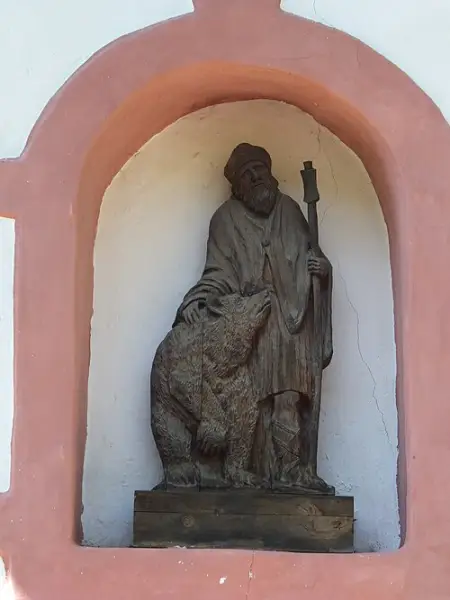
The tale that forever attached itself to Romedius belongs to the treasury of Alpine hagiography. As an old man, the story runs, he wished to visit the friend of his youth, Vigilius, the Bishop of Trento, who died in the year 405. On the mountain road his horse was set upon by a wild bear and torn to pieces — a calamity that would have ended the journey of any other traveler. Romedius, however, saw in the slayer of his mount the providential replacement for it. He commanded his disciple David to bridle the beast, and the bear, subdued, became docile and carried the hermit on its back all the way to Trento. From that day his iconography was settled: in paintings and statues across the Tyrol and Trentino he appears astride the bear or standing beside it, the tamed animal at his feet. The motif was not his alone in the hagiography of the region — a similar tale is told of Saint Psalmodius and of Lucanus of Sabiona, and the tamed bear figures also in the legend of Saint Corbinian, bishop of Freising — but nowhere did it take deeper root than in the valley of the Non. The image endures because it compresses the hermit's whole vocation into a single scene: the man of God, by sheer authority of holiness, commanding gentleness from what is fierce.
§ Legend
The Sanctuary of San Romedio
When Romedius died in his retreat, his disciples carved a burial place for him in the rock beside the grotto he had inhabited, and almost at once the tomb began to draw pilgrims. A church was raised to venerate the saint, and from that modest beginning there grew the Sanctuary of San Romedio, a complex of several churches spanning the Romanesque period to the twentieth century, set beyond a gateway in the wooded slopes above Sanzeno, a village across the lake from Cles, where the Val di Non begins. Inside, a narrow stone stairwell climbs toward the highest chapel that marks the site of the saint's retreat, votive offerings of crutches line the walls — the discarded supports of pilgrims who found healing there. His local cult took firm shape during the eleventh century and won formal recognition in the twelfth from the Bishop of Trento. In 1795 the diocese of Brixen, whose territory then embraced the Northern Tyrol, authorized the celebration of Masses in his honor. His legend lives on in unexpected places: in 1958 the Italian senator G. G. Gallarati Scotti, an honorary member of the founding committee of the World Wildlife Fund in Italy, rescued a bear named Charlie from death and gave it to the sanctuary; near the shrine, the Province of Trentino safeguards the Alps' surviving brown bears within the Adamello-Brenta National Park; and in Illustrissimi, the letters of Pope John Paul I written when he was Patriarch of Venice, Romedius' bear appears as a recipient of the pontiff's correspondence.
§ Veneration
Timeline
- 1795
The diocese of Brixen, then covering the Northern Tyrol, gave leave for Masses to be celebrated in his honor.
§ Veneration
- 1958
Senator G. G. Gallarati Scotti purchased a bear destined to be killed, named Charlie, and donated it to the Sanctuary of San Romedio.
§ Romedius' Bear
The Record
- Major works
- Hermitage in the grottoes of the Val di Non
- Symbols
- depicted riding a bear·alongside a bear·tamed bear
- Canonization
- Local cult officially recognized in the twelfth century by the Bishop of Trento
Prayer
Bibliography
Show 6 sources
- "Sanctuary of Saint Romedius", Trentino Cultura, Department for Culture Heritage of Trento.
- "San Romedio". santiebeati.it. Retrieved May 24, 2014.
- "Saint Psalmet". Mairie de Eymoutiers. n.d. Retrieved May 6, 2009.
- "The bear and the scallop-shell - a unique papal coat of arms". Catholic World News. 2005-04-27. Retrieved 2007-01-05.
- "Unusual Places in Italy: The Sanctuary of Saint Romedius", Italy magazine.
- "The legend of the Trentino bear and Saint Romedius", Val di Non.
Profile text adapted from the Wikipedia article, licensed CC BY-SA 4.0.
Pray with this saint every day
Save St. Romedius to your favorites, read the full profile, and get feast-day reminders in the Saints app.
Get the Saints AppFree on the App Store for iPhone and iPad