
c. 951 – 1027·Feast June 19
St. Romuald
Founder of the Camaldolese order and reformer of eremitical life
Overview
Romuald, founder of the Camaldolese order, was the commanding figure of the eleventh-century renaissance of eremitical asceticism in Italy. Born at Ravenna around 951 into the aristocratic Onesti family, he was a youth of twenty when his father killed a kinsman in a duel over property; the horror of witnessing the crime drove Romuald to forty days of penance at the basilica of Sant'Apollinare in Classe, and there he became a monk. Seeking a stricter observance than the reformed but still comfortable abbey could offer, he placed himself under the hermit Marinus at Venice, and about 978 he stood beside the doge Pietro I Orseolo when that remorse-stricken ruler abandoned his office for the monastery of Saint-Michel-de-Cuxa in Catalonia, where Romuald lived some ten years beside the hermitage he and Marinus had built. He then gave some thirty years to journeys across Italy, planting and renewing monasteries and hermitages, an apostolate that included a stormy year as abbot of Sant'Apollinare and, in 1012, the foundation at Camaldoli that gave the Camaldolese order its name and its mother-house. His rule, with its admonition to empty oneself completely and sit waiting, joined the Benedictine, Irish eremitical, and Iberian traditions he had absorbed into a spirituality of silence and the Psalms. He died on June 19, 1027, at the monastery of Val di Castro, and his feast is kept on that day.
The Complete Life
A Nobleman's Penance at Classe
Romuald was born at Ravenna around the year 951, the son of Sergius degli Onesti and Traversara Traversari, an aristocratic couple of that old Byzantine capital of northeastern Italy. The early accounts do not pretend that his boyhood was saintly: as a youth he indulged, the old accounts say, in the amusements and faults typical of a tenth-century nobleman, with no outward sign of the austerity to come. The turning came through his father's sin. When Romuald was twenty years old he acted as second to Sergius in a duel fought over a property dispute, and he watched his father kill a relative. The young man was devastated by what he had witnessed and abetted. He made his way to the basilica of Sant'Apollinare in Classe, the great church just outside Ravenna, and remained there forty days in penance, the length of the flood, of the fast in the desert, of mourning taken to its limit. The forty days did not end where a nobleman's retreat usually ended. After some indecision Romuald became a monk in that very monastery, trading the armed retinue of his class for the cloister. Sant'Apollinare had lately been reformed by St. Mayeul of Cluny, so that the house he entered was no backwater but a front line of the monastic renewal of the age — and yet, as he soon discovered, even this was not strict enough for the penitent son of the Onesti.
§ Life
Marinus, Venice, and the Years at Cuxa
The observance of Sant'Apollinare, reformed though it was by Mayeul of Cluny, still fell short of the severity Romuald craved, and his zeal did him no favor with the community. His corrections of the less fervent monks were injudicious, the enmity they aroused grew sharp, and he asked for — and was readily granted — leave to withdraw. He withdrew to Venice, putting himself under the guidance of a hermit called Marinus, whose manner of living, rooted in the harsh solitary traditions that had come from Ireland, was of extraordinary severity; here at last was a school equal to his penitential temper. About 978 the two hermits were drawn into a drama of the Venetian state. Pietro I Orseolo, the doge of Venice, who had gained his office by acquiescing in the murder of his predecessor, was gnawed by remorse for the crime. On the counsel of Guarinus, abbot of Saint-Michel-de-Cuxa in Catalonia, and of Marinus and Romuald, Orseolo abandoned his office, his family, and his wealth, fled to Cuxa, and there took the habit of St. Benedict. Romuald and Marinus erected a hermitage close by the monastery, and Romuald remained some ten years in that Catalan solitude, using the rich library of Cuxa to refine his ideas about monasticism into a vision he would spend the rest of his life building.
§ Life
Thirty Years of Founding and Reform
From Cuxa, Romuald returned to Italy and entered upon two decades of ceaseless movement, roughly thirty years spent traversing the peninsula, founding and reforming monasteries and hermitages. His fame reached the advisors of the Holy Roman Emperor Otto III, and at their urging Romuald accepted the vacant abbacy of Sant'Apollinare in Classe, the very house of his profession, in the hope that he could bring the monks to a more dedicated way of life. The attempt failed. The monks would not accept his changes, and within a year Romuald stepped down in open disgust, throwing his abbot's staff at the emperor's feet, and withdrew once more into the eremitical life he loved. In 1012, wandering brought him to the Diocese of Arezzo. There, according to the legend, a certain Maldolus granted him ground on the mountainside, for the man had beheld a vision of monks clothed in white climbing toward heaven — the Campus Maldoli, hence Camaldoli. On that ground Romuald built five cells for hermits, and when the monastery of Fontebuono was added two years below on the mountain, the whole grew into the celebrated cradle of the Camaldolese Order. Even the powerful could not manage him: Rainier of Tuscany, we are told, was so awed by Romuald's daunting charisma that he could neither face the man nor send him away. Among the later foundations was the monastery of Val di Castro, his final home.
§ Life
The Rule: Stillness and the Psalms
Romuald's genius was to have known, in his own formation, three great schools of Western monastic tradition and to have fused them into one. At Sant'Apollinare in Classe he had lived the traditional Benedictine observance under the influence of the Cluniac reforms; with Marinus in Venice he had embraced the much harsher, more solitary asceticism that had come out of the Irish eremitical tradition; and Guarinus of Saint-Michel-de-Cuxa drew on the third stream, that of the Iberian Peninsula. From these materials he established his own monastic order, one capable of holding together what had too often been rivals: his reform built one framework in which the eremitic and the cenobitic calls could each live side by side within monastic life. The counsel his rule gives — to empty oneself completely and to sit in waiting — sets him inside the long Christian lineage of interior stillness and receptive passivity in meditation, a kinship visible in the nearly contemporary Byzantine practice known as Hesychasm. His counsels to the monks are the classic testimony of this school: to sit in one's cell as in paradise, to put the whole world behind one's back, to watch one's thoughts like a fisherman watching the water, and to keep to the path of the Psalms without ever leaving it; and when the mind wanders at reading, to hurry back and begin again without despair. Archbishop Cosmo Francesco Ruppi has noted that what Romuald set at the living heart of his Rule — the turning of the spiritual life inward, the first rank given to solitude and contemplation, the slow savoring of God's word, and the calm praying of the Psalms — forms the supporting pillars of Camaldolese spirituality.
§ St. Romuald's Rule
Val di Castro
The last dwelling of Romuald's restless life was Val di Castro, a monastery he had founded among the quiet hills, and there he died on June 19 in the year 1027, the date tradition has kept for him, though the oldest evidence for the very year is late and troubled, resting on the testimony of Guido Grandi almost seven centuries afterward. He had reached an extreme old age for his century, having spent some seventy of his years in one form or another of the monastic state. Fifteen years after his death — a strikingly short interval — Peter Damian, himself formed in the hermitages of Romuald's tradition, composed the vita on which nearly all later knowledge of the saint depends, preserving the memory of the duel at Ravenna, the doge's flight, the staff hurled at the emperor's feet, and the five cells of Camaldoli. The body of the saint did not remain long at Val di Castro. In 1481 his relics were transferred to Fabriano, in the March of Ancona, where they became the treasure of the town, and the anniversary of that translation would one day fix the date of his feast in the Roman calendar. He died, as he had lived for sixty years, a hermit among hermits — the wanderer of Italian monasticism who had finally stopped moving.
§ Life
The Calendar of His Feast
The liturgical history of Romuald's cult is unusually well documented, a small case study in how the Roman calendar grows. His feast did not appear in the Tridentine calendar of 1570, more than five centuries after his death, though his sanctity was never in doubt in the regions his hermitages had seeded. In 1594 the feast was added to the Roman calendar, assigned to June 19, the date of his death. The following year Pope Clement VIII transferred it to February 7, the anniversary of the translation of the saint's relics to Fabriano in 1481, and there it remained for more than three centuries: the General Roman Calendar of 1960 still kept him on February 7, as does the Eastern Orthodox Church, which commemorates him on that day as well. With the reform of the liturgy after the Second Vatican Council, the feast was moved back in 1969 to June 19, restoring the day of his death — the older and more natural principle of anniversary observance. Through every one of these changes, the memory of the founder was served by the same underlying facts: a tomb first at Val di Castro, then relics at Fabriano, and an order that never ceased to keep its father's name before the universal Church. His is one of the few medieval calendars to have traveled so completely around the circle, from the day of death to the day of translation and home again.
§ Life
Father of the Camaldolese
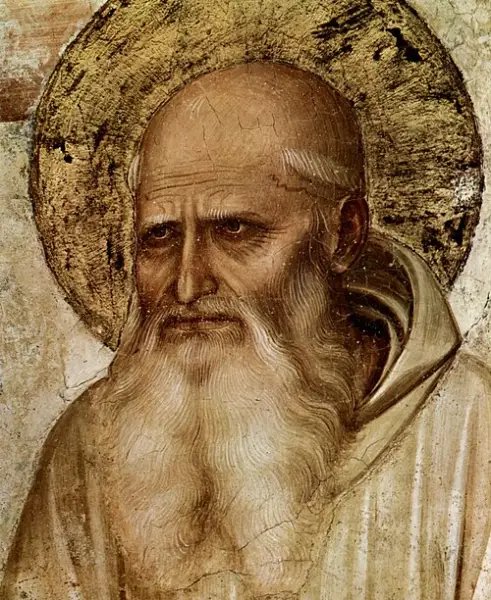
Romuald's most enduring work is an order that still carries his name. The Camaldolese congregation, born from the five hermit cells on Maldolus's mountain and the monastery of Fontebuono beneath them, embodied his conviction that the eremitical and cenobitic calls are not rivals but partners, each sheltered within a single structure. As a leading force in the eleventh-century revival of eremitical asceticism, he stands behind much of what followed in the Western contemplative tradition, a renewer who showed that the desert could be planted again in the heart of Italy. Art commemorated him almost from the first: Fra Angelico painted him into the San Marco altarpiece, the solemn portrait now in Minneapolis, and Guercino's San Romualdo of 1641, made for the church of his name in Ravenna, shows an angel taking up the abbot's staff to strike a wayward monk — an image drawn from the harsh zeal of the man himself. The hagiographers who came after him preserved his hard sayings, and the tradition he founded kept both his rule and his example alive across the centuries. Nearly a millennium after the five cells of Camaldoli, the admonition to empty oneself and sit waiting is still read wherever Christians seek the discipline of silence, and the pilgrim who climbs to the mother-house in the Apennines walks over ground the old hermit chose with his own feet.
§ Life
Timeline
- 951
Born at Ravenna into the aristocratic Onesti family.
§ Life
- 978
Pietro I Orseolo renounced the dogal office and withdrew to Saint-Michel-de-Cuxa, where Romuald and Marinus erected a hermitage beside the monastery.
§ Life
- 1012
Arrived in the Diocese of Arezzo, where Maldolus granted him land that became Camaldoli.
§ Life
- 1014
The monastery of Fontebuono was built near the five hermit cells of Camaldoli, forming the mother-house of the Camaldolese Order.
§ Life
- 19 Jun 1027
Died at the monastery of Val di Castro on 19 June.
§ Life
- 1481
His relics were transferred to Fabriano.
§ Life
- 1594
His feast was added to the Roman calendar, kept on 19 June.
§ Life
- 7 Feb 1595
Pope Clement VIII transferred his feast to 7 February.
§ Life
- 1969
His feast was moved back to 19 June, the day of his death.
§ Life
In Their Own Words
Sit in your cell as in paradise. Put the whole world behind you and forget it. Watch your thoughts like a good fisherman watching for fish. The path you must follow is in the Psalms — never leave it.
Empty yourself completely and sit waiting.
The Record
- Major works
- Camaldolese Order·The Rule of St. Romuald·Hermitage of Camaldoli·Monastery of Val di Castro
- Canonization
- Cult approved with his feast added to the Roman calendar in 1594
Prayer
Bibliography
Show 8 sources
- Peter Damian, Vita Beati Romualdi, edited by Giovanni Tabacco. Fonti per la storia d'Italia. Rome, 1957.
- Toke, Leslie. "St. Romuald." The Catholic Encyclopedia. Vol. 13. New York: Robert Appleton Company, 1912.
- Foley, Leonard O.F.M. "St. Romuald", Saint of the Day, Lives, Lessons and Feast, revised by Pat McCloskey O.F.M. Franciscan Media.
- Howe, John. "The Awesome Hermit: The Symbolic Significance of the Hermit as a Possible Research Perspective". Numen 30.1 (July 1983): 106-119.
- Turley, Thomas. "Romuald of Ravenna, Saint", in Key Figures in Medieval Europe, edited by Richard K. Emmerson. Routledge, 2013. ISBN 9781136775192.
- Ruppi, Cosmo Francesco. "A 'Burning Bush' and 'Father' of Spiritual Wisdom", L'Osservatore Romano, Weekly Edition in English, 25 January 2006, p. 4.
- McNary-Zak, Bernadette. Seeking in Solitude. Wipf and Stock Publishers, 2014. ISBN 9781606089699.
- Calendarium Romanum. Libreria Editrice Vaticana, 1969, p. 95.
Profile text adapted from the Wikipedia article, licensed CC BY-SA 4.0.
Pray with this saint every day
Save St. Romuald to your favorites, read the full profile, and get feast-day reminders in the Saints app.
Get the Saints AppFree on the App Store for iPhone and iPad