
died c. 90·Feast July 6
St. Romulus of Fiesole
First bishop of Fiesole martyred with four companions
Overview
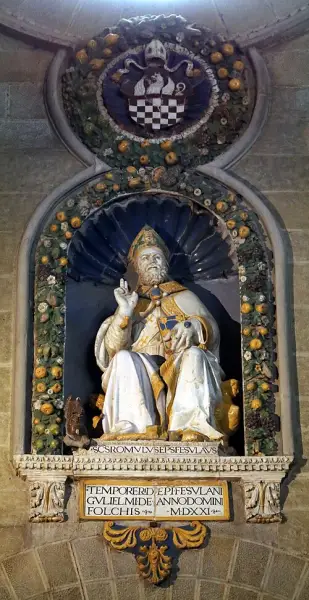
Romulus of Fiesole, remembered in Italian as San Romolo, was bishop of Fiesole in the first century and died around the year 90. He is honored as the patron saint of Fiesole, the hill town above Florence where his cult has centered for a millennium. The soberest judgment sees in him most likely a deacon, priest, or bishop serving Fiesole's first Christian generation, while the legend that grew around him made far larger claims: that he was converted and baptized by the apostle Peter himself, that he served as Fiesole's first bishop, and that he met his death under the emperor Domitian together with four companions — Carissimus, Dulcissimus, Marchisianus, and Crescentius. His cult has a documented history. He is absent from the records of 966, but a document of 1028 already names him a martyred bishop, and scholars judge that sometime around the year 1000 he was deliberately recast from confessor to martyr, perhaps by a local abbot named Teuzo. From 1468 his feast of July 6 appears in the Florentine edition of the Martyrology of Usuard, and in the sixteenth century the Roman Martyrology described him as a disciple of Peter. Fiesole Cathedral keeps his memory in stone and paint: a 1440 triptych by Bicci di Lorenzo, the earliest of his images, and frescoes by Nicodemo Ferrucci that fill the vault of the apse with scenes from his life.
The Complete Life
The Man and the Legend
Two figures answer to the name of Romulus of Fiesole: the barely visible Christian of the first century and the vivid hero of an eleventh-century legend. The sober tradition, which scholars such as Antonio Borrelli have weighed, holds that he was most likely a local deacon, priest, or bishop of Fiesole during the first Christian century, a real pastor of the hill town of whom almost nothing was written down. The legend, composed in the eleventh century and judged worthless by critical hagiographers, supplied what history had not. It made Romulus the illegitimate son of a woman named Lucerna, conceived with her father's slave, a man named Cyrus; an infant exposed like the foundling of Roman fable, he was suckled by a she-wolf, in conscious imitation of the Romulus of pagan myth. Rescued from the wild, the child was taken in, baptized, and brought up by the apostle Peter together with Justin, Peter's fellow worker, growing up in the apostolic generation itself. However little of this can be believed as history, the legend reveals what the people of Fiesole wanted their patron to be: a man knit to the person of the apostle Peter by bonds of adoption and teaching, and a life that echoed, in Christian key, the foundation legends of the city it sanctified. The wolf that nursed him followed him into his iconography, where it remains to this day beside the bishop's vestments.
§ Romulus of Fiesole
First Bishop of Fiesole
The tradition that took root at Fiesole made Romulus the first bishop of the town, the man who gathered its earliest Christians into an organized church and shepherded them as their bishop. According to the legend, he had been converted to Christianity by Saint Peter himself, becoming the apostle's disciple, and in that school of the first generation he received the faith he would later hand on. Beyond the hill town, the same tradition stretched his ministry across a wider field, for the legend has him evangelizing much of central Italy, carrying the Christian message through the towns and valleys of Etruria in the apostolic age. Whatever the exact form of his historical ministry — deacon, priest, or bishop, as the soberest accounts allow — his vocation was that of a founder: the churchman in whose lifetime the Christian community of Fiesole passed from scattering to structure. The office of bishop that he came to hold made him responsible for the whole Christian people of the district, and it placed him in the front line when persecution reached the hills above the Arno. In the memory of Fiesole he has never been anything but the first and the model of its bishops, the standard against which the long line of his successors in the cathedral that bears his name has always been measured by the people of the town.
§ Romulus of Fiesole
Martyrdom with Four Companions
The tradition of Fiesole records that Romulus sealed his ministry with martyrdom, put to death in the reign of the emperor Domitian — the persecution that had already claimed members of the apostolic circle — and that he did not die alone. Four companions were joined to him in passion and in honor: Carissimus, Dulcissimus, Marchisianus, and Crescentius, names preserved precisely because the community that remembered the bishop refused to forget the men who died at his side. In the iconography that grew from this memory, Romulus is depicted standing at the martyrdom of his four companions or enthroned among them, the bishop framed by the four witnesses who shared his fate; another tradition of his images presents him as a bishop with a broken arrow standing over his chest, the mark of the wound that killed him. The governor Repertian, in the eleventh-century legend, is named as the officer who condemned him to death. Whether the martyrdom occurred under Domitian or, as the older computations of his death year would allow, in the neighborhood of the year 90, the essential witness remained fixed: the first bishop of Fiesole had died for the faith he planted, and his people had watched him go to execution in the company of his own clergy. The four martyrs were enrolled beside him in the calendar, honored on the same feast of early July that the town keeps for their bishop.
§ Romulus of Fiesole
How a Confessor Became a Martyr
The documented history of Romulus's cult is a lesson in how saints were made in the minds of medieval communities. The records are stubborn about one point: in documents dating from the year 966, Romulus appears neither as bishop nor as martyr of Fiesole. Then, in 1028, a document names him precisely as a martyred bishop, and from that moment the martyr story stands at the center of his cult, complete with the four companions, Carissimus, Dulcissimus, Marchisianus, and Crescentius, whose names the tradition assigned to him. As Antonio Borrelli has remarked, somewhere in the years around the millennium, as the tenth century closed and the eleventh opened, Romulus was raised from confessor to martyr in the community's judgment, perhaps through the work of a local abbot named Teuzo, who may have supplied the new narrative. The recast saint proved durable. His feast on July 6 was listed in the 1468 Florentine edition of the Martyrology of Usuard, the standard calendar of the Middle Ages in its Italian printing, and in the sixteenth century his name entered the Roman Martyrology itself, where he was described as a disciple of Saint Peter. Whatever the historical critics may say of the transition, the Church's calendars and the devotion of Fiesole have kept the martyred bishop of the eleventh-century documents ever since, and the Orthodox churches honor him with a feast of their own on June 6.
§ Romulus of Fiesole
Patron of Fiesole in Stone and Paint
No saint is more thoroughly woven into the identity of his city than Romulus is into Fiesole. whose people honor him as their patron. The cathedral itself stands under his name, its formal title the cathedral of San Romolo. The building is his gallery. The most ancient image of the saint that survives is the triptych painted in 1440 by Bicci di Lorenzo for Fiesole Cathedral, in which Romulus appears flanked by Saints Alexander, Peter, and Donatus — Peter's presence in the company quietly repeating the old claim that the apostle had converted the bishop. A century later the decoration was carried further: a cycle of frescoes by Nicodemo Ferrucci adorns the vault of the apse, depicting scenes from the life of Saint Romulus so that the whole story of the legend, the episcopate, and the martyrdom unfolds above the high altar. His iconography gathered distinctive emblems along the way: the she-wolf that nursed the legendary foundling, an arrow broken above his breast as a bishop, and the composition of the bishop enthroned among or standing at the martyrdom of his four companions. Pilgrims and visitors who climb the piazza of Fiesole enter a town that has never stopped telling his story — in its cathedral's name, in its patronal feast of July 6, and in the painted witnesses that have kept his face before Tuscany for nearly six centuries.
§ Romulus of Fiesole
Timeline
- 90
Suffered martyrdom, according to tradition, during the reign of the emperor Domitian, together with his four companions.
§ Romulus of Fiesole
- 966
No document of this year yet named Romulus as a bishop or martyr of Fiesole.
§ Romulus of Fiesole
- 1028
A document first named Romulus as a martyred bishop of Fiesole and recorded the names of his four companions.
§ Romulus of Fiesole
- 1440
Bicci di Lorenzo painted the earliest surviving image of Romulus, a triptych in Fiesole Cathedral.
§ Romulus of Fiesole
- 1468
His feast of 6 July was listed in the Florentine edition of the Martyrology of Usuard.
§ Romulus of Fiesole
The Record
- Patron of
- patron of Fiesole
- Symbols
- depicted with a wolf·bishop with an arrow broken above his breast·enthroned among four martyrs·depicted at the martyrdom of his four companions
- Canonization
- Pre-congregation saint; venerated as a martyred bishop of Fiesole from the early eleventh century
Prayer
Bibliography
Show 6 sources
- Borrelli, Antonio (2002-12-28). "San Romolo di Fiesole". Santiebeati.it (in Italian). Retrieved 2023-10-26.
- "Archived copy". Archived from the original on 2011-04-08. Retrieved 2012-03-08.
- Benigni, Umberto (1913). "Diocese of Fiesole". In Herbermann, Charles (ed.). Catholic Encyclopedia. New York: Robert Appleton Company.
- Tribe, Shawn. "The Duomo of Fiesole in Tuscany". Liturgical Arts Journal. Retrieved 2023-10-26.
- Gattolini, Jacopo (1745). Documenti per la vera istoria di San Romolo Vescovo, Martire e Protettore della Città di Fiesole (in Italian). Venezia: Giambattista Pasquali.
- Verrando, Giovanni Nino (2000). "I due leggendari di Fiesole". Aevum. 74 (2): 443-491.
Profile text adapted from the Wikipedia article, licensed CC BY-SA 4.0.
Pray with this saint every day
Save St. Romulus of Fiesole to your favorites, read the full profile, and get feast-day reminders in the Saints app.
Get the Saints AppFree on the App Store for iPhone and iPad