
1576 – 1628·Feast November 16
St. Roque González y de Santa Cruz
Jesuit missionary and martyr of the Guaraní
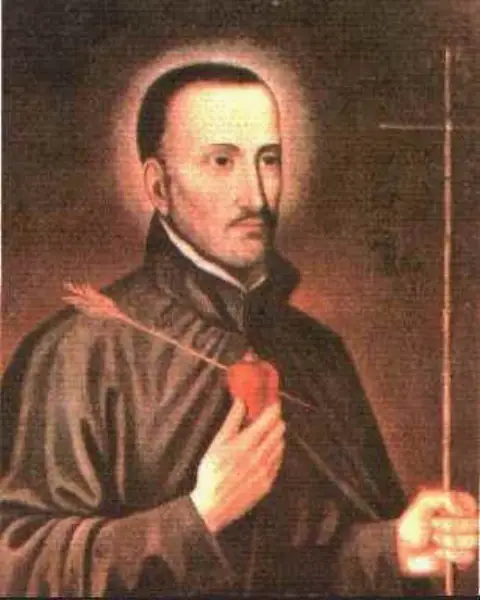
Overview
Roque González y de Santa Cruz was a Jesuit priest of Guaraní and Spanish descent who became the first missionary to work among the Guaraní of Paraguay. Born at Asunción in 1576 to a Spanish conquistador father and a mestiza mother, he grew up speaking both Spanish and Guaraní with ease, a gift that shaped his whole apostolate. Ordained a priest at twenty-three for the diocese of Córdoba, he entered the Society of Jesus in 1609 and carried the reduction system from Paraguay into territory that now lies in Brazil, becoming the first European known to have entered the region of Rio Grande do Sul. Across nearly two decades he founded a chain of mission towns, among them San Ignacio Miní, Itapúa, Concepción de la Sierra Candelaria, Candelaria, and Caaró, winning the confidence of indigenous leaders who feared the missionaries might open their lands to Spanish settlement. His labors stirred the enmity of Nheçu, the chieftain who resisted his mission field. On 15 November 1628, at the mission of Todos los Santos de Caaró, González and his fellow Jesuit Juan del Castillo were killed on Nheçu's orders, and their bodies were burned in the mission church. Beatified by Pius XI in 1934, John Paul II canonized him at Asunción in 1988, making him the first person born in Paraguay ever raised to the altars.
The Complete Life
A Son of Two Worlds
The city of Asunción, where Roque González was born on 17 November 1576, stood at the meeting point of Spanish colonial ambition and the vast Guaraní world. His father, Bartolomé González de Villaverde, was a Spanish conquistador; his mother, María de Santa Cruz, had been born in Asunción herself, the daughter of the Spaniard Juan de Santa Cruz and a Guaraní woman. The family's roots in South America ran deep: both the boy's father and his grandfather had crossed the Atlantic in the fleet commanded by Pedro de Mendoza, the first great Spanish expedition to the Río de la Plata. Because the region held a large native population, the child grew up with Guaraní on his tongue as naturally as Spanish, learning the language of the majority of his neighbors from his earliest years. This double inheritance — European by law and lineage, American by birth and speech — made him a bridge between two peoples long before he chose his life's work. In an age when many colonists regarded the indigenous inhabitants with suspicion or violence, a priest who could pray, negotiate, and preach in Guaraní was a rare figure. That early fluency would prove decisive when, as a missionary, he sought to persuade village leaders that the men in black robes came as friends rather than as the vanguard of conquest.
§ Biography
From Diocesan Priest to Jesuit Missionary
González prepared for the priesthood in the service of the Church on the South American frontier. In 1598, at twenty-three, he received ordination from Bishop Fernando Trexo y Senabria of Córdoba and took up ministry in that diocese. For a decade he worked as a secular priest, but a wider call was forming. In 1609 he entered the Society of Jesus and turned to the missionary life, directing his steps toward the lands beyond the Parana, in what is now Brazil. There he achieved what no European had done before: he was the first European ever to set foot in the territory of the present state of Rio Grande do Sul. His task was to carry north and east the network of Jesuit reductions — organized mission communities — that had already taken shape in Paraguay. It was demanding work among peoples who had no reason to trust the newcomers. González understood that the missionaries were suspected of preparing the ground for Spanish colonists who would seize land and labor. Rather than force his way forward, he built fragile bonds of confidence with the indigenous headmen, quieting their fears before he asked for their welcome. That patient diplomacy, grounded in his fluency and respect, opened the door for the reductions to be planted.
§ Biography
Founder of Reductions
The record of González's missionary career is a chain of foundations strung across the rivers of the Río de la Plata basin. In 1613 he led the establishment of the Reduction of San Ignacio Miní. Two years later, in 1615, he founded Itapúa, on the site of the present city of Posadas in the Argentine province of Misiones; when circumstances demanded, he moved that settlement across the river to the ground where Encarnación now stands. The work continued: Concepción de la Sierra Candelaria in 1619, Candelaria in 1627, and in addition the reductions of San Javier, Yapeyú in what is now Corrientes province, San Nicolás, Asunción del Ijuí, and Caaró, which lies today within Brazil. Each foundation required negotiation, travel, and persistence, for the mission towns stood on land whose peoples watched the priests warily. The gravest opposition came in the region of Iyuí, where the chieftain and sorcerer Nheçu — written Ñezú in Spanish — resisted the spread of the missions and the faith they carried. González did not abandon the field. He kept working among the villages, founding and consolidating, even as Nheçu's hostility hardened. It was in one of his own foundations, at Caaró, that this opposition would finally meet him, but by then the reductions he had planted were already rooted in the Guaraní world.
§ Biography
Martyrdom at Caaró
The end came at the Mission of Todos los Santos de Caaró, one of the communities González had founded in the lands of present-day Brazil. On 15 November 1628 he was busy with a humble piece of practical piety: arranging the hanging of a new bell in the mission church. On the orders of Nheçu, the chieftain who had long opposed the reductions, attackers struck him down and killed him with a tomahawk. His fellow Jesuit, Juan del Castillo, was killed alongside him. The violence did not stop at their deaths. The bodies of the two missionaries were dragged into the church and the building was set on fire, an attempt to erase both the men and the worship they represented. Nor was González the last to die. Two days later, on 17 November 1628, another colleague, Alonso Rodríguez y Olmedo, was murdered by followers of Nheçu, extending the martyrdom to a third priest of the Guaraní missions. González was fifty-one years old, two days short of his fifty-second birthday. He had given nearly twenty years to the founding of mission towns among the Guaraní, and he died not in Asunción, his birthplace, but at the frontier post where his work had carried him, in the company of the brothers with whom he had labored.
§ Biography
Raised to the Altars
Three centuries passed between the martyrdom at Caaró and the Church's formal recognition of it. On 28 January 1934, Pope Pius XI beatified Roque González, together with the companions who had died with him in the same persecution. The cause reached its culmination in the pontificate of John Paul II, who canonized González and his fellow martyrs at Asunción itself — the city of the saint's birth — on 16 May 1988. The ceremony made the missionary the first child of Paraguay ever to be raised to the altars of the Catholic Church, an honor that carried back to his homeland the fruit of his life. In the liturgy he is commemorated on 16 November, joined with the other Martyrs of the Río de la Plata, the band of missionaries who gave their lives in the same mission field. The Church thus honors him in two linked company: with Juan del Castillo and Alonso Rodríguez y Olmedo, who fell within days of him in 1628, and with the wider fellowship of missionary saints. Devotion to him is strongest where he worked and died; the river cities of Posadas in Argentina and Encarnación in Paraguay, both born from foundations he made, claim him as their patron.
§ Veneration
Patron of Two River Cities
The reductions that González founded became the seedbeds of towns that still exist on both sides of the border between Argentina and Paraguay. Posadas, now a provincial capital in Argentina, preserves the memory of Itapúa, which he established in 1615; Encarnación, across the Paraná in Paraguay, occupies the ground to which that settlement was moved. Both cities honor him as their patron, a rare instance of one founder watching over two nations. His canonization in 1988 at Asunción gave Paraguay its first saint, and gave the Guaraní people a champion from among their own descendants, for the missionary's mother was the daughter of a Guaraní woman and he spoke their language from childhood. In the region of Iyuí, where the chieftain Nheçu opposed the missions to the death, the memory of the conflict remains part of the story of the Gospel's arrival. Each year, on 16 November, the Church keeps the feast of the Martyrs of the Río de la Plata, and González stands first among them: the priest who opened the mission field, planted its towns, and was killed in one of them while raising a bell for its church. His life joined the Spanish and Guaraní worlds, and his death sealed that labor.
§ Veneration
Timeline
- 17 Nov 1576
Born at Asunción, son of the conquistador Bartolomé González de Villaverde and María de Santa Cruz.
§ Biography
- 1598
Ordained a priest at the age of twenty-three by Bishop Fernando Trexo y Senabria of Córdoba, for service in that diocese.
§ Biography
- 1609
Entered the Society of Jesus and began missionary work in the region that is now Brazil.
§ Biography
- 1613
Led the founding of the Reduction of San Ignacio Miní.
§ Biography
- 1615
Founded the reduction of Itapúa, later relocated across the river to the site of Encarnación.
§ Biography
- 1619
Founded the reduction of Concepción de la Sierra Candelaria.
§ Biography
- 1627
Founded the reduction of Candelaria.
§ Biography
- 15 Nov 1628
Killed with a tomahawk at the Mission of Todos los Santos de Caaró, together with Juan del Castillo, on the orders of Nheçu.
§ Biography
- 28 Jan 1934
Beatified by Pope Pius XI.
§ Veneration
- 16 May 1988
Canonized by Pope John Paul II at Asunción, becoming the first native of Paraguay declared a saint.
§ Veneration
The Record
- Major works
- Jesuit reductions of San Ignacio Miní, Itapúa, Concepción de la Sierra Candelaria, Candelaria, San Javier, Yapeyú, San Nicolás, Asunción del Ijuí, and Caaró
- Patron of
- Patron of Posadas, Argentina·Patron of Encarnación, Paraguay
- Canonization
- Canonized 16 May 1988 by Pope John Paul II in Asunción; beatified 28 January 1934 by Pope Pius XI
Prayer
Bibliography
Show 5 sources
- "Editora Protexto", www.protexto.com.br, archived from the original on 2018-08-23
- "St. Roque González, SJ (1576-1628)", Ignatian Spirituality, retrieved 2018-08-22
- Ghezzi, Bert. "St. Roque González, SJ (1576-1628)", Voices of the Saints, ISBN 978-0-8294-2806-3
- Clement J. McNaspy, S.J.: Conquistador without Sword. The Life of Roque González, S.J., Chicago, Loyola University Press, 1984, 206pp.
- 'Os Olhos do Pe. Roque' or 'Father Roque's Eyes' (in Portuguese), archived 2018-08-23 at the Wayback Machine
Profile text adapted from the Wikipedia article, licensed CC BY-SA 4.0.
Pray with this saint every day
Save St. Roque González y de Santa Cruz to your favorites, read the full profile, and get feast-day reminders in the Saints app.
Get the Saints AppFree on the App Store for iPhone and iPad