
1130 – 1166·Feast September 4
St. Rosalia
Hermit of Mount Pellegrino and patroness of Palermo
Overview
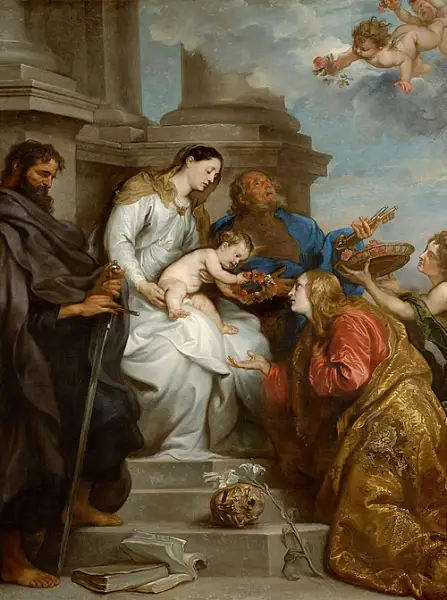
Rosalia, tenderly nicknamed la Santuzza — the Little Saint — first saw the light of day at Palermo in the year 1130, heir to a Norman house whose pedigrees stretched back to Charlemagne. Rejecting the marriage and rank expected of her station, she withdrew as a hermit to a cave on Mount Pellegrino above her native city, where — according to tradition — angels guided her to the spot. She lived there in solitude until her death in 1166, aged about thirty-five, leaving an inscription on the rock dedicating her retreat to Christ. For nearly five centuries her tomb remained unknown. In 1624, while plague devastated Palermo, she was believed to have appeared to a sick woman and a hunter, revealing where her bones lay and directing that they be carried in procession through the city. When the pestilence ceased after the relics had circled Palermo three times, her cult spread with extraordinary speed. A sanctuary rose in her cave, and the Flemish painter Anthony van Dyck, trapped in the quarantined city, fixed her image in a series of canvases that became the standard iconography. Today she is patroness of Palermo and of towns in Venezuela and Sardinia's wider Italian diaspora, invoked especially against plague.
The Complete Life
A Noble Daughter of Norman Sicily
Rosalia was born at Palermo in 1130, six years after her grandfather's generation had completed the Norman conquest of Sicily and only months into the reign that would make the island a kingdom under Roger II. Her family belonged to the Norman aristocracy that had come south with the conquerors, and it cherished a pedigree reaching back to Charlemagne himself. The Sicily of her childhood was unlike any other Christian land: under the new kingdom, Greeks of the Byzantine rite, Latin Christians, Muslims, and Jews lived and worked side by side in a Mediterranean capital whose ties ran to Europe, North Africa, and Byzantium alike. Into that cosmopolitan court world a daughter of the Norman houses was expected to bring advantages: a strategic marriage, the management of a household, children to carry the line forward. Rosalia's birth gave her every worldly claim on wealth and standing. It was precisely against that inheritance of expectation that her life would define itself, choosing the eremitic poverty of the desert tradition over the privileges of the conquering race that had settled her island.
§ Norman Sicily and Religious Diversity
The Cave on Mount Pellegrino
Rosalia turned her back on the career her station prescribed and withdrew to a cave on Mount Pellegrino, the great peak that rises over Palermo and its harbour. Tradition embellishes the retreat with its tenderest detail: two angels led her to the place. There she lived as a solitary, in the pattern of the hermits whose ideals of sacrifice, humility, and separation from the world medieval spirituality prized above almost everything else. Her choice was not a private eccentricity but part of a broader movement of the age, in which noblewomen across Europe abandoned wealth and family position to devote themselves wholly to God. Before she died, an inscription on the rock proclaimed who she was and why she had come: a daughter of Sinibald, lord of delle Rose and Quisquina, resolved to live in the cave for the love of her Lord Jesus Christ. In 1166, aged about thirty-five, she died as she had chosen to live, alone on the mountain with the city she had renounced spread out below her — and had never ceased to hold in her heart.
§ Life
The Bones That Ended the Plague
For more than four and a half centuries Rosalia lay forgotten in her cave. In 1624 the plague fell upon Palermo, and in the city's extremity she was believed to intervene. First a sick woman, then a hunter, received apparitions of the hermit: she showed the hunter where her remains lay on the mountain and commanded that her bones be brought down and borne in procession through the stricken streets. The hunter climbed Mount Pellegrino and found the cave exactly as described. Once the relics had made three circuits of the stricken streets, the pestilence came to an end. The effect on Palermo was decisive; the spread of her popular cult across Italy in the wake of the epidemic was one of the great devotional expansions of the seventeenth century. Venerated as patroness of the city, Rosalia received a sanctuary built in the very cave where the remains had been found. The episode fixed forever her identity as the protector who saves Palermo from pestilence, a role her citizens renewed when they invoked her again during the COVID-19 pandemic of 2020.
§ 1624 plague
From van Dyck to Bensonhurst and Beyond
The image of Rosalia that the world knows was largely created by Anthony van Dyck, stranded in Palermo by the quarantine of 1624–1625. His five canvases of the saint — a young woman with flowing fair hair in a Franciscan cowl, bending from heaven toward the endangered city — became the standard iconography, and further paintings of 1629, made for the Jesuits, carried her cult far beyond Sicily. In Palermo her great feast, the Festino, fills the streets each July and continues into the next day, while on September 4 pilgrims walk barefoot from the city up to her sanctuary on the mountain. Her devotion has crossed oceans: it flourishes among the Tamil community of Sri Lankan origin now settled in Palermo, draws crowds each summer to Bensonhurst in Brooklyn, and honours her as patroness of the Italian sardine fleet of Monterey, California, as of towns in Venezuela and Chihuahua. Some Orthodox faithful venerate her as well. In an unexpected afterlife, the ecologist G. E. Hutchinson proposed her as patron of evolutionary studies after meditating on a rock pool below her cave — a final tribute from science to the Little Saint.
§ Veneration
Timeline
- 1130
Rosalia is born at Palermo into a Norman noble family claiming descent from Charlemagne.
§ Life
- 1166
Rosalia dies alone in her cave on Mount Pellegrino above Palermo, aged about thirty-five.
§ Life
- 1624
Plague strikes Palermo; Rosalia is believed to appear to a sick woman and a hunter, revealing the location of her remains.
§ 1624 plague
- 1624
Her bones are found in the cave and carried in procession three times around Palermo, after which the plague ceases.
§ 1624 plague
- 1624
Trapped in Palermo by the quarantine, Anthony van Dyck paints five images of Rosalia that set the standard iconography of the saint.
§ In art
- 1629
Van Dyck produces further paintings of Rosalia to aid Jesuit efforts to spread her devotion beyond Sicily.
§ In art
- 1629
Cornelis Galle the Elder publishes in Antwerp an illustrated life of Rosalia engraved after van Dyck's designs.
§ In art
- 1 May 1959
The ecologist G. E. Hutchinson proposes Rosalia as patron saint of evolutionary studies in The American Naturalist.
§ In biology
- Mar 2020
During the COVID-19 pandemic, citizens of Palermo invoke Rosalia to protect the city from the virus.
§ Saint Rosalia
In Their Own Words
I, Rosalia, daughter of Sinibald, Lord of [Monte] delle Rose, and Quisquina, have taken the resolution to live in this cave for the love of my Lord, Jesus Christ.
The Record
- Major works
- Sanctuary of Santa Rosalia, built in her cave on Mount Pellegrino
- Patron of
- Palermo·against plague and infectious disease·Camargo, Chihuahua·El Hatillo, Miranda·Zuata, Anzoátegui·El Playón, Portuguesa·El Alto de Escuque, Trujillo·Italian fishermen of Monterey, California·evolutionary biology
- Symbols
- cross·book·skull·spray of lilies·chisel and hammer·crown of roses·winged angels·cave opening of Palermo harbour
- Canonization
- Pre-congregation; her cult was firmly established after the translation of her relics during the plague of 1624
Prayer
Bibliography
Show 8 sources
- Stracke, Richard (20 October 2015). "Rosalia of Palermo". Christian Iconography.
- Tondo, Lorenzo (13 March 2020). "Palermo pins hopes on patron saint to rid Italy of coronavirus". The Guardian.
- "St. Rosalia". Catholic Online. Retrieved 12 July 2018.
- Bailey, Gauvin Alexander (1 March 2012). "Van Dyck in Sicily". Apollo. 175 (596): 116-122.
- Loud, G. A.; Metcalfe, Alex, eds. (2002). The Society of Norman Italy. The Medieval Mediterranean. Leiden Boston: BRILL. ISBN 978-90-474-0146-9.
- Salerno, Rossana M. (18 January 2024). "Internal Secularisation at the Festival of Saint Rosalia". Religions. 15 (1): 126. doi:10.3390/rel15010126. ISSN 2077-1444.
- Hutchinson, G. E. (1 May 1959). "Homage to Santa Rosalia or Why Are There So Many Kinds of Animals?". The American Naturalist. 93 (870): 145-159. doi:10.1086/282070.
- Farago, Jason (26 March 2020). "The Saint Who Stopped an Epidemic Is on Lockdown at the Met". The New York Times.
Profile text adapted from the Wikipedia article, licensed CC BY-SA 4.0.
Pray with this saint every day
Save St. Rosalia to your favorites, read the full profile, and get feast-day reminders in the Saints app.
Get the Saints AppFree on the App Store for iPhone and iPad