
1586-1617·Feast August 23
St. Rose of Lima
Virgin, First Saint of the Americas
Overview
Isabel Flores de Oliva was born at Lima on 20 April 1586, daughter of a Spanish harquebusier and his criolla wife, one of eleven children. A servant's story that the infant's face had turned into a rose gave her the name she made official at confirmation in 1597, administered by the future saint Archbishop Toribio de Mogrovejo. Taking Catherine of Siena as her model, she fasted three days a week in secret as a girl; admired for her looks, she cut her hair and rubbed peppers into her face to discourage suitors, and held out against her parents' marriage plans until her father gave her a room of her own. From it she cared for the sick and hungry she brought home, and supported both family and the poor with her needlework, lace, embroidery, and garden flowers. Barred from the convent by her father, she received instead the habit of a Dominican tertiary at about twenty and vowed perpetual virginity; she wore a silver crown studded with spikes inside, after Christ's crown of thorns, and allowed herself barely two hours' sleep. Eleven years of that life ended in a long illness; she died on 24 August 1617, thirty-one years old, having foretold the day. Clement X canonized her in 1671.
The Complete Life
Early Life
Isabel Flores de Oliva was born on 20 April 1586 in Lima, the capital of the Viceroyalty of Peru, into the Spanish colonial society of the Pacific coast. Her father Gaspar Flores was a harquebusier of the imperial army, an immigrant from Extremadura whose family had passed through Puerto Rico; her mother Maria de Oliva was a criolla, Lima-born of Spanish descent. Isabel was one of eleven children raised in the straitened household of a soldier's pay. The nickname that replaced her name came from infancy: a servant claimed to see her face transformed into a rose, and in 1597, when the archbishop of Lima, Toribio de Mogrovejo, himself a future saint, confirmed her, she formally took the name Rosa. She grew up in a city full of religious energy, the Lima of the great generation, Toribio, Martin de Porres, the Dominican and Franciscan houses, and the girls of her class commonly took the path of the Third Order.
§ Biography
Conversion and Vocation
From childhood Rosa modeled herself on Catherine of Siena, the Dominican tertiary of Siena, whose life she knew through the devout literature of the period. As a girl she began fasting three times a week and performing severe penances in secret; when her beauty began to draw admiration she cut off her hair and disfigured her face with peppers to be free of it. She rejected every suitor against the insistence of family and friends, and her parents' determination to see her married made the household a long contest of wills. Her desire was the cloister, and her father forbade it; the compromise, when it came, was the family house itself. Her father at last gave her a room of her own, and in her twentieth year Rosa took the habit of a tertiary of the Order of Saint Dominic and vowed perpetual virginity, a nun of the household, in the pattern of Catherine, whose way she had chosen as her own.
§ Biography
Mission and Ministry
Rosa's ministry was conducted from a room and a garden. She supported the family by her needlework, by lace and embroidery, and by the flowers she grew and sold in the market, and she spent what she gained on the poor, bringing the sick and hungry into her own room to care for them, Indians and Spaniards alike, at a time when the colonial city kept them apart. She built a hermitage in the garden where she prayed, and her life became reclusive, leaving the house mainly for church. Within that narrow compass her influence grew: the Dominicans of Lima recognized her, the sick sought her, and her direction of consciences, by letter and in person, made her a center of the city's spiritual life. She is remembered as the first flower of sanctity produced by the Americas, and the first canonized saint of the New World.
§ Veneration
Spirituality and Teaching
Rosa's spirituality was penitential, Dominican in its structure, and entirely concentrated on the Eucharist. She received communion daily, a practice so rare in her time that it marked her out, and she spent hours in adoration before the Blessed Sacrament. Her austerities were extreme even by the measure of her century: she slept at most two hours a night, on a bed of broken pottery and cinders in the later years, and wore a silver crown set with inward-pointing spikes in emulation of the crown of thorns. Modern readers have found these practices difficult, and her biographers have not denied their harshness, but they record too the practical charity that ran beside them and the levelheadedness of her counsel. Her last words, tradition holds, were a prayer that the Lord would let her have him at last, and her one recorded political intervention, a warning of divine chastisement on the city for its sins, belongs to the prophetic side of her character that Lima both feared and revered.
§ Further reading
Trial and Final Years
Rosa's body, weakened by eleven years of that regimen, failed over a long final illness, during which the whole city came to know of the recluse of the garden. She died on 24 August 1617, thirty-one years old, having, as it was said, foretold the date of her own death. Her funeral, in the cathedral of Lima, drew all the public authorities of the viceroyalty, an extraordinary tribute to a young woman of the artisan class, and the crowd pressed about her body for relics. The viceroy himself is said to have put his hand to the coffin.
§ Introduction
Canonization
Rosa's cause moved with the speed the colonial church reserved for its most obvious cases: she was beatified by Pope Clement IX in 1667, and canonized by Pope Clement X on 12 April 1671, fifty-four years after her death, the first canonized saint of the Americas. The universal calendar received her feast on 23 August, formerly 30 August in the traditional calendar. She was named patroness of Lima and of the New World, of the Philippines, and of the Indies, and later of Peru's police and of the Peruvian army, a comprehensive patronage that made her the Marian-like protective figure of the Spanish colonial world.
§ Introduction
Legacy
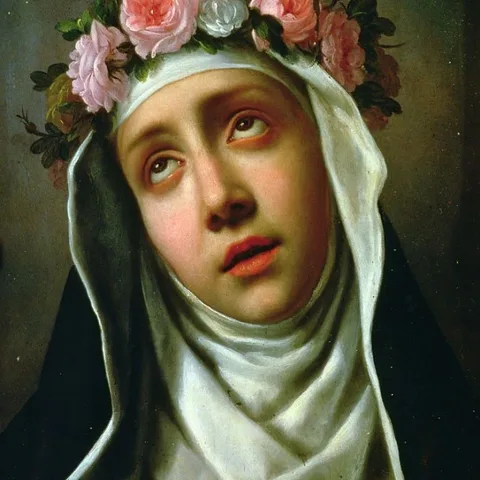
Rosa of Lima's legacy runs through the whole Catholic world of Spanish inheritance. She is the first saint of the Americas, the beginning of the New World's own calendar, and every Latin American devotion that followed, from Martin de Porres to the Mexican martyrs, has been counted from her. The city of Lima keeps her shrine at the house of her birth and death, and her image, crowned with roses, is carried in procession each August. Thousands of churches, towns, and girls across Latin America and the Philippines bear her name. In art she is shown as a Dominican tertiary with roses, sometimes with the Christ child, and in Peru her cult shades into the national identity itself. Her austerity has been re-read in each generation, as fanaticism, as protest, as mysticism, but the fact that endures beneath the readings is the one her contemporaries attested: that Lima buried a young woman whom the whole city, from viceroy to beggar, had come to regard as its intercessor with heaven.
§ Introduction
Timeline
- 20 Apr 1586
Born Isabel Flores de Oliva at Lima in the Viceroyalty of Peru
§ Introduction
- 1597
Confirmed by Archbishop Toribio de Mogrovejo and formally takes the name Rose
§ Biography
- 1606
In her twentieth year, dons the habit of a Dominican tertiary and vows perpetual virginity
§ Biography
- 24 Aug 1617
Dies at Lima aged thirty-one after a long illness
§ Biography
- 10 May 1667
Beatified in Rome by Pope Clement IX
§ Veneration
- 12 Apr 1671
Canonized by Pope Clement X; no one born in the Americas had yet been raised to the altars
§ Introduction
- 1729
Her feast is inserted into the General Roman Calendar, kept initially on 30 August
§ Veneration
- 1969
Paul VI's calendar revision moves her worldwide feast to 23 August
§ Veneration
In Their Own Words
Apart from the cross there is no other ladder by which we may get to heaven.
The Record
- Patron of
- Peru·Latin America·Indigenous peoples of the Americas·The Philippines (co-patroness)·Lima·Embroiderers and lacemakers·Gardeners and florists·People ridiculed or misunderstood for their piety·Against vanity
- Symbols
- Dominican tertiary habit·Roses·Spiked silver crown·Anchor·The Infant Jesus
- Canonization
- Beatified by Pope Clement IX in 1667; canonized by Pope Clement X on 12 April 1671 — the first person born in the Americas to be canonized
Prayer
Bibliography
Show 11 sources
- 1 2 3 4 5 Marques, Luis Carlos L. (2000). "Rose de Lima". In Leonardi, C.; Riccardi, A.; Zarri, G. (eds.). Diccionario de los santos (in Spanish). Vol. II. Madrid, Spain: San Pablo. pp. 2003– 2006. ISBN 84-285-2259-6 .
- 1 2 (translation) \"...I, Clement, (..) proclaim Blessed Rosa de Santa Maria as the principal patroness of each and every province, country, island and area of the entire land of the Americas, the Philippines and the Indies, with the same p
- 1 2 3 4 "CATHOLIC ENCYCLOPEDIA: St. Rose of Lima" . newadvent.org .
- ↑ Familia Dominicana. VOL. I: Nueve personajes históricos (in Spanish). Editorial San Esteban. 1983. p. 201. ISBN 9788471881496 . Retrieved 31 August 2022 .
- 1 2 3 del Busto, José Antonio (2020). Santa Rosa de Lima . Fondo Editorial de la PUCP. ISBN 9786123175177 . Retrieved 31 August 2022 .
- 1 2 3 "St. Mark - Saint of the Day - AmericanCatholic.org" . americancatholic.org .
- ↑ Mills, Kenneth & Taylor, William B. Eds. "Colonial Latin America: A Documentary History".(2002) Oxford: SR Books. Page 205.
- ↑ Calendarium Romanum (Libreria Editrice Vaticana 1969), p. 101
- ↑ Hansen, Leonardus (1664). Vita Mirabilis et Mors Pretiosa Venerabilis Sororis Rosæ de S. Maria Limensis, ex Tertio Ordine S. P. Dominici ac Sanctissimum d. N. Alexandrum VII. Pontificem Max. Excerpta & collecta Per P. M. F. Leonardum Hans
- ↑ "Downtown Sacramento Partnership" .
- ↑ "Roman Catholic Diocese of Sacramento – History & Archives" . diocese-sacramento.org . Archived from the original on 31 January 2008.
Profile text adapted from the Wikipedia article, licensed CC BY-SA 4.0.
Pray with this saint every day
Save St. Rose of Lima to your favorites, read the full profile, and get feast-day reminders in the Saints app.
Get the Saints AppFree on the App Store for iPhone and iPad