
c. 1233 – 1251·Feast September 4
St. Rose of Viterbo
Child preacher and virgin of the Third Order
Overview
Rose of Viterbo was a young Franciscan tertiary of the thirteenth century whose short life was spent in prayer, penance, and public preaching for the papal cause. Born near 1233 at Viterbo, a commune of the Papal States bitterly contested in her day and ruled by the emperor Frederick II, she came of poor and devout parents and showed from childhood a hunger for prayer and care for the poor. Before she was ten, she is said to have received from the Blessed Virgin the command to clothe herself in the Franciscan Third Order habit and preach penance through the city. Living as a recluse in her father's house, she would periodically come forth to urge repentance on the crowds. In 1250, when Viterbo was in revolt against the pope, the twelve-year-old preached openly for the Guelph cause and was exiled with her family to Soriano nel Cimino, returning once the papal faction recovered the city. She foretold the death of Frederick II in December 1250 and reportedly endured three hours amid the flames of a pyre at Vitorchiano without injury, winning over its people. Refused entry to the Poor Clares for lack of a dowry, she died in her father's home on 6 March 1251, aged about seventeen. Canonized in 1457, she remains the cherished patron figure of Viterbo.
The Complete Life
A Child of Poor and Pious Parents
Rose was born at Viterbo around 1233, in an era when the chronology of her life is difficult to fix with precision: the acts of her canonization, which are the chief historical sources, record no dates, and most scholars can only place her birth near 1233. Her family was poor, but marked by devotion, and the girl grew up with an unusual hunger for prayer and for helping those poorer than herself. She prayed constantly for the conversion of sinners, a concern that would define her public message. Before she had reached her tenth year, tradition holds that the Blessed Virgin Mary appeared to direct her along a decisive path: she was to clothe herself in the habit of Francis's Third Order and preach penance through Viterbo, a city that at that moment lay under the rule of Frederick II, the Holy Roman Emperor whose long conflict with the papacy set the whole region ablaze. That a child should receive such a commission and carry it out made her story singular from the start. The Franciscan habit given to a girl of the poor quarters of Viterbo announced the two loyalties of her life: the Poverello of Assisi and the papal cause his order defended.
§ Life
Recluse and Penitent
Rose did not become a wandering preacher in the ordinary sense. Her life took the shape of a recluse's vocation: she dwelt in prayer, penance, and solitude within her father's house, following a contemplative rhythm behind the walls of the family home. Yet the solitude was repeatedly interrupted by the call she had received. From time to time she emerged from her retreat to entreat the people of the city to do penance, and her brief public appearances carried the weight of prophecy. Her mission of preaching lasted approximately two years, a short span that coincided with the deepest crisis of Viterbo's political and religious allegiance. The combination — a cloistered discipline joined to sudden, fiery public utterance — gave her ministry its distinctive character. She embodied the penance she preached, living austere and hidden, and then delivered the message in the streets when the moment demanded it. Those who saw her appear from her seclusion to denounce sin and summon the city to repentance understood that a force beyond her years was at work. In an age when women rarely preached at all, and children never, the sight of a twelve-year-old tertiary admonishing a rebellious city made her an instrument of the papal party that no one could ignore or easily refute.
§ Life
Preacher in a Rebellious City
The crisis came to a head in January 1250. Viterbo, Rose's native city, had risen in revolt against the pope, and the twelve-year-old began preaching a message in the streets aligned with the Guelph aspirations — that is, against the emperor Frederick's dominion over Viterbo. The courage of the child and her effectiveness as a voice of the papal party provoked a stern reaction: she and her family were driven out of the city and found refuge at Soriano nel Cimino. Her exile ended when Pope Innocent IV's faction regained control of Viterbo by 1250–1251, and Rose was permitted to return. In December of that turbulent year she delivered her most famous prophecy: she announced the emperor's approaching death, a word fulfilled barely a week later, on 13 December, when Frederick II died. Soon afterward she journeyed to Vitorchiano, a town whose inhabitants, according to the surviving reports, had fallen under the influence of a supposed sorceress. There she stepped into a pyre's flames and stood unharmed for three hours, by which ordeal she won the conversion of the whole population — the sorceress included. The episode became the most celebrated image of her legend, depicted in glass and paint for centuries afterward as the girl who defied the fire.
§ Life
Prayer, Penance, and a Closed Door
The inner shape of Rose's sanctity was penitential. Her life of prayer, mortification, and solitude in her father's house followed the spirit of the Third Order of St. Francis, whose habit she wore from childhood, and her preaching was always an appeal to penance before it was an argument about politics. She interceded tirelessly for the conversion of sinners, and her dramatic interventions — the prophecy of the emperor's death, the ordeal by fire at Vitorchiano — belong to the same single purpose: to turn hearts back to God. Near the end of her short life she sought to deepen her consecration by entering the Poor Clares of Saint Mary in Viterbo. The community refused her, because her poverty left her unable to provide the dowry that admission required. Her response to the closed door became one of the most touching episodes of her story: she accepted the rejection without bitterness, and foretold that she would enter the monastery after her death. The prediction proved true in a way the sisters could not have foreseen, for her body would one day be carried into that very house and the monastery renamed in her honor. The girl whom the cloister had turned away became its inseparable companion in death, and its name ever after.
§ Life
Death at Seventeen
Rose died on 6 March 1251, in her father's home at Viterbo, still in her teens — she can have been no more than seventeen or eighteen years old. The city for which she had preached, suffered exile, and worked wonders kept her memory from the day of her burial. For centuries it was believed that she had died of tuberculosis, the classic killer of the young in crowded medieval towns, and that diagnosis entered her legend as a final note of frailty: the girl of the burning pyre consumed from within by disease. Modern science revised the picture. In 2010, researchers examining her remains concluded that she had in fact died of complications arising from Pentalogy of Cantrell, a rare congenital condition, a finding that showed how extraordinary her two years of public preaching had been, undertaken with a body marked from birth by serious malformation. She was buried first in the small parish church of Santa Maria in Poggio, in the Piazza della Crocetta in central Viterbo, a modest resting place for one whose fame already filled the city. The movement toward her canonization began immediately, opened by Pope Innocent IV in the very year of her death — an unusual speed that testifies to how strongly her sanctity was felt by those who had known her.
§ Life
From Parish Grave to the Altars
The process of Rose's canonization was opened in 1251 by Pope Innocent IV, though the definitive undertaking did not come until 1457, when Pope Callistus III enrolled her among the saints. Between those two dates, the veneration of the city of Viterbo grew around her tomb. Originally buried in the parish church of Santa Maria in Poggio, she was honored by a papal gesture within a few years of her death: in 1257 Pope Alexander IV ordered her remains translated to the monastery of the Poor Clares that she had longed to enter and been refused, a house only a few hundred meters from her first grave. At that moment the monastery was renamed in her honor, fulfilling in reverse her own prophecy that she would enter it after death. The liturgical calendar of the Roman Catholic Church, reformed after the Second Vatican Council, assigned her feast to the date of her death in March, but the date actually celebrated in Viterbo and by the Franciscans is 4 September — the anniversary of the day her relics were carried to the Monastery of St. Damian. The mismatch between universal calendar and local devotion is itself a monument to her story: the city's feasting on her September day keeps alive the memory of the 1258 exhumation that began it all.
§ Veneration
The Machine of Saint Rose
No saint of medieval Italy is commemorated by a more spectacular annual rite than Rose of Viterbo. On the eve of her feast, 3 September, the people of the city accompany La Macchina — the Machine of Saint Rose — a towering structure 28 meters tall, glowing with three thousand small electric lights and 880 candles, her statue at its crown, borne 1,200 meters through the darkened medieval streets on the shoulders of about 100 volunteers known as facchini. The tradition reaches back to 4 September 1258, when the saint's body was exhumed and carried to the Monastery of Saint Damian; the machine itself first appeared in 1664, after the city had survived seven years of plague, when the citizens voted in gratitude to renew her veneration every year. Her cult crossed the ocean as well. St. Rose of Viterbo Convent in La Crosse, Wisconsin, motherhouse of the Franciscan Sisters of Perpetual Adoration, bears her name and is listed on the National Register of Historic Places, and those sisters founded Viterbo University, a Catholic Franciscan liberal arts institution in the same city. In contemporary culture she figures among the religious subjects of Erik Ehn's award-winning series of saint plays, the drama of her life premiering at Goshen College in October 2008 — the child preacher of Viterbo still commanding the stage seven and a half centuries after her death.
§ Veneration
Timeline
- 1233
Born at Viterbo, then a contested commune of the Papal States, to poor and pious parents.
§ Life
- Jan 1250
As Viterbo stood in revolt against the pope, began preaching in the streets at about age twelve for the Guelph cause against Emperor Frederick II's rule.
§ Life
- 1250
Exiled from Viterbo with her family, taking refuge at Soriano nel Cimino.
§ Life
- 5 Dec 1250
Foretold the speedy death of Emperor Frederick II.
§ Life
- 13 Dec 1250
Her prophecy was fulfilled with the death of the emperor.
§ Life
- 6 Mar 1251
Died in her father's home at Viterbo, aged about seventeen.
§ Life
- 1251
Pope Innocent IV opened the process of her canonization in the year of her death.
§ Veneration
- 1257
Pope Alexander IV ordered her remains moved to the monastery she had wished to enter, which was renamed in her honor.
§ Veneration
- 4 Sep 1258
Her body was exhumed and carried to the Monastery of Saint Damian, the origin of the city's annual September feast.
§ Veneration
- 1457
Canonized by Pope Callistus III.
§ Veneration
- 1664
After seven years of plague, the citizens of Viterbo voted to renew her veneration annually, and the first Macchina appeared.
§ Veneration
- Oct 2008
A play celebrating her life premiered at Goshen College in Erik Ehn's saint-play series.
§ Veneration
The Record
- Symbols
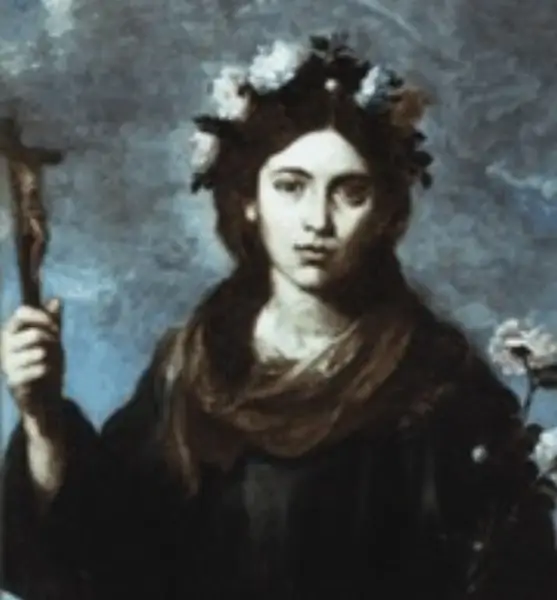
- Crown of roses·Crucifix
- Canonization
- Canonized 1457 by Pope Callistus III; her cause was opened the year of her death by Pope Innocent IV
Prayer
Bibliography
Show 10 sources
- Cleary, Gregory. "St. Rose of Viterbo", Catholic Encyclopedia, retrieved 6 October 2016
- Foley, Leonard, OFM; McCloskey, Pat, OFM, rev. (2009). "St. Rose of Viterbo", Saint of the Day, Lives, Lessons, and Feast, Franciscan Media, ISBN 978-0-86716-887-7
- Habig, Marion (1959). The Franciscan Book of Saints, Franciscan Herald Press
- "St. Rose of Viterbo", FaithND, University of Notre Dame
- Pinzi, Cesare (1889). Storia della città di Viterbo lungo il medioevo, Volume 2, page 24
- D'Anastasio, Ruggero, PhD, et al. (19 June 2010). "The Heart of Santa Rosa", The Lancet, 375 (9732): 2168, doi:10.1016/s0140-6736(09)60729-7, PMID 20541795
- "Il Monastero", Monastero Sanctuario Clarisse di Santa Rosa
- ANDREUCCI, Andrea Girolano. Notizie Critico-Istoriche Dell'Ammirabile S. Rosa Virgine Viterbese, Roma, 1750
- DE KERVAL, Leon. Saint Rose: sa vie et son temps, Paris, 1896
- PIACENTINI, Ernesto (O.F.M). Il libro dei Miracoli di Santa Rosa da Viterbo, Roma, 1991
Profile text adapted from the Wikipedia article, licensed CC BY-SA 4.0.
Pray with this saint every day
Save St. Rose of Viterbo to your favorites, read the full profile, and get feast-day reminders in the Saints app.
Get the Saints AppFree on the App Store for iPhone and iPad