
1769 – 1852·Feast November 18
St. Rose Philippine Duchesne
Missionary educator of the American frontier
Overview
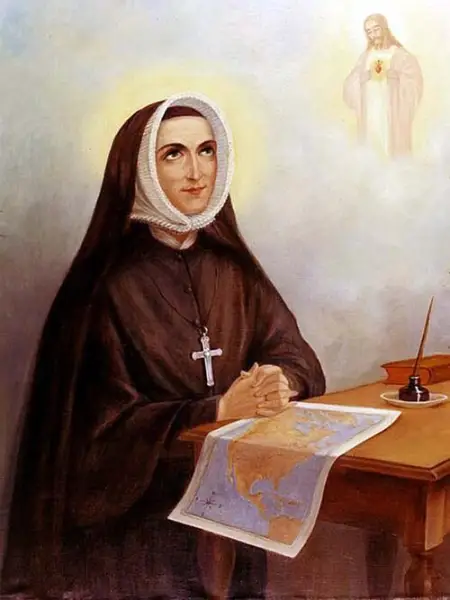
Rose Philippine Duchesne was a French religious sister of the Society of the Sacred Heart who carried her congregation across the Atlantic and became one of the great educators of the American frontier. Born in Grenoble in 1769 to a prominent lawyer and the sister of an industrialist, she entered the Visitation convent of Sainte-Marie-d'en-Haut in 1788 against her family's wishes, only to see the French Revolution scatter the community. Through the Terror she nursed prisoners, taught children, and kept Catholic ministry alive at personal risk. In 1804 she met Madeleine-Sophie Barat, founder of the Society of the Sacred Heart, and merged her struggling community into the new congregation; in 1815 she established the society's Paris convent. In 1818 she sailed for the United States with four companions and founded, in a log cabin at St. Charles in the Missouri Territory, the first free school west of the Mississippi River. Over the following decades she planted Sacred Heart houses in Florissant, Grand Coteau, and St. Louis. In 1841, at seventy-one, she joined the Jesuit mission to the Potawatomi in Kansas, where her constant prayer earned her the name Woman Who Prays Always. She spent her last decade in a tiny cell at St. Charles, dying there on 18 November 1852. She was canonized in 1988.
The Complete Life
A Lawyer's Daughter in Grenoble
Rose Philippine Duchesne was born on 29 August 1769 at Grenoble, in the Dauphiné region of the Kingdom of France, into a household of comfortable standing. Her father, Pierre-François Duchesne, was a prominent lawyer noted for his role at the Day of the Tiles, the uprising that marked the coming revolution in that city; her mother, Rose-Euphrosine Périer, belonged to a family of industrialists and lived with her husband in her parents' home across from the Palace of Justice, where her brother Claude Périer and his wife occupied a separate floor. Philippine was the second of seven daughters; a single brother completed the family of eight children. As a child she survived an attack of smallpox that left her slightly scarred for life. At twelve, in 1781, her parents sent her to board at the school of the Monastery of Sainte-Marie-d'en-Haut near Grenoble, conducted by the Order of the Visitation of Holy Mary. The girl soon felt drawn to the Visitation life itself. Her father disapproved, and in 1782 he removed her from the school to be educated at home by tutors. In those same years the parish church of the family was occasionally visited by priests returned from mission service among the Native American peoples of the former French colony of Louisiana, and their stories planted in her the desire that would govern her whole life: to minister to those distant peoples.
§ Early life
Revolution and the Ruined Cloister
Her family tried to close every door to the convent, arranging a marriage for her when she was seventeen, but the vocation survived their schemes. In 1788, at nineteen, she deceived her way in: she persuaded an aunt to accompany her on what was presented as a short visit to Sainte-Marie-d'en-Haut, and upon arrival she asked at once to be received into the Visitation Order. The nuns granted her request; the aunt went home to Grenoble alone. For three years Philippine lived the cloistered life she had chosen. Then history broke in. The French Revolution, beginning in 1789, moved against the Church: property was seized and Catholic institutions were shut. In 1791 or 1792 the monastery itself was closed and its buildings turned into a prison and barracks, and Duchesne fell back on her family's country home near Grenoble. The Reign of Terror of 1793 brought imprisonment and execution to priests and religious throughout France, and throughout that decade she did the work of a religious without a house: nursing prisoners held at the former monastery, feeding and teaching children, and carrying ministry to Catholics at constant personal danger. When Napoleon's rise ended the persecution, she returned in 1801 to the ruined monastery, opened a boarding school there, and was left as superior of a congregation of three.
§ Monastery of the Visitation
The Remotest Village in the United States
The meeting that changed her life came in 1804, when Madeleine-Sophie Barat, founder of the Society of the Sacred Heart, traveled to Grenoble and offered to absorb Duchesne's struggling community into the new congregation. Duchesne accepted, and the two women formed a friendship that lasted their lives. In 1815 Barat set her the task of founding a house in Paris; in 1817 the visiting Bishop Louis DuBourg of Louisiana and the Two Floridas gave her the chance of the mission field she had desired since girlhood. In 1818, with Barat's blessing, she sailed on the Rebecca with four companions — a voyage of ten weeks that included a refusal of entry at Havana and an encounter with an Argentine pirate ship that let the American vessel pass. From New Orleans the sisters went by paddle steamer up the Mississippi to St. Charles, a village of the Missouri Territory that DuBourg called the remotest in the United States. In a log cabin they nicknamed the Duquette Mansion they founded their convent, and beside it the first free school west of the Mississippi River. In 1819 DuBourg moved them across the Missouri to Florissant, and in 1821 Duchesne opened a convent and novitiate at Grand Coteau, Louisiana. Here she also confronted a moral horror her French formation had never met: slavery, lawful in Missouri, which she deplored even as her house was drawn into it.
§ Missouri Territory
Woman Who Prays Always
Duchesne's spirituality was formed in the cloister of the Visitation and matured in the active, uncloistered life of the Sacred Heart, but its constant element was prayer. The proof came at the end of her active life. In 1841 the Jesuit Pierre-Jean De Smet invited the Society of the Sacred Heart to join a new mission to the Potawatomi near present-day Mound City, Kansas, among the survivors of the United States' Indian removals. The Jesuits initially left Duchesne out — she was seventy-one — until the priest Peter Verhaegen insisted on her inclusion with a sentence that became famous: she could contribute little labor, yet her prayers alone would guarantee the mission's success. He judged her correctly. At the mission she tried to learn the Potawatomi language and could not master it well enough to teach. So she prayed — long hours in the chapel while the others labored — and the Potawatomi children, watching her, gave her the name by which history knows her there: Quahkahkanumad, Woman Who Prays Always. De Smet's tales of the Rocky Mountains stirred in her a desire to see them, but her health failed, and in 1842, after a year among the Potawatomi, she returned to St. Charles. The apostolate of her final decade would be the one Verhaegen had named: intercession.
§ Kansas
The Cell Beneath the Stair
Duchesne passed the last ten years of her life at the Sacred Heart Convent in St. Charles, the settlement where her American work had begun in 1818. Her lodging was a cramped cell beneath a staircase beside the chapel, and there she passed her days in solitude and prayer, rising through old age, blindness, and increasing bodily weakness to keep the vigil that had become her ministry. Her letters from these years are stripped and honest. She wished for letters from her old friend Barat; she wished for travel she could no longer make; and above all she could not stop thinking of the Native peoples she had served so briefly. Writing of her days, she described a life of solitude given to reviewing what had been and readying herself for death, and confessed that she could not put away the thought of the Indians — that in her ambition she flew to the Rockies. In 1842 the society had opened its first Canadian mission at Montreal, an extension of the work she had planted. She died at the convent in St. Charles on 18 November 1852, at the age of eighty-three, and was buried in the convent cemetery. The missionary who had crossed an ocean ended as she had lived: close to the chapel, in prayer, with the frontier on her mind.
§ Final years and death
From Cause to Canonization
The road to her canonization was long even by the standards of the Roman causes. The process was introduced in 1895, and in 1909 Pope Pius X declared her Venerable. On 12 May 1940 Pope Pius XII beatified her at Vatican City, and the cause for canonization formally opened on 9 April 1943. In 1951 the Vatican directed the Society of the Sacred Heart to build a worthier shrine for her remains at St. Charles; the new shrine was completed that summer, and her remains, which since 1855 had rested at a modest shrine on the Academy of the Sacred Heart's grounds, were lifted and carried to the new Shrine of Saint Rose Philippine Duchesne. The miracle that would carry her to the altars had occurred that same year, when Marie-Bernard, a Sacred Heart sister with an inoperable malignant tumor on her neck, recovered after praying to Duchesne. The Vatican first rejected the case, and the cause lay dormant. In 1986 Pope John Paul II, preparing for a trip to the United States, asked Archbishop John L. May for a candidate for canonization; the Bernard case was reexamined and judged a true miracle, and despite initial hesitation within the order, the leadership of its United States Province gave support. On 3 July 1988 Pope John Paul II canonized her in Rome.
§ Canonization
Schools, Shrines, and a Reckoning
Duchesne's memory endures above all in education. Schools and colleges across the United States and beyond bear her name: Duchesne Academies in Houston and Omaha, Duchesne High Schools in St. Charles and in Utah, Duchesne Primary School in Florissant, Villa Duchesne in St. Louis, and a university in Pittsburgh founded in the Sacred Heart tradition, together with schools in Salt Lake City. College buildings honor her as well, from Duchesne Hall at Boston College — its frescoes depicting her life — to Maryville University and Digby Stuart College in London. The Digby Stuart honor, however, was withdrawn in a reckoning with history: in 2018, on discovering that Duchesne had owned enslaved people in Missouri, the college, itself a Sacred Heart foundation, gave the building the name of Nelson Mandela instead. The order itself has confronted this record, acknowledging in 2018 the history of enslavement within the American foundations she began. Her shrine at St. Charles remains the center of her cult, and the Potawatomi name the children gave her — Woman Who Prays Always — remains her most beloved title. She is honored as a patron of perseverance amid adversity, of the Archdiocese of St. Louis, and of the Diocese of Springfield-Cape Girardeau, and her feast is kept on 18 November, the day of her death.
§ Legacy
Timeline
- 29 Aug 1769
Born at Grenoble, Dauphiné, second of the seven daughters of Pierre-François Duchesne and Rose-Euphrosine Périer.
§ Early life
- 1781
Sent at the age of twelve to the school of the Visitation monastery of Sainte-Marie-d'en-Haut near Grenoble.
§ Monastery of the Visitation
- 1788
Entered the Visitation Order at nineteen despite her family's opposition, remaining at the monastery for three years.
§ Monastery of the Visitation
- 1801
Reoccupied the monastery of Sainte-Marie-d'en-Haut with the Visitation nuns after the revolutionary persecution ended; left as mother superior over three nuns with a boarding school.
§ Monastery of the Visitation
- 1804
Merged her struggling Visitation congregation into the Society of the Sacred Heart founded by Madeleine-Sophie Barat.
§ Merger with Visitation congregation in Grenoble
- 1815
Established the Convent of the Sacred Heart in Paris and served as mistress of novices for the new congregation.
§ Merger with Visitation congregation in Grenoble
- 1818
Sailed from France on the Rebecca with four Sacred Heart sisters, arriving after ten weeks at sea in New Orleans.
§ Recruitment by Bishop DuBourg
- 1818
Founded a Sacred Heart convent and the first free school west of the Mississippi River at St. Charles in the Missouri Territory.
§ Missouri Territory
- 1819
Moved with her community across the Missouri River to Florissant, opening a new school and novitiate.
§ Missouri Territory
- 1821
Opened a convent and novitiate at Grand Coteau, Louisiana.
§ Missouri Territory
- 1828
By this year the Sacred Heart work had reached six houses with numerous schools.
§ Missouri Territory
- 1841
Joined the Jesuit mission to the Potawatomi near present-day Mound City, Kansas, at the age of seventy-one.
§ Kansas
- 1842
Returned to St. Charles after a year at the Potawatomi mission, her health failing.
§ Kansas
- 18 Nov 1852
Died at the Sacred Heart Convent in St. Charles, aged eighty-three, and was buried in the convent cemetery.
§ Final years and death
- 1895
The cause for her canonization was introduced.
§ Beatification
- 1909
Declared Venerable by Pope Pius X.
§ Beatification
- 12 May 1940
Beatified by Pope Pius XII at Vatican City.
§ Beatification
- 3 Jul 1988
Canonized by Pope John Paul II in Rome.
§ Canonization
In Their Own Words
Poverty and Christian heroism are here, and trials are the riches of priests in this land.
I live now in solitude and am able to use my time reflecting on the past and preparing for death. I cannot put away the thought of the Indians and in my ambition I fly to the Rockies.
In spite of my repugnance for having Negro slaves, we may be obliged to purchase some.
The Record
- Major works
- First free school west of the Mississippi River, St. Charles, Missouri (1818)·Convents and schools at Florissant and Grand Coteau, Louisiana·Convent of the Sacred Heart, Paris (1815)
- Patron of
- Perseverance amid adversity·Archdiocese of St. Louis·Diocese of Springfield-Cape Girardeau
- Canonization
- Canonized 3 July 1988 by Pope John Paul II in Rome; beatified 12 May 1940 by Pope Pius XII
Prayer
Bibliography
Show 9 sources
- "Rose Philippine Duchesne", Encyclopædia Britannica
- "Rose Philippine Duchesne - Kansapedia", Kansas Historical Society, retrieved November 19, 2022
- "Sister Rose Duchesne", SHSMO Historic Missourians, retrieved November 19, 2022
- "St. Rose Philippine Duchesne", Society of the Sacred Heart - United States & Canada, February 3, 2020
- Mooney, Catherine M. Philippine Duchesne: A Woman with the Poor, NY: Paulist Press, 1999; rpt. Wipf & Stock, 2007
- Swarns, Rachel L. (August 2, 2019). "The Nuns Who Bought and Sold Human Beings", The New York Times, ISSN 0362-4331
- Lowth, Catherine. "Philippine-Rose Duchesne", New Advent Catholic Encyclopedia, retrieved January 19, 2008
- Callan, Louise, R.S.C.J. Philippine Duchesne: Frontier Missionary of the Sacred Heart, The Newman Press, 1954
- "Rose-Philippine Duchesne (1769-1852) - biography", www.vatican.va
Profile text adapted from the Wikipedia article, licensed CC BY-SA 4.0.
Pray with this saint every day
Save St. Rose Philippine Duchesne to your favorites, read the full profile, and get feast-day reminders in the Saints app.
Get the Saints AppFree on the App Store for iPhone and iPad