
c. 1263 – 1329·Feast January 17
St. Roseline of Villeneuve
Carthusian prioress of Provence
Overview
Roseline of Villeneuve was a French Carthusian nun who spent more than forty years in the order she entered against her father's wishes. Born near 1263 to a noble house at the château of Les Arcs, in the Argens valley of eastern Provence, she showed an early taste for secret charity, slipping food from the family larder to the poor of the neighborhood, an act that became attached in her legend to the miracle of the roses. She overcame her father's opposition to religious life and became a Carthusian at Bertaud in the Alps of the Dauphiné, receiving her consecration in 1288. In time took over from her aunt Jeanne de Villeneuve the superior's office at La Celle-Robaud, in the diocese of Fréjus close to the family estates. Her brother Hélion, Grand Master of the Knights of St. John, restored the monastery in 1320, and Pope John XXII, once Bishop of Fréjus, increased its revenues and granted indulgences in 1323 and 1328. Visionary gifts, severe austerities, and a reported power over demons marked her reputation for holiness. She obtained leave to resign her office before dying at Celle-Roubaud on 17 January 1329, aged sixty-six. Her relics were translated in 1334, her cult was confirmed in the nineteenth century, and her shrine at Les Arcs-sur-Argens has drawn pilgrims for six centuries.
The Complete Life
Bread from the Château Larder
Roseline was born around 1263 into the aristocracy of Provence, at the château of Les Arcs-sur-Argens in the Var, in the eastern part of the region not far from Draguignan. The world of her childhood was one of castles, vineyards, and feudal privilege, yet the girl fixed her attention on those beneath her family's table rather than on the privileges of her rank. Discreetly, without her elders' knowledge, she carried food out of the château larder and gave it to the poor people of the district. To this childhood charity the legend of the miracle of the roses became attached — a story told of her as of several other saints, in which concealed bread was found transformed into flowers when the young benefactor was questioned. Whatever the historical kernel of that tale, it preserved the memory of a girl whose almsgiving was both constant and hidden. The Villeneuve family into which she was born was powerful and well connected; her brothers would rise to high office in the military orders and the Church, and her aunt would become a Carthusian superior. It was from this same aunt that Roseline would one day receive the government of the monastery that became the center of her life.
§ Life
Against Her Father's Wishes
The path to the cloister was not smooth. Roseline's father opposed her wish to become a nun, as fathers of her class often did when a daughter's dowry and marriage alliances were at stake, but she persevered and overcame his resistance. She entered the Carthusians — an order famed for the extreme silence and solitude of its observance — at Bertaud, a house in the Alps of the Dauphiné, far from the gentler climate of her Provençal home. There, in 1288, she received her consecration as a nun, sealing a choice made as a girl of about twenty-five. Her family's religious ties to the order did not end with her: her aunt, Jeanne, also called Diane, de Villeneuve, served as prioress of La Celle-Robaud, the Carthusian house in the Diocese of Fréjus that lay near the family estates. In the fullness of time Roseline herself would succeed this aunt in that office, returning to the neighborhood of her birthplace as its superior. The vocation she defended against paternal opposition lasted the rest of her life, more than four decades of Carthusian discipline, and carried her from the remote Alpine foundation of Bertaud to the leadership of the monastery whose church and lands her family would do so much to endow.
§ Life
Prioress of La Celle-Robaud
At La Celle-Robaud, the Carthusian house in the diocese of Fréjus, Roseline governed a community whose fortunes rose with those of her own family. Her brother Hélion de Villeneuve, who served as Grand Master of the Knights of St. John from 1319 to 1346, restored the monastery in 1320, securing its physical fabric. Papal favor followed: Pope John XXII, who before his elevation had been Bishop of Fréjus and so knew the region and the house, increased the monastery's revenues in 1323 and again in 1328, and granted indulgences to the faithful for the anniversary of the dedication of its church. Under such patronage the house flourished, and its prioress acquired a reputation that reached beyond the cloister walls. Many visions were ascribed to her, together with extraordinary austerities and a great power over demons, the marks by which medieval spirituality recognized exceptional holiness. She led the community through these years of growth while maintaining the severe Carthusian regime of contemplation and penance that had formed her. When age began to weigh on her, she did not cling to authority: she obtained leave to resign the office of prioress before her death, withdrawing from the government of the house in order to spend her last period in the simplicity of an ordinary nun of the community.
§ Life
Contemplation and the Angels' Dinner
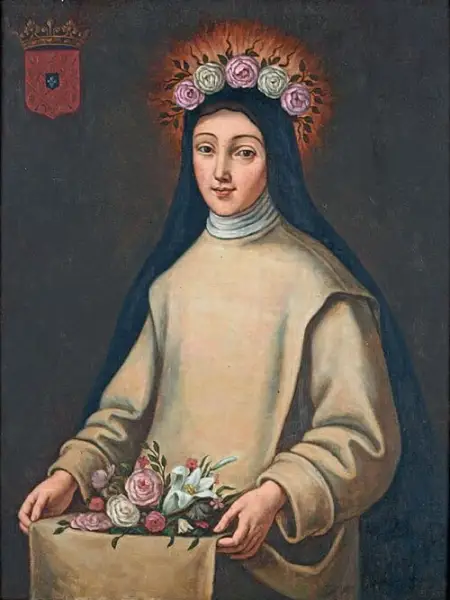
The holiness remembered of Roseline was of the Carthusian type: hidden, austere, and marked by reported supernatural favor. Visions were counted among her gifts, and medieval readers credited her with extraordinary austerities and a commanding power over demons. The most beloved story of her sanctity, however, is domestic in scale. According to legend, she was one day so absorbed in contemplation that she forgot to prepare the dinner for her sisters in the community. While she stood rapt in God, angels came down to the kitchen, prepared the meal, and set the table in her place. The tale captures exactly the virtue her order prized above efficiency: a love of God so total that ordinary obligations dissolved before it, and a heaven that made up the deficiency with tenderness. That story became fixed in the art of her chapel, where Marc Chagall rendered it in wall mosaic for modern pilgrims. Her iconography carries the same note of quiet wonder — rosebuds or full roses borne in her scapular, a wreath of roses about her — echoing the miracle of the roses tied to her childhood charity. In art she may also be shown with a reliquary holding two eyes, for her eyes were removed after death and preserved apart as relics of the seer they had served.
§ Veneration
Resignation and Death
Roseline's last years unfolded at Celle-Roubaud, the monastery she had governed, where she exchanged the burden of office for the quiet rank of a simple sister. Having obtained permission to resign the prioress's charge, she lived out her remaining time in the observance she had kept since her consecration at Bertaud in 1288 — the long offices, the solitude, the fasting that contemporaries considered extraordinary even by Carthusian measure. She died on 17 January 1329, at the age of sixty-six, at Celle-Roubaud near Les Arcs, in the same Provençal countryside where she had been born and where her family's castles and benefactions surrounded the house. Her death closed a religious life of more than forty years and opened the devotion of the next seven centuries. The date of her passing became her principal feast, and the people of the region began at once to honor her grave. Within five years her remains were solemnly moved by a bishop of her own family, the first of the translations that fixed her shrine at Les Arcs-sur-Argens as a permanent station of pilgrimage. The nun who had given away her father's bread as a child was thereafter given back to the poor of Provence as their saint and intercessor.
§ Life
Feast, Decrees, and the Confirmed Cult
Roseline never received the formal canonization of a papal ceremony; instead, the Church confirmed a cult that had flourished among her people for centuries. The Acta Sanctorum first placed her feast on 11 June, the date chosen for the 1334 rite at which her brother Elzéar moved her relics for the first time de Villeneuve, Bishop of Digne. In time the observance was moved to 17 January, the anniversary of her death, and the faithful gain a plenary indulgence by entering a Carthusian church on that day. The people's devotion, unbroken since the fourteenth century, was ratified by decree in 1851 for the Diocese of Fréjus and extended to the entire Carthusian Order in 1857. The scholarship of her legend reflects her age: no ancient life of the saint survives, and the biography printed in the Acta Sanctorum was constructed by the Bollandist Papebroch from early documents. Six centuries of pilgrims have made their way to her shrine in the town of Les Arcs-sur-Argens, close to Draguignan. The Roseline Chapel near the Château Sainte Roseline, set in a private vineyard, enshrines her body in a glass reliquary, where pilgrims may still see the saint of Provence as she rested at Celle-Roubaud on the day she died.
§ Veneration
The Saint of Les Arcs
Six centuries of pilgrimage have made Roseline inseparable from the town of Les Arcs-sur-Argens and the diocese that grew from Fréjus. She is invoked as a patron of the Diocese of Fréjus-Toulon and of sailors, an intercessor claimed both by the inland chalk hills of Provence and by those who work the sea. Her relics remain the heart of her shrine: her body is exposed in a glass reliquary in the Roseline Chapel beside the Château Sainte Roseline, and her eyes, removed and preserved apart from the body in accordance with medieval practice, were still kept at Arcs as late as 1882. Artists have kept renewing her memory. The legend of the angels preparing the dinner while the prioress prayed is depicted in a wall mosaic by Marc Chagall in her chapel, placing a Carthusian kitchen miracle among the masterpieces of modern religious art. In her iconography the roses of her legend bloom in her scapular and crown her head. For the Carthusian Order she stands among its few women saints, a witness of the silent order's hidden fruitfulness; for Provence she remains, in the phrase of her own diocese, the rose without a thorn — the aristocrat who spent her life in poverty of spirit and left her town a shrine.
§ Veneration
Timeline
- 1263
Born around this year into an aristocratic family at the Château d'Arcs, Les Arcs-sur-Argens, in eastern Provence.
§ Life
- 1288
Professed among the Carthusians at Bertaud, high in the Dauphiné Alps, after winning over her opposed father.
§ Life
- 1320
Her brother Hélion de Villeneuve, Grand Master of the Knights of St. John, restored her monastery of La Celle-Robaud.
§ Life
- 1323
Pope John XXII, formerly Bishop of Fréjus, increased the monastery's revenue and granted indulgences for the anniversary of the church's dedication.
§ Life
- 1328
Pope John XXII again increased the monastery's revenues.
§ Life
- 17 Jan 1329
Died at Celle-Roubaud, Les Arcs, at the age of sixty-six, having obtained leave to resign as prioress.
§ Life
- 11 Jun 1334
Her relics were translated for the first time by her brother Elzéar de Villeneuve, Bishop of Digne.
§ Veneration
- 1851
Her local cultus was confirmed for the Diocese of Fréjus by decree.
§ Veneration
- 1857
The confirmation of her cult was extended to the whole Carthusian Order.
§ Veneration
The Record
- Patron of
- Diocese of Fréjus-Toulon·Sailors
- Symbols
- Rosebuds or roses in her scapular·Wreath of roses
- Canonization
- Her immemorial cult was confirmed by decree in 1851 for the Diocese of Fréjus and in 1857 for the Carthusian Order
Prayer
Bibliography
Show 4 sources
- Webster, Douglas Raymund. "St. Roseline", The Catholic Encyclopedia, Vol. 13, New York: Robert Appleton Company, 1912
- d'Hérouville, Lætitia. "Sainte Roseline de Villeneuve, la « rose sans épine » de Provence", Diocèse de Fréjus-Toulon
- "Maison Mimosa – Wine tasting in Provence"
- Herbermann, Charles, ed. (1913). "St. Roseline", Catholic Encyclopedia, New York: Robert Appleton Company
Profile text adapted from the Wikipedia article, licensed CC BY-SA 4.0.
Pray with this saint every day
Save St. Roseline of Villeneuve to your favorites, read the full profile, and get feast-day reminders in the Saints app.
Get the Saints AppFree on the App Store for iPhone and iPad