
died 15 April 584·Feast April 15
St. Ruadhán of Lorrha
Abbot of Lorrha and prophet of Tara
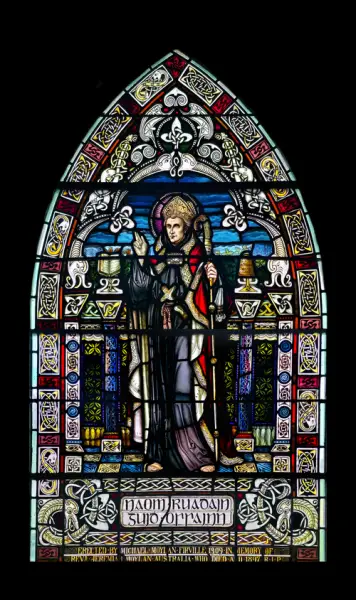
Overview
Ruadhán mac Fergusa Birn, remembered under many spellings including Rowan and Rodan, was an Irish abbot of the sixth century and one of the celebrated Twelve Apostles of Ireland. Born at Tara, he was educated at the school of Finnian at Clonard in County Westmeath, the nursery of Irish monasticism. He became founder and abbot of the monastery of Lorrha in County Tipperary, near Terryglass, a settlement where he directed one hundred and fifty monks behind its great earthen rampart, and whose surrounding village traces its origin to the monastery's trade and refuge. Tradition holds that he took over the site from Brendan the Navigator, who crossed the Shannon to found Clonfert. Ruadhán was famed above all as a prophet. His embassy in 556 to the high king Diarmait mac Cerbaill at Tara passed into legend as the Curse of Tara, and the decline of that royal stronghold from a thriving seat of the high kings was credited to his word. He foretold that Diarmait would die by the roof-beam of his hall, a prophecy that Irish story made famous in its elaborate fulfillment. He died at Lorrha on 15 April 584, and each year the Church keeps his memory on that date.
The Complete Life
A Prince of Tara at the School of Clonard
Ruadhán was born at Teamhair — Tara, the ancient royal center of Ireland, which the sources variously place in the kingdom of Meath and in Leinster. Little is recorded of his family beyond his patronymic: he was son of Fergus Birn. The decisive turn of his youth took him away from the hill of kings to the school of Finnian at Clonard in County Westmeath. In the sixth century Clonard stood at the fountainhead of Irish monasticism, and its master trained the remarkable generation remembered as the Twelve Apostles of Ireland — among them the two Brendans, Ciarán of Clonmacnoise, Columba, and Ruadhán himself. The boy from Tara thus received the standard formation of the early Irish church: scripture, ascetic discipline, and the monastic virtues, under the greatest teacher of the age. That a youth of the royal seat should enter the claustro of Clonard reflected a pattern of the time, when the sons of Irish nobility filled the monasteries and gave the Church both their numbers and their leadership. From Finnian's school Ruadhán carried the double inheritance that marked his whole career: the authority of Clonard's tradition and the confidence of one who had moved easily among kings, an ease he would need at Tara when he came to preach judgment to its master.
§ Life
Abbot of Lorrha
Ruadhán's life's work was the monastery of Lorrha, known in Irish as Lothra, in County Tipperary near Terryglass. Tradition preserves a striking detail of its origin: he is said to have replaced Brendan the Navigator on that ground, Brendan having crossed the Shannon to establish his own monastery at Clonfert in County Galway. At Lorrha, Ruadhán directed a community of one hundred and fifty monks. The settlement would have been ringed by a ditch or broad mound to keep the animals in and intruders out, and the outlines of that enclosure remain visible in the landscape today. Life within was hard but orderly: the monks rose early from beds of rushes or straw laid on the bare ground, and between domestic tasks they prayed and fasted. The community was self-sufficient, producing its own food, clothing, and shelter. Such houses reshaped the Irish countryside, for villages and towns naturally gathered around monastic settlements, drawn by trade and the promise of refuge; Lorrha village itself owes its existence to this pattern, growing up in the shadow of Ruadhán's foundation. As abbot he thus governed not only souls but a small economy and a living community, exercising the quiet civilizing influence that the early Irish monasteries carried through a land only newly Christian.
§ Life
The Curse of Tara
Ruadhán's fame as a prophet gathered around his confrontation with the high king Diarmait mac Cerbaill. In 556 he undertook an embassy to Diarmait at Tara. The occasion, as tradition tells it, was a violation of the sanctuary rights of the Church: Diarmuid mac Cerbhaill had broken the sanctity of a church by seizing a hostage from under its protection. The encounter between the abbot and the king passed into Irish legend as the Curse of Tara, the tale in which Ruadhán's word is held to have doomed the royal stronghold itself. History and legend here run side by side: the high king in fact continued to reside at Tara until his own death in 564, and the story that its halls stood deserted after that date is acknowledged to be of comparatively late invention — Adomnan held a synod at Tara as late as 697. Still, Tara's fading from a royal seat into ruin has been laid to Ruadhán's curse. The prophecy attached to him is more personal still: he predicted that Diarmait would meet his death by the ridgepole of his own hall at Tara. The king threw the beam into the sea and asked his druids to search out the manner of his death, but the story of Banbán's hall, the single-seed flax shirt, and the fire at Ráith Bec fulfilled every word of it.
§ Ruadhán's prophecy
Veneration Through the Centuries
Ruadhán belongs to the saints of the undivided early Irish Church, honored by acclamation rather than by process. After his death at Lorrha on 15 April 584, he was venerated as a saint and reckoned among the Twelve Apostles of Ireland, the company of Finnian's disciples who evangelized and organized the island. His feast is kept on 15 April, the anniversary of his death, and the medieval Irish life of him, the Betha Ruadhain, collected by Plummer among the lives of the saints of Ireland, preserved his cult. Physical memorials endured as well: the bell of St. Ruadhán, cast in bronze with a decorated handle, was found in a well that carries his name, standing opposite the present-day Church of Ireland, and is kept today in the British Museum. Modern precise cataloguing has introduced one caution: while tradition holds him a saint, he does not appear in the latest official and complete martyrology of the Catholic Church, the Latin Martyrologium Romanum of 2004. This absence has not disturbed his local standing in Tipperary, where the priory of St. Ruadan at Lorrha still carries his name and the memory of the abbot who governed one hundred and fifty monks beside the Shannon.
§ Life
The Abbot in the Vision of Tundale
Six centuries after his death, Ruadhán appeared in one of the most influential books of the Middle Ages. The Visio Tnugdali, written around 1149, recounts the otherworld journey of the Irish knight Tundale, and in its blessed company the knight encounters the abbot of Lorrha. Suddenly, the text says, Saint Ruadan approached, welcomed Tundale with joy, took him in his arms and embraced him, calling him his son and promising him a good end to his life — while reminding him that he had once been his patron saint and deserved some generosity in return. Beside him stood Patrick of Ireland in shining robes amid the bishops of the Irish Church. The passage shows what Ruadhán had become in the imagination of later medieval Ireland: a familiar, almost domestic patron, embracing his client in paradise and still concerned with the devotions owed him on earth. At Lorrha his monastery endured in memory if not in stone, its priory and village keeping his name; at Tara the legend of his curse became one of the fixed stories attached to the fall of the royal seat; and in the British Museum his bronze bell remains, recovered from the well that bore him. Few sixth-century abbots left so many marks across legend, literature, and landscape.
§ Visio Tnugdali
Timeline
- 556
Undertook his embassy to King Diarmait mac Cerbaill at Tara, an encounter remembered in legend as the Curse of Tara.
§ Ruadhán's prophecy
- 564
King Diarmait mac Cerbaill, the object of Ruadhán's prophecy, died; the high king had continued to reside at Tara until his death.
§ Ruadhán's prophecy
- 15 Apr 584
Died at the abbey of Lorrha; the yearly feast falls on this day.
§ Life
- 1149
The Visio Tnugdali, written around this year, portrayed him welcoming the soul of Tundale as his patron saint.
§ Visio Tnugdali
In Their Own Words
My son, your arrival here is blessed indeed. From now onwards, while you live in the world you can look forward to a good end to your life. I was once your patron saint and in your worldly life you should be willing to show me some generosity and to kneel, as you well know, in my presence.
The Record
- Major works
- Monastery of Lorrha (Lothra), County Tipperary
- Canonization
- Pre-congregation; venerated from early times as one of the Twelve Apostles of Ireland, though not listed in the 2004 Martyrologium Romanum
Prayer
Bibliography
Show 9 sources
- Gratton-Flood, W. H., "The Twelve Apostles of Erin", The Catholic Encyclopedia, Vol. I, New York: Robert Appleton Company, 1907
- "St. Ruadhan", Lorrha Dorrha
- Monks of Ramsgate. "Ruadhan", Book of Saints, 1921, CatholicSaints.Info, 13 April 2017
- Grattan-Flood, William. "St. Ruadhan", The Catholic Encyclopedia, Vol. 13, New York: Robert Appleton Company, 1912
- Healy, John. Irish Essays: Literary and Historical, 1908
- Byrne, Francis John. Irish Kings and High-Kings, B.T. Batsford, London, 1973, ISBN 0-7134-5882-8, pp. 97-99
- Catholic Church (2004). Martyrologium Romanum (2004)
- Betha Ruadhain (medieval Irish Life of Ruadán), ed. Charles Plummer, Bethada Náem nÉrenn, Oxford: Clarendon Press, 1922
- Aided Díarmata meic Cerbaill, "The Violent Death of Diarmait mac Cerbaill", ed. and tr. S.H. O'Grady, Silva Gadelica, London, 1892
Profile text adapted from the Wikipedia article, licensed CC BY-SA 4.0.
Pray with this saint every day
Save St. Ruadhán of Lorrha to your favorites, read the full profile, and get feast-day reminders in the Saints app.
Get the Saints AppFree on the App Store for iPhone and iPad