
907 – 977·Feast March 1
St. Rudesind
Bishop, abbot, and defender of Galicia
Overview
Rudesind, known in Galician as San Rosendo, was a tenth-century Galician bishop and abbot who combined the government of souls with the government of a troubled frontier. Born in 907 at Monte Córdova in the County of Portucale, into the highest nobility of the Leonese kingdom, he became a monk in youth and was raised to the see of Mondoñedo at eighteen, serving as its bishop from 925 to 950 and again briefly from 955 to 958. He founded the monasteries of Saint John of Caaveiro in 934 and San Salvador de Celanova in 936, the latter becoming the center of his life and later his abbacy. Under his kinsmen the Kings of León he also served as a regional administrator and military leader: named governor of the lands of Celanova by Ordoño III in 955, he exercised jurisdiction from the Minho to the Cantabrian coast, governed all Galicia from 968 to 969, and took the field against both Moors and Norsemen, rallying Galician forces after the death in battle of the bishop Sisnand and killing the Norse leader Gundered. From 968 until his death he administered the see of Iria Flavia. As abbot of Celanova he drew visitors from across Galicia and Portugal seeking spiritual counsel, and he died there on 1 March 977, leaving a reputation for holiness confirmed by his canonization in 1195.
The Complete Life
Born of Counts and Promised by an Angel
The family into which Rudesind was born in 907 stood at the very summit of the Christian kingdoms of the northwest Iberian peninsula. His father was Count Gutierre Menéndez, brother-in-law to King Ordoño II and a supporter of Alfonso III of León; his mother was Ilduara Eriz, herself later honored as a saint, daughter of Count Ero Fernández. His sister Hermesenda married Count Pelayo González, and through his grandmother Ermesenda Gatónez he was kin to Bishop Sabarico II of Dumium, the predecessor whose see he would one day hold, as well as to the abbess St. Senorina. A legend wrapped his very birth in prophecy. His mother had lost every earlier child in infancy; when her husband marched with Alfonso III against Coimbra, she went with him, and climbing alone and barefoot to the hermitage of San Salvador on Monte Cordova, she prayed there. St. Michael, the tradition says, revealed to her that the son she would bear would become both a great leader of men and a holy one. In gratitude she ordered a church built on the spot and stayed until the child was born. When she sought to baptize him at that sanctuary, the cart hauling the font up the hill broke down — and, the legend adds, St. Michael made the broken cart climb of its own accord.
§ Legends
A Bishop at Eighteen
Rudesind entered monastic life young, and his family's standing in the Church of Galicia made his advance rapid even by the standards of a noble house. At eighteen he was elected to the see of Mondoñedo, the coastal diocese also known as Dumium, taking the episcopal name Rudesind II in succession to his own kinsman Sabarico II. He was consecrated in 925 and governed the diocese for a quarter of a century. The tenth-century Church of Galicia demanded of its bishops the toughness of lay lords: sees had to be defended against Norse raiders and Moorish raids, and episcopal families were entangled with the counts and kings who sustained the Christian frontier. In 950 Rudesind stepped aside, and his nephew Arias Núnez took up the office; in 955 he returned for a second term, which lasted until 958, when Arias succeeded him once more. The see would remain in the family circle — another nephew, Arias Peláez, held it later still. This intertwining of prelacy and lineage was the ordinary fabric of the Leonese Church, and within it Rudesind moved with ease. Yet his deepest ambition was not administrative but monastic: even while a reigning bishop he was founding houses of prayer, a labor that would prove his most lasting achievement.
§ Life
Founder of Monasteries
The great constructive work of Rudesind's life was the founding of monasteries, planted allegedly under the Benedictine Rule in a land where monastic custom was still taking classical shape. In 934 he established the Monastery of Saint John of Caaveiro, set in the rugged Serra do Xistral country of Galicia. Two years later, on 12 September 936, he founded the house that became his monument: the Monastery of San Salvador de Celanova. Its site required negotiation as delicate as any campaign. To build at Villar, he prevailed upon his brother Fruela and his cousin Jimena to surrender the rights they held over the land — a renunciation of family property for the sake of the monastery that became the pattern of Celanova's endowment. The house grew into one of the principal religious centers of Galicia, its church and scriptorium serving the whole region, and it remained the setting of Rudesind's final years and of his tomb. Celanova Abbey is honored today as his major shrine. Through these foundations the bishop, who had governed souls on the frontier of a warring kingdom, created communities that would outlast every political boundary of his age — houses of the Benedictine observance carrying learning and stability into the tenth-century northwest, where raiders had recently burned what they could not carry away.
§ Founder of monasteries
Abbot and Teacher of Galicia
At Celanova Rudesind at last took up the office his monastic vocation had always pointed toward: he succeeded St. Franquila, originally of the monastery of Ribas de Sil, as abbot of the house he had founded. In that role he became one of the leading figures of his time. Religious leaders came to Celanova from throughout Galicia and Portugal to seek his spiritual advice, making the monastery a center of counsel for the whole northwest. The affection in which he was held survives in the words a deacon named Egila wrote when making a donation to the house: addressing Rudesind as eminent bishop, holiest father, and true teacher, who taught his subjects no less by his deeds than by his words. That testimony — a teacher whose life confirmed his instruction — captures the spirituality of the man better than any catalogue of offices: a bishop who lived as a monk, an abbot who governed provinces, and in every role a father to those under him. His contemporaries credited him with the working of miracles, and this reputation followed him from the battlefield and the chapter house alike. In the monastery he had raised on the land of Villar, the last shape of his life was the simplest and the most influential: the abbot in his own church, receiving the weary from near and far.
§ Career as abbot
Soldier of the Frontier and Last Years
Rudesind's career belongs to the military history of Galicia as much as to its church history. Named in 955 by King Ordoño III as governor of the lands of Celanova, he held jurisdiction over a vast stretch of territory from Riocaldo on the southern boundary of Galicia to Santa Maria de Ortigueira on the Cantabrian coast. He led forces against both Norse and Moorish armies; the Moors had crossed the Mondego and pushed as far north as the Minho. The gravest crisis came in 966, when Norsemen raided Galicia and killed in battle Sisnand, the warlord and bishop of Santiago de Compostela, at Fornelos. Rudesind rallied the local forces, hunted down the raiders, and killed their leader, Gundered. As a consequence of Sisnand's death he was appointed administrator of the see of Iria Flavia, the diocese of Compostela, and he governed it from 968 until 977. In those same years, at the request of Elvira Ramírez, aunt of the future Ramiro III, he also served as governor of all Galicia from the spring of 968 to early 969. After 977 he withdrew from his sees — the monk Pelayo Rodríguez of Celanova succeeded him at Compostela — and he died at Celanova on 1 March 977, closing a life of seventy years given entirely to the Church and kingdom of Galicia.
§ Administrative and military career
Honored at Celanova
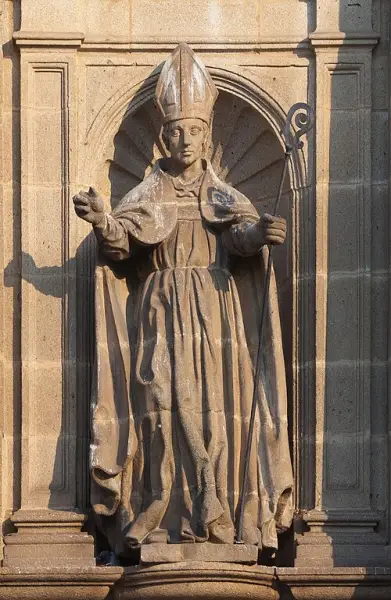
Devotion to Rudesind flourished at the abbey he founded and spread from there through the churches of Galicia and Portugal. His feast is kept on 1 March, the anniversary of his death at Celanova. Two centuries after his passing, the Church confirmed what local memory had long held: in 1195 Pope Celestine III canonized him. He is venerated not only in the Roman Catholic Church but also in the Eastern Orthodox Church, a rare breadth of remembrance for a western medieval bishop. The abbey church of San Salvador de Celanova became his shrine, and there his cult took material form: in 1601 his remains were lifted from the earth and set in a silver urn upon the high altar, where pilgrims could honor the founder at the heart of the church he had raised in 936. A statue of the saint stands in the monastery, and his image — bishop and abbot together — has presided over Galician religious life ever since. Among the honors of his cult is a curious transatlantic one: the diocesan patronage of Pinar del Río in Cuba, carried across the ocean by the same Galician and Portuguese emigration that carried his name, so that the tenth-century bishop of the Galician frontier remains invoked in the Caribbean today.
§ Veneration
The Man Who Saved Galicia
Rudesind's legacy is written in stone, lineage, and story. The Monastery of San Salvador de Celanova endured for centuries as one of the great houses of Galicia, its church still standing as the major shrine of the saint; Caaveiro, his first foundation, remains a ruin of romance in its forest gorge. Through his relatives the episcopacy of Mondoñedo and the abbacy of Celanova passed to his kin, knitting the Church of the northwest into the network of his family for generations — a fact that historians of the Leonese kingdom cannot ignore, for in tenth-century Galicia the fortunes of counts, bishops, and abbots rose and fell together. His martial feats entered regional memory as legend: the rally after Fornelos and the killing of Gundered made him one of the few bishops remembered as much for battle as for benefice, and the tale of his mother's vision at Monte Cordova, with its self-moving cart, gave his life a supernatural opening worthy of its course. The judgment of his own contemporaries, preserved in the donation of the deacon Egila, has not been revised: a true teacher who instructed by word and by deed. Canonized in 1195, keeper of three offices in one lifetime — bishop twice, governor, abbot — he stands as the fullest embodiment of the Galician Church of the tenth century, its pastor, builder, and defender in one person.
§ Career as abbot
Timeline
- 907
Born at Monte Córdova, Santo Tirso, in the County of Portucale, son of Count Gutierre Menéndez and St. Ilduara Eriz.
§ Life
- 925
Became a monk in youth and was made bishop of Mondoñedo at the age of eighteen.
§ Life
- 934
Founded the Monastery of Saint John of Caaveiro.
§ Founder of monasteries
- 12 Sep 936
Founded the Monastery of San Salvador de Celanova on land at Villar yielded by his brother Fruela and cousin Jimena.
§ Founder of monasteries
- 950
Left the see of Mondoñedo after twenty-five years of episcopal service, his nephew Arias Núnez filling the role.
§ Life
- 955
Resumed the bishopric of Mondoñedo for a second short tenure, and King Ordoño III made him governor of the Celanova lands.
§ Administrative and military career
- 966
After Norse raiders killed Bishop Sisnand of Santiago de Compostela at the battle of Fornelos, gathered the local levies and slew the raiders' chieftain Gundered.
§ Administrative and military career
- 968
Appointed administrator of the See of Iria Flavia after Sisnand's death, and made governor of Galicia at the request of Elvira Ramírez.
§ Second Episcopal career
- 1 Mar 977
Died at Celanova, having retired from his sees.
§ Second Episcopal career
- 1195
Canonized by Pope Celestine III.
§ Veneration
- 1601
His remains were raised from their tomb and set in a silver urn upon the high altar of the abbey church.
§ Veneration
In Their Own Words
To you, eminent bishop, Rudesind, holiest father, true teacher, who teaches your subjects with your words and deeds...
The Record
- Major works
- Monastery of Saint John of Caaveiro (934)·Monastery of San Salvador de Celanova (936)
- Patron of
- Pinar del Río, Cuba
- Canonization
- Canonized 1195 by Pope Celestine III
Prayer
Bibliography
Show 8 sources
- "Centenario de la Diócesis", archived from the original on 2007-12-27 at the Wayback Machine
- "Orthodox Europe :: Portugal"
- Vazquez, Manuel. "San Rosendo Celanova", www.terradecelanova.com, retrieved 2018-08-06
- Manuel Carriedo Tejedo, "Cronología de los obispos mindonienses del siglo X", El legado cultural de la iglesia mindoniense, Ferrol, 1999, pp. 235-253
- "Monasterio de Caaveiro (San Juan de Caaveiro)", Arteguias
- "SAN ROSENDO, OBISPO Y ABAD", www.mercaba.org, retrieved 2018-08-06
- "St. Rudesind - Saints & Angels", Catholic Online, retrieved 2018-08-06
- "Patron Saints Index: Saint Rudesind", archived from the original on 2005-12-16, retrieved 2007-11-19
Profile text adapted from the Wikipedia article, licensed CC BY-SA 4.0.
Pray with this saint every day
Save St. Rudesind to your favorites, read the full profile, and get feast-day reminders in the Saints app.
Get the Saints AppFree on the App Store for iPhone and iPad