
died 257·Feast July 10
St. Rufina and Secunda
Roman virgin-martyrs of the Valerian persecution
Overview
Rufina and Secunda were Roman virgins put to death for their faith in 257, in the course of the persecution launched by the emperor Valerian. The account of their passion makes them daughters of Asterius, a member of the Roman senate. The men betrothed to the sisters, Armentarius and Verinus, professed themselves Christians but abandoned the faith when the persecutions began; the sisters refused to follow their example. Fleeing to Etruria to escape danger, they were seized, brought before a prefect, tortured, and finally beheaded. Their bodies were laid to rest on the Via Aurelia, and a Roman church was later dedicated in their honor. Very little can be established with certainty about their lives: a note published with Pope Paul VI's 1969 reform of the General Roman Calendar states that history preserves nothing of the sisters beyond their names and the site of their burial, at the ninth milestone of the Via Cornelia. Their cult, however, is ancient and well attested. Pope Damasus I raised a basilica over their grave, and the town that grew beside it, Santa Rufina, became the seat of a suburbicarian diocese later joined with Porto. Their memory has been kept on July 10 since the feast entered the Roman Calendar in the twelfth century.
The Complete Life
Daughters of a Roman Senator
The story of Rufina and Secunda begins in third-century Rome, where they are said to have been born into a family of rank. The account of their passion names their father as Asterius, a member of the Roman senate, and describes his daughters as Christian virgins raised in the faith of the city's persecuted church. Both sisters were betrothed: their intended husbands, Armentarius and Verinus, were Christians like themselves. The match promised an ordinary domestic future within Rome's Christian community. That future collapsed when the emperor Valerian turned against the Church. Faced with the imperial edicts, the two fiancés renounced their faith and presumably withdrew from the engagement, leaving the sisters to choose between apostasy and danger. Rufina and Secunda chose the harder path. Rather than remain in a city where their constancy would soon be put to the test, they escaped to Etruria, beyond the immediate reach of the Roman authorities. The flight did not save them; it only delayed the confrontation that would make their names endure. Their story, as the acts tell it, is one of young women abandoned by those who should have protected them, yet unmoved in the belief that had shaped their lives.
§ Legend
Martyrdom in the Valerian Persecution
The persecution of Valerian, which began in 257, aimed at the clergy and at Christians of standing, and it swept up the two sisters despite their flight from Rome. Captured in Etruria, Rufina and Secunda were brought before a prefect whose task was to enforce the imperial decrees. When they refused to sacrifice to the gods, they were subjected to torture intended to break their resistance. The interrogators failed. The acts of the martyrs record that the sisters remained constant under suffering and were condemned to death, perishing by the sword: both were beheaded. Their execution made them part of the long roll of Roman martyrs of the mid-third century. The Christians of the city recovered their bodies and buried them with honor, and the places of their rest were remembered. Tradition places their burial on the Via Aurelia, and a church honoring the two saints, Sante Rufina e Secunda, was eventually built in Rome in their memory. The severed ties of family and betrothal in their story gave later generations a striking image of fidelity: two sisters who lost their promised husbands to fear, and gained a shared crown.
§ Legend
An Ancient and Verifiable Cult
Rufina and Secunda were never formally canonized; they belong to the company of saints venerated from the earliest centuries on the testimony of their martyrdom. Their cult rests on firmer ground than many ancient legends, for the places associated with them were recorded and visited. The Bern manuscript of the Martyrologium Hieronymianum carries their names, and pilgrim itineraries of the seventh century point to their tomb on the Via Cornelia, at its ninth milestone. Over that grave Pope Damasus I erected a basilica in the fourth century. A settlement named Santa Rufina grew up around the shrine, and it became the seat of one of the suburbicarian dioceses of the Roman Church, later united with Porto as Porto-Santa Rufina — a dignity that still preserves the martyr's name. In the twelfth century their relics were transferred to the Lateran Basilica, and on that occasion their feast was inserted into the Roman Calendar. When Pope Paul VI revised the calendar in 1969, the accompanying note acknowledged candidly that almost nothing historical is known of the sisters except their names and their burial; yet their feast was retained, and by the rules of the present Roman Missal they may be celebrated with their own Mass on July 10 throughout the Church.
§ Historicity
Feast, Calendar, and the Painting by Three Hands
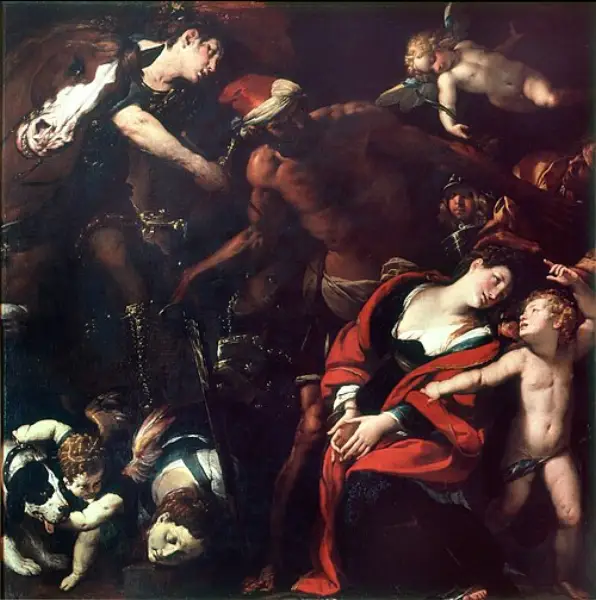
The liturgical memory of Rufina and Secunda has followed the changing fortunes of the Roman Calendar itself. Their feast entered the Tridentine calendar as a semi-double celebration, a rank that marked it as relatively solemn. The General Roman Calendar of Pope Pius XII reduced it to a simple commemoration, and the General Roman Calendar of 1960 ranked it as a third-class feast. The 1969 reform retained the two saints while noting the poverty of the historical record, and under the present Roman Missal their Mass may be said wherever no obligatory feast claims the day. Their legend also left its mark on religious art. Artists picture the pair as two young women adrift on the Tiber, millstones bound about their necks, an image evoking a form of punishment by drowning associated with their passion. In the 1620s three Milanese painters — Il Morazzone, Giulio Cesare Procaccini, and Giovanni Battista Crespi — collaborated on a Martyrdom of Saints Rufina and Secunda, a canvas so remarkable for joint execution that contemporaries celebrated it as the work of three hands — il quadro delle tre mani. That collaboration, chronicled in connection with the Metropolitan Museum of Art's survey of Venetian and northern Italian painting, keeps the memory of the two sisters alive far beyond the road outside Rome where they were buried.
§ Feast day
Timeline
- 257
Martyred in Rome under the persecution of Emperor Valerian, after torture and beheading by order of a prefect.
§ Legend
- 1969
Pope Paul VI's revision of the General Roman Calendar noted that only their names and burial place are historically known.
§ Historicity
The Record
- Symbols
- two maidens floating in the Tiber River with weights attached to their necks
- Canonization
- Pre-congregation; venerated as martyrs from the early Roman Church
Prayer
Bibliography
Show 6 sources
- Kirsch, Johann Peter. "Sts. Rufina." The Catholic Encyclopedia Vol. 13. New York: Robert Appleton Company, 1912.
- Butler, Alban. "SS. Rufina and Secunda, Virgins, Martyrs", The Lives of the Saints. 1866.
- "Sts. Rufina and Secunda", Our Sunday Visitor's Encyclopedia of Saints.
- "Calendarium Romanum" (Libreria Editrice Vaticana, 1969), p. 129.
- General Instruction of the Roman Missal, 355 c.
- Metropolitan Museum of Art: Venice and Northern Italy, 1600–1800 A.D.
Profile text adapted from the Wikipedia article, licensed CC BY-SA 4.0.
Pray with this saint every day
Save St. Rufina and Secunda to your favorites, read the full profile, and get feast-day reminders in the Saints app.
Get the Saints AppFree on the App Store for iPhone and iPad