
died 238 or 239·Feast August 11
St. Rufinus of Assisi
First bishop and martyr of Assisi
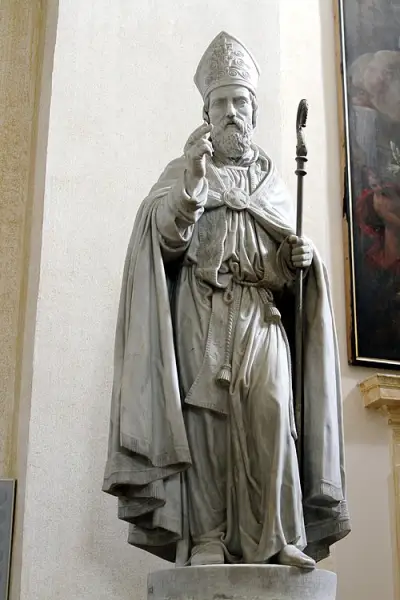
Overview
Rufinus of Assisi, honored by Catholics and Orthodox alike, is remembered by legend as the first bishop of Assisi and the man who brought Christianity to that Umbrian city. He is said to have come from Anatolia with his son to preach the Gospel, laboring among a people who had not yet heard it. The date of his mission is disputed, but his death is placed in 238 or 239, when the Roman proconsul Aspasius seized him, put him to the torture, and had him drowned in the waters of the Chiascio, close to Costano. His body was recovered from the water and buried close to where it was found, and a church soon rose on the spot. On the testimony of Peter Damian, his remains were brought up to Assisi in the eighth century and laid to rest in a Roman sarcophagus. The acts of his martyrdom are purely legendary; scholars take him, in all likelihood, to be the same man as the episcopus Marsorum — a bishop of the Marsi people — commemorated in the Roman Martyrology on August 11. The earliest witnesses to his cult are an eleventh-century sermon of Peter Damian and a fourteenth-century Passio. Nevertheless, his memory took deep root in Assisi: he became the city's patron saint, the cathedral that bears his name enshrines his remains, and the annual Palio di San Rufino keeps his name before the people each summer.
The Complete Life
Missionary from Anatolia
The tradition of Assisi remembers Rufinus as a man who crossed the sea for the sake of the Gospel. According to the legend, he came from Anatolia together with his son, and the two preached the Christian faith in the Umbrian hill town that would become forever associated with his name. The sources assign him the title of first bishop of Assisi and credit him with the conversion of the city to Christianity, though when this work was accomplished remains disputed among scholars. The mission of a foreign bishop in a pagan provincial town would have demanded patience and courage: Rufinus and his son preached in territory where the Roman civic order and its gods still governed daily life, and where a missionary's success inevitably drew official suspicion. The legend gives no details of his years of labor, only their fruit — a Christian community at Assisi that honored him as its founder. The obscurity surrounding the historical Rufinus is deep; the acts recounting his martyrdom are openly legendary, and the soberest early evidence for his identity is the note in the Roman Martyrology, entered under August 11, describing an episcopus Marsorum, a bishop of the Marsi, whom scholars generally take to be the same man.
§ Legend
Arrest, Torture, and Martyrdom
Rufinus's preaching eventually brought him before the Roman authorities. The proconsul Aspasius, whose office carried the duty of enforcing the imperial cult, had the bishop arrested. When imprisonment and interrogation did not silence him, torture was applied; when torture failed, the sentence of death followed. The legend relates that Rufinus was drowned in the Chiascio River near Costano, a village in the plain below Assisi. The manner of his death — death by water — became part of his story, though the image of the saint floating in the Tiber attached to other martyrs never displaced the simple account of his drowning. The Christians of the region recovered his body from the river and laid it in the earth beside the bank where it lay. On that ground a church soon rose, the first of several sanctuaries that would stand over the martyr's grave. The execution meant to end his influence instead fixed his memory in the landscape: the river, the burial place, and the church at Costano all became landmarks of a cult that would soon travel up the hill to Assisi itself, where the bishop who had converted the city would eventually rest beneath its cathedral altar.
§ Legend
An Ancient Cult and Its Earliest Witnesses
Rufinus was never formally canonized; his veneration as a martyr and bishop belongs to the age before formal processes, resting on the continuous devotion of the churches of Umbria. The documentary trail begins late: the oldest substantial witness to his cult is a sermon on the miracles of Saint Rufinus the Martyr preached by Peter Damian in the eleventh century, followed by a Passio Sancti Rufini composed in the fourteenth century. Neither text preserves reliable history — the acts of the martyrdom are frankly legendary — yet both attest that the saint was honored centuries after his death. Peter Damian is also the source for the translation of the relics: he records that Rufinus's remains were brought from Costano to Assisi in the eighth century. There they were placed in a Roman sarcophagus whose front bears shallow-relief sculpture of the myth of Selene and Endymion, pagan funerary art put to Christian use. The Roman Martyrology commemorates him on August 11, where he probably appears under the designation bishop of the Marsi. Venerated in both Roman Catholicism and Eastern Orthodoxy, Rufinus stands among those early Italian bishops whose historical outlines have faded but whose cult has never been interrupted.
§ Legend
The Cathedral of San Rufino and the Palio
No saint is more bound to the civic identity of Assisi than Rufinus, its patron. His remains rest today under the main altar of the Cathedral of San Rufino, the third church to be erected over them — a sequence of buildings that measures the city's devotion across the centuries. The cathedral named for him stands at the heart of Assisi, the town that would later give the Church Francis and Clare; their spiritual home was, in a sense, the field Rufinus had sown as its first bishop. The saint's memory is not confined to stone. In the final week of every August, from Thursday through Saturday, Assisi keeps the Palio di San Rufino, a historic re-enactment rooted in the Middle Ages in which the city's three medieval districts, the Terzieri, compete with crossbows to win the pennant of the palio. The festival, promoted by the city itself, turns the bishop-martyr's feast into the great civic moment of the Umbrian year. Through cathedral and contest alike, the Anatolian missionary who died in the Chiascio River remains a living presence in the city he is said to have brought to Christ.
§ Legend
The Record
- Patron of
- patron of Assisi
- Canonization
- Pre-congregation; venerated as a martyr since antiquity
Prayer
Bibliography
Show 4 sources
- Kirsch, Johann Peter. "Sts. Rufinus." The Catholic Encyclopedia Vol. 13. New York: Robert Appleton Company, 1912.
- Schäfer, Joachim. "Rufinus von Assisi", Ökumenisches Heiligenlexikon.
- City of Assisi website – the Palio of St. Rufinus.
- Ekkart Sauser, Biographisch-Bibliographisches Kirchenlexikon, vol. XXI (2003), pp. 1284f.
Profile text adapted from the Wikipedia article, licensed CC BY-SA 4.0.
Pray with this saint every day
Save St. Rufinus of Assisi to your favorites, read the full profile, and get feast-day reminders in the Saints app.
Get the Saints AppFree on the App Store for iPhone and iPad