
died between 50 and 100·Feast April 8
St. Rufus of Thebes
Apostle of the Seventy and bishop of Thebes
Overview
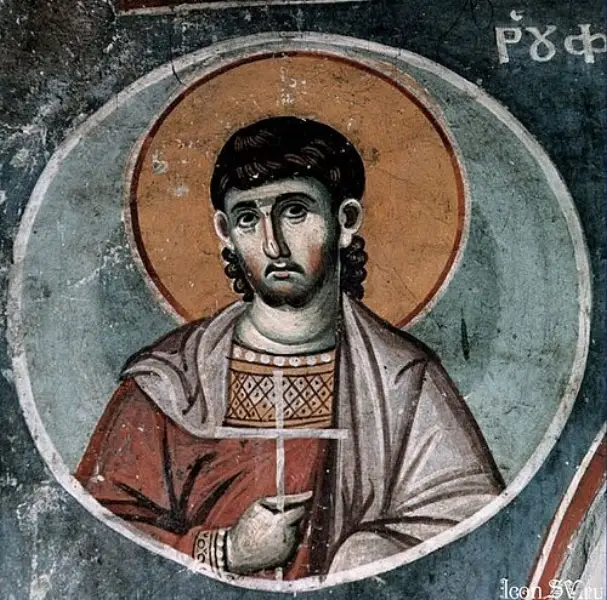
Rufus of Thebes is numbered among the Seventy Disciples whom the Lord sent out to preach, according to the tradition of the Eastern Orthodox Church, which honors him as an apostle, a bishop, and a hieromartyr. He served as bishop of Thebes in Greece, the ancient Boeotian city where he is remembered as the founding shepherd of the local church. The date of his death falls somewhere in the second half of the first century, between 50 and 100, and the title hieromartyr — a martyr who was a priest or bishop — indicates that the tradition remembers him as having sealed his episcopate with his blood. Some traditions identify him with the Rufus to whom Saint Paul sends greetings in the thirteenth verse of the sixteenth chapter of Romans, the man Paul calls chosen in the Lord, together with a mother whom Paul counts as his own; Easton's Bible Dictionary, however, suggests that the Rufus of Romans could well have been the Rufus named in Mark's Gospel as a son of Simon of Cyrene. Whatever the resolution of that question, the Orthodox Church keeps his feast on April 8 and commemorates him again on January 4, together with all the Seventy Apostles, singing him among the six-fold choir of apostles — Herodion, Agabus, Rufus, Asyncritus, Phlegon, and holy Hermes — who ever entreat the Trinity for our souls.
The Complete Life
Among the Seventy Disciples
In the tradition of the Eastern Orthodox Church, Rufus of Thebes belongs to the company of the Seventy Disciples, the wider circle of the Lord's followers whom Christ sent out ahead of him to every town and place he was about to visit, and whose mission Luke's Gospel records. To be numbered among the Seventy is to stand in the inner tradition of the apostolic age: these were disciples of the Lord himself, chosen after the Twelve and entrusted with the first preaching of the kingdom. Orthodox liturgy gathers them into choirs and celebrates them in common on January 4, while assigning each his own feast through the year. Rufus shares his special commemoration with a group of five companions of the Seventy — Herodion, Agabus, Asyncritus, Phlegon, and Hermes — several of whom are also greeted by name in the closing chapter of Paul's letter to the Romans, where the apostle sends salutations to Asyncritus, Phlegon, Hermes, Patrobas, Hermas, and the brothers with them. The hymns of the Orthodox Church sing this six-fold choir together, praising the apostles who became disciples of Christ and who now gaze on God the Word. Whether the Rufus of the Seventy is the same as the Rufus of the New Testament epistles remains a question for the commentators; the tradition of the Church has never hesitated to venerate him as one of the Lord's own emissaries.
§ Rufus of Thebes
Bishop of Thebes and Hieromartyr
The mission that tradition assigns to Rufus led him to Thebes, the ancient capital of Boeotia, where he served as bishop of the young Christian community. Thebes stood among the oldest cities of Greece, rich in pagan myth and memory, and to preside over its church in the first Christian generation was to plant the Gospel in soil that had never heard it. The Orthodox sources give Rufus the title of hieromartyr — a bishop or priest who dies for the faith — and place his death between the years 50 and 100, within the lifetime of the apostolic church. The title implies that his episcopate ended in martyrdom, though the acts of his passion have not come down to the Church in any detailed form; his story survives in the compressed form of the calendars, the menologies, and the liturgical books. There he appears as the apostle and first bishop of Thebes, one of the missionaries who carried the faith from Jerusalem to the cities of the Roman world in the decades after Pentecost. His Greek designation, Rufus the Theban, fixed his memory to the city he served, and the Orthodox Church of Greece has honored him through the centuries as the founding shepherd of the Theban flock who gave his life at the end of his ministry.
§ Rufus of Thebes
Feasts, Hymns, and the Question of Identity
The memory of Rufus of Thebes lives principally in the liturgy of the Orthodox Church. His feast is kept on April 8, and he is commemorated a second time on January 4, when the Church celebrates all the Seventy Apostles together. In the services for the day he is sung with his companions of the Seventy: the troparion in the first tone praises the six-fold choir of apostles — Herodion, Agabus, Rufus, Asyncritus, Phlegon, and holy Hermes — who ever entreat the Trinity for our souls, while the kontakia liken them to stars whose radiance, poured out by the Holy Spirit, lights the faithful on their way and scatters the darkness of error. Behind the liturgy stands a long discussion of who this Rufus was. Some traditions connect him with the Rufus greeted in Romans 16:13, the man chosen in the Lord whose mother was a mother to Paul as well; Easton's Bible Dictionary, by contrast, holds that the Rufus of Romans could well have been the Rufus whom Mark names as a son of Simon of Cyrene. The Orthodox sources draw on the Prologue from Ohrid of Saint Nikolai Velimirovic, whose retellings of the lives of the saints carried the memory of the Seventy through the Slavic world, and modern directories such as those of the Orthodox Church in America and the Greek Archdiocese continue to publish his life each April.
§ Rufus of Thebes
In Their Own Words
Let us praise in hymns the six–fold choir of Apostles: Herodion and Agabus, Rufus, Asyncritus, Phlegon and holy Hermes. They ever entreat the Trinity for our souls!
Like stars, O holy Apostles, You illumine the way of the faithful with the light of the Holy Spirit. You dispel the darkness of error as you gaze on God the Word!
The Record
- Canonization
- Pre-congregation; numbered among the Seventy Disciples in Eastern Orthodox tradition
Prayer
Bibliography
Show 4 sources
- Easton's Bible Dictionary - "Rufus".
- "Apostle Herodion of the Seventy, and those with Him". www.oca.org. Retrieved 2024-08-14.
- St. Nikolai Velimirovic, The Prologue from Ohrid.
- "Rufus of Thebes", OrthodoxWiki.
Profile text adapted from the Wikipedia article, licensed CC BY-SA 4.0.
Pray with this saint every day
Save St. Rufus of Thebes to your favorites, read the full profile, and get feast-day reminders in the Saints app.
Get the Saints AppFree on the App Store for iPhone and iPad