
662·Feast November 3
St. Rumbold
Infant saint of the Anglo-Saxon royal house
Overview
Rumbold, also written Rumwold, Rumwald or Rumbald, is remembered as an infant saint of Anglo-Saxon England who, by tradition, lived only three days in the year 662. The eleventh-century Vita Sancti Rumwoldi makes him a grandson of the pagan Mercian king Penda and a son of a Northumbrian king, most plausibly Alhfrith son of Oswiu and his wife Cyneburh. The legend relates that the child spoke from the moment of his birth, proclaiming himself a Christian, asking for baptism and for the name Rumwold, and then preaching a short sermon before foretelling his own death and choosing Buckingham as the place where his body should rest. Baptized by Bishop Widerin, he died at the age of three days. His short life gave rise to a lasting cult: churches across Mercia and beyond were dedicated to him, wells at Astrop, Brackley and Buckingham were associated with his name, and Boxley Abbey in Kent treasured a statue of the saint famous for its miraculous weight. His memory endures in place names and in the parish churches that still carry his dedication.
The Complete Life
A Birth in the Royal Households
The story of Rumbold's origins comes chiefly from the eleventh-century Vita Sancti Rumwoldi, which casts him as a child of two royal houses at war in spirit with one another. His grandfather was Penda of Mercia, the last great pagan king of the English; his father was a king of Northumbria, a man the Vita describes as a pagan as well. Modern scholars have tried to name the couple, and the likeliest candidates are Alhfrith, son of Oswiu of Northumbria, and Cyneburh, daughter of Penda. The identification is not without difficulty: Alhfrith ruled only the subkingdom of Deira and, by Bede's account, was himself a Christian who helped convert Penda's son Peada. Some Northumbrian genealogies do give Alhfrith and Cyneburh a further son, Osric, who later wore the crown. According to the hagiography, Rumbold's mother was a devout Christian who refused to consummate her marriage until her husband accepted the faith of Christ; he consented, and she conceived. Summoned by Penda as her time drew near, she gave birth on the journey, at Walton Grounds near King's Sutton, then part of the Mercian royal estates.
§ Hagiography
Three Days of Speech
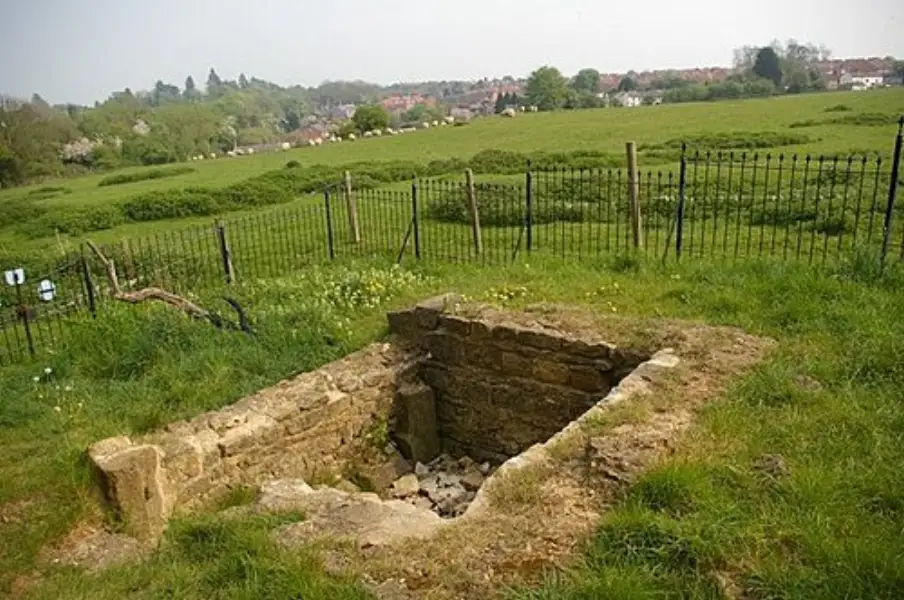
The wonder of Rumbold's life lies in what tradition says he accomplished in his seventy-two hours. At the moment of his birth, the tale runs, the newborn cried out three times over that he was a Christian, then to have gone on professing his faith in fuller words. He asked for baptism, which was administered by Bishop Widerin, and requested the name Rumwold for himself. Having received the sacrament, he delivered a sermon, an astonishing gift attributed to a newborn, and then foretold the hour of his own death. He also declared where he wished his body to be laid, naming Buckingham, and there his relics were afterwards honored. A field at Walton Grounds, where a chapel once marked the supposed spot of his birth, could still be pointed out in later centuries, and the parish church of the neighboring village has long maintained that its ancient font, whether Saxon or Norman in date, was the vessel that held the water of his baptism. Wells remember him too: one at Astrop close by the birthplace, and others at Brackley and Buckingham, towns that once kept his remains, all came to carry his name.
§ Hagiography
Churches, Wells and a Wonder-Working Statue
Rumbold's cult spread widely for a saint of such a brief life. Churches dedicated to him largely followed the missionary routes of Saint Wilfrid, yet dedications stretched up into the North Riding, east through Lincoln and Essex, and down into Dorset, where Pentridge keeps his patronage; four of these churches still stand. Boxley Abbey in Kent kept a celebrated statue of the infant saint, small and so light that a child could lift it, yet at times so heavy that strong men could not raise it from the ground; tradition held that only those who had never sinned could lift it. At the Dissolution of the Monasteries it was discovered that a wooden pin, worked by a hidden hand behind the figure, controlled its weight. The name of Rumbold has also been entangled with that of Rumbold of Mechelen, the martyred confessor called Rumoldus or Rombout in the Low Countries; medieval scribes sometimes corrected or confused the two, and an unknown annotator reclassified a fifteenth-century life of the Mechelen martyr as that of a confessor. In 2005 the former Saint Rumwold church in Lincoln, now a college, set up a plaque in honor of its patron.
§ St. Rumbold of Mechelen
Timeline
- 662
Born at Walton Grounds near King's Sutton, on the Mercian royal estates, and baptized by Bishop Widerin
§ Hagiography
- 662
Died at the age of three days, after professing his faith and foretelling his own death
§ Rumbold of Buckingham
- 2005
The former church of Saint Rumwold in Lincoln, then a college, erected a plaque celebrating its connection with the saint
§ Hagiography
The Record
- Canonization
- Pre-congregation; venerated as an infant saint from the early medieval period
Prayer
Bibliography
Show 6 sources
- Love, Rosalind C. (1996). Three Eleventh-Century Anglo-Latin Saint's Lives — Vita S. Birini, Vita et Miracula S. Kenelmi, Vita S. Rumwoldi. Clarendon Press, Oxford University Press. ISBN 9780198205241.
- Kirby, David P. (1991). The Earliest English Kings. London: Unwin Hyman. ISBN 0-04-445691-3.
- Butler, Alban (1866). "Saint Rumwald, Confessor". Lives of the Fathers, Martyrs, and Principal Saints – via CatholicSaints.Info.
- Elliott, Douglas J. (1975). Buckingham: the loyal and ancient borough. Philimore. ISBN 9780850331820.
- Wasyliw, Patricia Healy (2008). Martyrdom, Murder, and Magic: Child Saints and Their Cults in Medieval Europe. Peter Lang. p. 71. ISBN 9780820427645.
- Sidney Heath (1912). Pilgrim Life in the Middle Ages. T.F. Unwin. pp. 232–233.
Profile text adapted from the Wikipedia article, licensed CC BY-SA 4.0.
Pray with this saint every day
Save St. Rumbold to your favorites, read the full profile, and get feast-day reminders in the Saints app.
Get the Saints AppFree on the App Store for iPhone and iPad