
6th century·Feast August 28 (England); June 1 (Brittany); July 22 (Ireland)
St. Rumon
Celtic missionary and bishop of Devon and Cornwall
Overview
Rumon, whose name appears in the variant forms Ronan, Ruadan and Ruan, is a saint of the early British church venerated by Catholics, Anglicans and Orthodox alike, though almost nothing certain is known of his life. He was most likely a missionary who came from Ireland, and according to Alban Butler he was a bishop, though the see he governed cannot be identified. John Leland recorded that a manuscript, unearthed at Tavistock when the abbey was broken up, told of Rumon leaving Ireland at some point in the fifth or sixth century to live as a solitary close to Falmouth in Cornwall. His cult became anchored at Tavistock in Devon, where the abbey founded in 974 took his name alongside that of the Mother of God, and where his relics, brought from Ruan Lanihorne in Cornwall, were enshrined. Because medieval writers confused him with the Breton saint Ronan, the surviving Lives of Rumon borrow heavily from Breton material, and historians treat their details with caution. He remains the patron of Tavistock, Romansleigh and Ruan Lanihorne, and several churches in Devon and Cornwall still bear his name.
The Complete Life
A Saint Behind the Names
Rumon belongs to the shadowy company of Celtic saints whose historical outlines have been blurred by time and by the borrowed pens of medieval hagiographers. His name survives in several spellings, Rumon, Ronan, Ruadan and Ruan, and some authorities judge him identical with the Ronan honored in Brittany on the first of June. The evidence for his origins is slight but consistent in one respect: he was probably an Irishman who crossed the sea as a missionary. Alban Butler, gathering the older tradition, calls him a bishop without being able to name his see. The antiquary John Leland passed on a report that a manuscript, come to light at Tavistock as the abbey was being wound up, told of Rumon's crossing from Ireland at some time in the fifth or the sixth century and of the solitary life he made for himself close to Falmouth in Cornwall. The written Lives that purport to describe him are late and derivative: a Life of St. Rumon, most likely written at Tavistock at some date from the twelfth to the fourteenth century, reworks the Breton Life of Ronan, and a fourteenth-century Gotha manuscript draws on the same tenth-century Breton text. Nicholas Orme judges that only what concerns Ruan Lanihorne and Tavistock can be trusted.
§ Biography
Missionary and Hermit
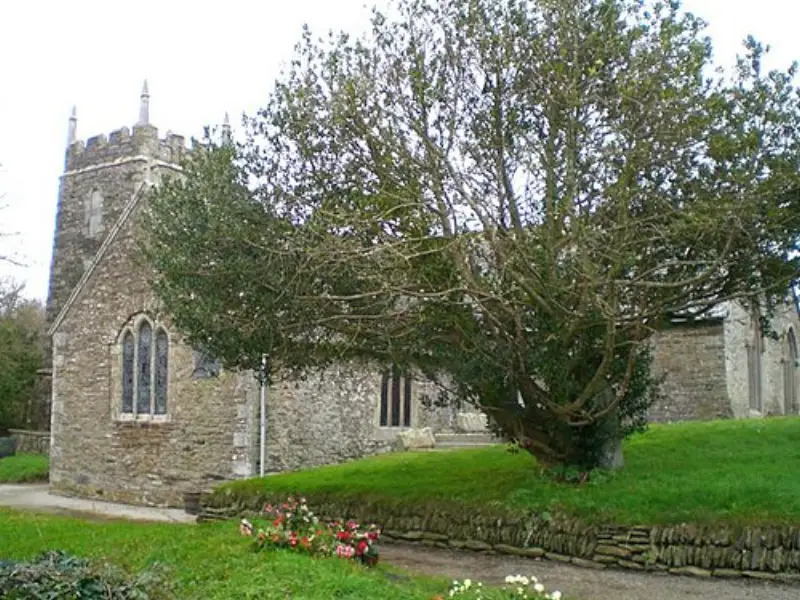
What can be reconstructed of Rumon's activity places him among those wandering ascetics who carried monastic Christianity from Ireland into the Celtic west of Britain. His settlement near Falmouth would have put him in the heart of Cornish Celtic Christianity, close to the sea lanes that connected Cornwall with Brittany, Wales and Ireland, along which saints, scribes and traditions moved constantly in the early middle ages. Whether he labored as a bishop among scattered settlements or lived chiefly as a solitary, the memory that endured was of holiness attached to particular places: the creek-side church of Ruan Lanihorne kept his remains and his festival, and sites in Devon claimed his patronage as well. His cult, like those of many Cornish saints, later crossed the Channel, for the Breton Ronan with whom he is identified was venerated widely in Brittany. The medieval devotion that gathered around him was strong enough that when Ordulf founded his great abbey at Tavistock in 974, he placed it under the joint patronage of Saint Mary and Saint Rumon, and within a decade the saint's relics had been brought there from Cornish soil.
§ Biography
Tavistock and the Spread of the Cult
The flowering of Rumon's veneration came through Tavistock Abbey. Ordulf, Earl of Devon, established the Abbey of Saint Mary and Saint Rumon there in 974, and in 981 his remains, head excepted, were brought up from the Celtic house at Ruan Lanihorne and enshrined in the new abbey. King Henry I granted the abbey the privilege of a three-day fair at the feast of its patron, a sign of how substantial the pilgrimage traffic had become. In the later calendar his translation is kept on January 5 in both the Catholic and Orthodox churches, while the holy hierarch Rumon is venerated in Orthodoxy on August 30; local English tradition keeps his feast on August 28, the Breton Ronan on June 1, and Irish usage on July 22. Rumon is depicted as a bishop in the stained glass of the Lady Chapel of St Eustachius' Church at Tavistock, and churches in Devon and Cornwall bear his name, as does the village of Romansleigh. At Ruan Lanihorne the patronal festival is still kept each year on the last Sunday of August, keeping alive the memory of the saint of uncertain history and enduring devotion.
§ Veneration
Timeline
- 974
Ordulf, Earl of Devon, established the Abbey of Saint Mary and Saint Rumon at Tavistock
§ Veneration
- 981
Rumon's remains, though not his head, were carried from the Celtic house at Ruan Lanihorne to a new resting place in Tavistock
§ Veneration
The Record
- Patron of
- Tavistock, Devon·Romansleigh, Devon·Ruan Lanihorne, Cornwall
- Symbols
- Depicted as a bishop
- Canonization
- Pre-congregation
Prayer
Bibliography
Show 7 sources
- Hunter-Blair, Oswald. "Tavistock Abbey." The Catholic Encyclopedia Vol. 14. New York: Robert Appleton Company, 1912.
- Orme, Nicholas. The Saints of Cornwall. OUP Oxford, 2000, p. 226. ISBN 9780191542893.
- Jankulak, Karen (2000). The Medieval Cult of St Petroc. Studies in Celtic history. Vol. 19. Boydell & Brewer. p. 3. ISBN 978-0-85115-777-1.
- Freeman, Mary (2012). "Ordulf's Shadow in Tavistock". In Bliss, Jane, et al. (eds.). Aspects of Devon History. Devon History Society. pp. 23–36. ISBN 978-0-903766-02-9.
- The Oxford Dictionary of Saints, 5th rev. ed. (David Farmer, ed.). OUP, 2011. ISBN 9780199596607.
- "Notices of Tavistock and its Abbey", The Gentleman's Magazine, Vol. 100, Edw. Cave, February 1830, p. 117.
- Harris, Helen. A Handbook of Devon Parishes. Tiverton: Halsgrove, 2004, p. 142. ISBN 1-84114-314-6.
Profile text adapted from the Wikipedia article, licensed CC BY-SA 4.0.
Pray with this saint every day
Save St. Rumon to your favorites, read the full profile, and get feast-day reminders in the Saints app.
Get the Saints AppFree on the App Store for iPhone and iPad