
712 – 732·Feast May 15
St. Rupert of Bingen
Young pilgrim and founder of hospices by the Nahe
Overview
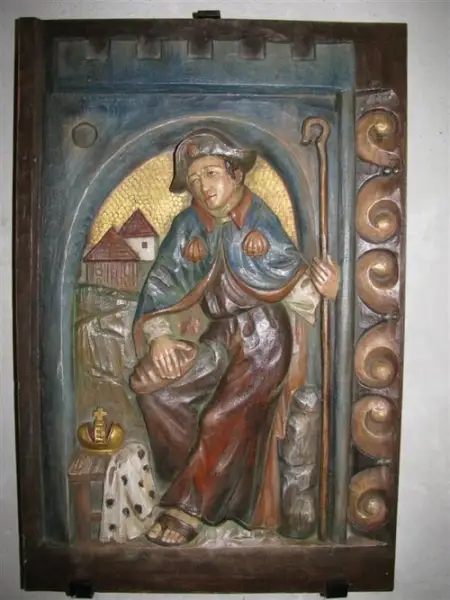
Rupert of Bingen was a young German nobleman whose short life of twenty years became the seed of a lasting local cult in the Rhineland. Born in 712 to Bertha of Bingen, a Christian noblewoman, and a pagan father named Robolaus, he lost his father early and was raised in the Christian faith by his mother. At fifteen he set out with her on a pilgrimage to Rome, an enterprise that marked him permanently as a devotee of the pilgrim life. On their return the young man devoted his inherited wealth to the service of God, founding churches in the country around Bingen. With his mother he settled on a hill above the river Nahe, a height that came to be known as the Rupertsberg, and there they established hospices for the poor and for travelers in need. He died of a fever at the age of twenty, in 732. Centuries later Hildegard of Bingen, who founded her own convent on the very hill bearing his name, promoted his veneration and composed a biography of him, the Vita Sancti Ruperti. He is honored as a patron of pilgrims, and his relics are venerated at Eibingen and Bingen.
The Complete Life
A Christian Mother, a Pagan Father
Rupert was born in 712 into a household divided in faith. His mother, Bertha of Bingen, was a Christian noblewoman whose name has been honored alongside her son's ever since; his father, Robolaus, also written Robold, was a pagan. The father died while Rupert was still a child, and his upbringing fell wholly to Bertha, who raised him as a Christian in the country around Bingen, where the Nahe river meets the Rhine. The household she kept was one of substance, for Rupert later commanded inherited wealth enough to endow churches, and the position of the family in the Christian community of the Rhineland gave the boy both example and opportunity. Nothing else is recorded of his childhood, but the pattern of his later life, its care for the poor and its instinct for pilgrimage, belongs naturally to the faith of a widowed mother and an only son. Medieval writers remembered the two of them together, and when the relics of the saint were carried to safety in the seventeenth century, those of Bertha went with him, mother and son sharing one honor at Eibingen as they had once shared one household and one pilgrimage.
§ Rupert of Bingen
The Road to Rome
At the age of fifteen Rupert undertook the work that would define his reputation: a pilgrimage to Rome, made not alone but in the company of his mother. The journey from Bingen down the Rhine and over the Alps to the tombs of the Apostles was a formidable undertaking for any seventh- or eighth-century traveler, and to attempt it as a mother and her teenage son suggests both their devotion and their means. In an age when pilgrimage was becoming one of the great expressions of Christian life, the two of them practiced it at its most demanding, and the experience fixed Rupert's vocation. After the return home he did not settle into the quiet management of his estates. Instead he began to pour his inheritance into the things he had seen Rome embody: new churches where worship was wanting, and provision made for the destitute and the wayfarer. He is honored as a patron of pilgrims precisely because pilgrimage was the form his own holiness took, first as a pilgrim himself and then as one who built for pilgrims. The road to Rome, undertaken once in his youth, became in effect the road of his whole remaining life.
§ Rupert of Bingen
Churches and Hospices on the Rupertsberg
Returning from Rome, Rupert and his mother Bertha took up residence on a hill above the river Nahe near Bingen, a height that came to be called the Rupertsberg in his memory. There mother and son carried out together the work his pilgrimage had inspired. The wealth his father had left him went into new churches raised across the district, extending the visible structure of Christian life through the Rhineland countryside. On the hilltop itself mother and son raised a string of refuges where the traveler, the destitute and the ailing could count on lodging and care. The combination is characteristic of the age's best Christian philanthropy: the dignity of worship and the service of persons joined on one hillside. Rupert did not live long to enjoy what he had built. A fever took him in 732, when he was only twenty years old, and he was buried with the lamentation of those he had helped. Yet the hill kept his name, and more than four centuries later it drew the attention of the greatest spiritual figure of the medieval Rhineland, who recognized in the young founder a predecessor worthy of her own foundation.
§ Rupert of Bingen
Hildegard and the Cult of Rupert
The veneration of Rupert of Bingen owes its medieval flowering to Hildegard of Bingen. In 1150, after years at the monastery of Disibodenberg, Hildegard brought her nuns down to a rocky height where the Nahe runs into the Rhine, the same hill on which Rupert and Bertha had lived and labored, and there established her first convent. In choosing the Rupertsberg she deliberately bound her new foundation to the memory of its first inhabitant, and she went further, promoting his veneration and writing his life in the work known as the Vita Sancti Ruperti. Under her influence the young pilgrim-founder of the eighth century became a recognized patron of the region. Hildegard obtained the ground from Hermann, a dean of Mainz, and from Count Bernhard of Hildesheim, alongside a number of lesser gifts; her chapel was consecrated by Archbishop Henry of Mainz in 1152, and her charters were settled by his successors in 1158 and 1171. The convent flourished on the hill until the Thirty Years' War, when in 1632 the monastery was destroyed and the relics of Rupert and Bertha were carried to Eibingen for safety, where his arm remains displayed in a reliquary in the parish church.
§ Rupertsberg
Relics at Eibingen and Bingen
Rupert's memory has been attached for nearly nine centuries to the geography of the middle Rhine. The hill of his residence took his name and kept it, so that Hildegard's famous convent is known to history simply as the Rupertsberg, and the pilgrim-saint became the invisible landlord of one of the most celebrated religious houses in Germany. When war destroyed that house in 1632, his relics, with those of his mother, found a refuge at Eibingen, where they remain, his arm enshrined in the church. Other portions came back across the river in 1814, and these are honored in the chapel that rises on the Rochusberg above Bingen, so that the town of his name retains its portion of him as well. His feast falls on May 15. Pilgrims claim him as their patron, a fitting charge for a man whose single great journey shaped his whole life and whose hospices served the road-bound poor. For pilgrims walking the Rhine today, and for the visitors who come to Eibingen for Hildegard's sake, Rupert remains the quiet first figure of the story, the young man whose generosity made the holy hill.
§ Rupertsberg
Timeline
- 712
Born to the Christian noblewoman Bertha of Bingen and her pagan husband Robolaus
§ Rupert of Bingen
- 727
At the age of fifteen, undertook a pilgrimage to Rome together with his mother
§ Rupert of Bingen
- 732
Died of a fever at the age of twenty, after founding churches and hospices near Bingen
§ Rupert of Bingen
- 1150
Hildegard of Bingen founded her first convent on the Rupertsberg, the hill named for Rupert, after leaving Disibodenberg
§ Rupertsberg
- 1152
The convent chapel on the Rupertsberg was consecrated by Archbishop Henry of Mainz
§ Rupertsberg
- 1158
Charters for the Rupertsberg convent were drawn up by Archbishop Arnold of Mainz
§ Rupertsberg
- 1171
Archbishop Christian of Mainz extended tax concessions to the convent on the Rupertsberg
§ Rupertsberg
- 1632
The Rupertsberg monastery was destroyed in the Thirty Years' War, and the relics of Rupert and Bertha were transferred to Eibingen
§ Rupertsberg
- 1814
Further portions of his remains returned to Bingen in this year and are honored today in the chapel that crowns the Rochusberg
§ Rupertsberg
The Record
- Patron of
- Pilgrims
- Canonization
- Pre-congregation; his cult was promoted by Hildegard of Bingen
Prayer
Bibliography
Show 5 sources
- "Den hellige Rupert av Bingen (712-~732) | Den katolske kirke". www.katolsk.no (in Norwegian Bokmål). 2009-05-15. Retrieved 2026-01-13.
- "Vita Ruperti". www.clerus.org. Retrieved 2026-01-13.
- "Monastic Matrix". arts.st-andrews.ac.uk. Retrieved 2026-01-13.
- Schipperges, Heinrich (1998). The World of Hildegard of Bingen: Her Life, Times and Visions. The Liturgical Press. pp. 31–32.
- "BERTHA VON BINGEN". Bistum Augsburg (in German). Retrieved 2023-08-21.
Profile text adapted from the Wikipedia article, licensed CC BY-SA 4.0.
Pray with this saint every day
Save St. Rupert of Bingen to your favorites, read the full profile, and get feast-day reminders in the Saints app.
Get the Saints AppFree on the App Store for iPhone and iPad