
c. 660 – 710·Feast September 24 (Austria); March 27 (Eastern Orthodox)
St. Rupert of Salzburg
Apostle of the Bavarians and first Bishop of Salzburg
Overview
Rupert of Salzburg, known in Latin as Robertus or Rupertus and in older documents by forms such as Hrodperht, was a Frankish churchman who became the apostle of Bavaria and the first bishop of Salzburg. Holy tradition counts him a scion of the Merovingian royal house; scholars suspect kinship with the Robertians and descent from the count palatine Chrodbert II. As bishop at Worms he won a reputation for wisdom and devotion, but the largely pagan townspeople drove him out by the end of the seventh century. Duke Theodo of Bavaria then invited him to Regensburg to evangelize his duchy. Rupert preached at Altötting, sailed the Danube converting town after town, and finally made his base at the ruined Roman city of Juvavum, which he rebuilt and renamed Salzburg. There he restored the monastic community of St Peter's, laid the foundations of the cathedral, and founded the nunnery of Nonnberg for his niece Erentrude. He promoted the salt works of Reichenhall, brought higher education to his church, and died around 710, remembered ever after as the Apostle of the Bavarians and patron of Salzburg.
The Complete Life
A Frankish Prince of the Church
Rupert emerged from the highest ranks of Frankish society. Holy tradition describes him as a scion of the Merovingian royal dynasty, the long-haired kings from whom the mayors of the palace were then drawing away effective power, and scholars have suspected a connection with the Robertian family, tracing his line to Count palatine Chrodbert II. The very variety of his recorded names, Rudbertus, Roudbertus, Rupertus, Hrodperht, Hrodpreht and Robert, witnesses how deeply he was embedded in the Frankish world, and though the date of his birth is set around 660, even medieval writers admitted that the year was guesswork. What is certain is that by the latter part of the seventh century he was bishop at Worms, the old imperial city on the Rhine, a dignity his family standing would have made natural. There his contemporaries first received him as a wise and devout dignitary, a churchman whose learning and conduct distinguished him among the bishops of Austrasia. He was accompanied in his later missionary labors by the saints Chuniald and Gislar, companions of whom no acts survive, and he lived in the days of the Frankish king Childebert III, whose contemporary he is said to have been.
§ Life
Expulsion from Worms and the Call to Bavaria
Rupert's episcopate at Worms ended in failure that proved to be a doorway. The town's population, still largely pagan, first respected the devout bishop and then turned against him, and by the end of the seventh century they had forced him from the city. Expulsion might have ended a lesser man's career, but it delivered Rupert to the field of work for which he is remembered. The Agilolfing duke Theodo of Bavaria, seeking to bring the Christian faith to his tribal duchy, asked the exiled bishop to come to his residence at Regensburg to help spread the gospel among the Bavarians. Rupert accepted, and the movement of his mission marks the Christian opening of the Bavarian lands. He made Altötting an early center, preaching to the people of that sacred place, and then took to the water, sailing down the Danube and stopping at towns, villages and fortified posts along its banks. Within a short time a great stretch of the river's people had taken the faith, carrying the mission southeast to where Bavaria marches with the Pannonian lands of the Avar Khaganate. At Lorch, the old Roman city of Lauriacum, he found an early Christian church already standing.
§ Life
The Building of Salzburg
War along the Avar frontier closed the road of mission to the east, and Rupert turned instead along the Roman road by way of Seekirchen to Juvavum, a ruined Roman city that he chose as his base and renamed Salzburg. There, as at Lorch, he built on Christian foundations already laid in Roman times. He re-established the monastic community at St Peter's Abbey, which still keeps his name as its founder, and set in hand the building of Salzburg Cathedral, completed after his death by his successor Vergilius. Beneath the fortifications of the Festungsberg he founded the Benedictine nunnery of Nonnberg, installing his niece Erentrude as its first abbess, the beginning of a house that has continued for well over a thousand years. Rupert's vision was not only spiritual but civilizing: he introduced higher learning and other reforms to his young church, and from Duke Theodo came endowments at Piding and Reichenhall, where Rupert fostered the working of the salt mines that lent the city its name, an industry remembered in his emblem of a salt barrel. About 711 the mission pushed into the Alps, where the monastic cell called Cella Maximiliana was founded at present-day Bischofshofen.
§ Life
Death and Two Traditions
The end of Rupert's life is preserved in two competing traditions, a sign of how widely his memory was cherished. The Salzburg account reports that he died around the year 710, and, by a treasured coincidence, on Easter Sunday, so that the date of his death, March 27, came to be kept as his feast in the East. Another tradition holds that he did not end his days in his adopted Bavaria at all, but returned in old age to the Rhine, dying in 717 in his hometown of Worms, the city that had once rejected him. Whichever account is preferred, his bodily presence returned to Salzburg within a lifetime of the Carolingian takeover: in 774 Bishop Vergilius translated the mortal remains of the founder into the new cathedral whose foundations he had laid. There the saint and the church he began were joined, and the shrine made Salzburg a place of pilgrimage. Medieval chroniclers, among them the authors of the Conversio Bagoariorum et Carantanorum, preserved the record of his life and missionary work, so that the apostle of the Bavarians remained a living figure in the history of the southeastern marches of Christendom.
§ Life
Patron of Salzburg and the Salt Country
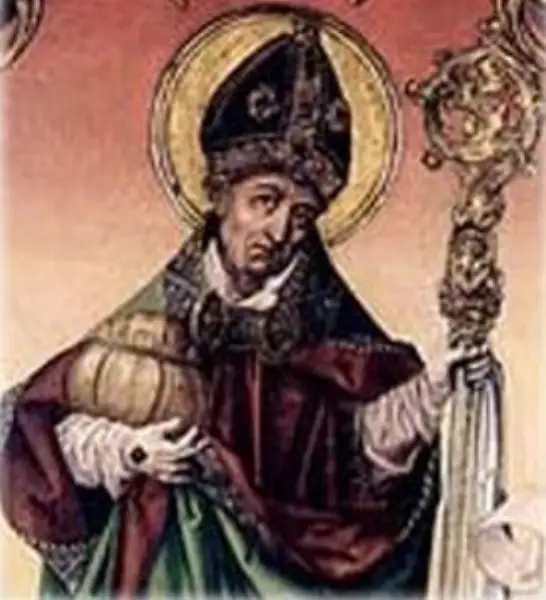
Few missionaries of the early middle ages left so dense a web of commemoration. Rupert is patron of the Austrian state of Salzburg and, together with his successor Vergilius, of the Roman Catholic Archdiocese of Salzburg, and of the neighboring Bavarian Rupertiwinkel, the corner of the old duchy his mission claimed for the faith. He is honored as the Apostle of the Bavarians, and settlements far and wide took or kept his name, from Sankt Ruprecht in Styria to Šentrupert in Slovenia, together with countless church buildings across the Alpine lands. His feast shows the two poles of his story: the Eastern Orthodox churches keep him on March 27, the anniversary of his death, and the Lutheran calendar a day later, while Austria celebrates him on September 24, the anniversary of the translation of his relics into Salzburg Cathedral. In his own city the Rupertitag, or Rupertikirtag, is still a public holiday throughout the state, a Volksfest of fairground merriment kept in the founder's memory. In art he is shown in clerical dress with mitre and crosier, holding the vessel of salt that proclaims both the city's wealth and his work.
§ Veneration
Timeline
- 660
Born around this year into the Frankish nobility, by tradition a scion of the Merovingian dynasty
§ Life
- 27 Mar 710
Reportedly died at Salzburg, tradition holding that his death fell on Easter Sunday
§ Life
- 711
Mission work extended into the Alps with the founding of the first monastic cell, Cella Maximiliana, at present-day Bischofshofen
§ Life
- 717
According to another tradition, Rupert returned to his hometown of Worms and died there in this year
§ Life
- 24 Sep 774
Bishop Vergilius transferred Rupert's mortal remains to Salzburg Cathedral
§ Veneration
The Record
- Major works
- Restoration of the monastic community at St Peter's Abbey, Salzburg·Foundations of Salzburg Cathedral·Foundation of the Benedictine nunnery of Nonnberg·Development of the saltworks at Reichenhall
- Patron of
- Salzburg·The State of Salzburg, Austria·The Roman Catholic Archdiocese of Salzburg·Salt miners·The Rupertiwinkel region of Bavaria
- Symbols
- Holding a container of salt·Wearing a mitre and holding a crosier
- Canonization
- Pre-congregation; venerated since the early medieval period
Prayer
Bibliography
Show 6 sources
- Ulrich Schmid (1912). "St. Rupert". The Catholic Encyclopedia. Vol. 8. Robert Appleton Company. Retrieved 2007-03-27.
- Delehaye, Hippolyte (1911). "Rupert, St". Encyclopædia Britannica. Vol. 23 (11th ed.). p. 856.
- W. Levison, "Die älteste Lebensbeschreibung Ruperts von Salzburg" in Neues Archiv für ältere deutsche Geschichtskunde, xxviii. 283 seq.
- Hauck, Kirchengeschichte Deutschlands (3rd ed.), i. 372 seq.
- O'Hanlon, John (1873), Lives of the Irish saints, vol. 9, p. 536.
- Bibliotheca hagiographica Latina, (Brussels, 1899), n. 7390-7403.
Profile text adapted from the Wikipedia article, licensed CC BY-SA 4.0.
Pray with this saint every day
Save St. Rupert of Salzburg to your favorites, read the full profile, and get feast-day reminders in the Saints app.
Get the Saints AppFree on the App Store for iPhone and iPad