
died 1407·Feast August 23 and December 19
St. Sabbas of Storozhi
Founder of the Savvino-Storozhevsky Monastery
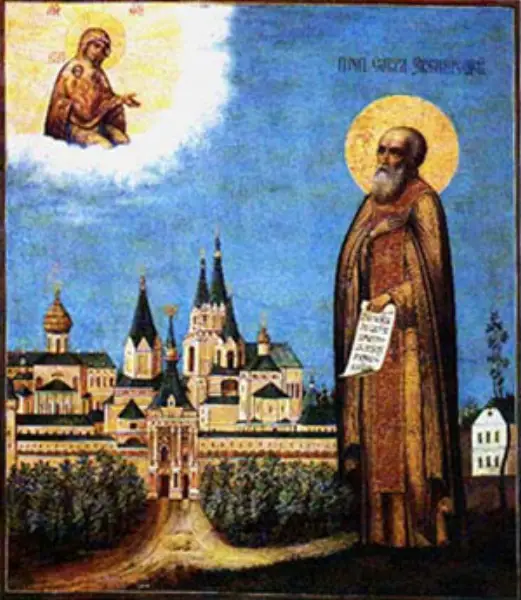
Overview
Sabbas of Storozhi (Savva Storozhevsky) was a Russian Orthodox monk of the fourteenth and fifteenth centuries and numbered among Sergius of Radonezh's earliest followers. Nearly all his years were passed within the Trinity house that bore his master's name, absorbing the ideals of prayer, labor, and stability that marked his master's renewal of Russian monastic life. From that formation he went out to found the monastery of the Nativity of the Theotokos on Storozhi hill above Zvenigorod, becoming its first hegumen; the house was later renamed the Savvino-Storozhevsky Monastery in his honor. Contemporaries sought him out for the healings attributed to his prayers, and remembered his preaching and discernment. He died in 1407. The Russian Orthodox Church canonized him in 1547, and his memory is kept on August 23 and December 19. His hilltop monastery became a principal shrine of the Moscow region. His most famous legacy is a story from 1812, when he was believed to have appeared in a dream to Eugene de Beauharnais, Napoleon's stepson, as troops raided the monastery; recognizing the saint from a portrait, Eugene ordered the house spared, an episode that fixed Sabbas in Russian devotion as a protector of his monastery in time of war.
The Complete Life
In the School of Sergius of Radonezh
Sabbas entered monastic life in one of the most fruitful spiritual milieus medieval Russia ever produced: the circle of Sergius of Radonezh, the great renewer of Russian monasticism. He stands among Sergius's first disciples, and he spent nearly the whole of his life within the Trinity-St. Sergius Lavra, the monastery that became the wellspring of a whole movement of desert houses across the northeastern lands. In that school he absorbed the ideals his master preached: unceasing prayer, manual labor, gentleness toward the brethren, and withdrawal from worldly ambition. Contemporaries and later tradition alike connected him with the gifts that mark a mature elder: discernment of souls, persuasive preaching, and healings attributed to his prayers, for which he became widely sought. Nothing in his story suggests restlessness. Where many of Sergius's disciples went out to found new houses in the wilderness, Sabbas remained long years in stability before obedience finally sent him across the nearby hills to a height above Zvenigorod. The humility of those hidden decades at the Lavra became the foundation of everything that followed: a monastery, a cult, and a reputation for holiness that has not faded in six centuries.
§ Sabbas of Storozhi
A Monastery Above Zvenigorod
On a hill called Storozhi, overlooking Zvenigorod to the west of Moscow, Sabbas raised the monastery of the Nativity of the Theotokos and became its first hegumen. The site was strategic as well as spiritual, a watchpost above the surrounding country, and under his leadership the community took root in the forested borderlands of the principality. His guidance of the brethren won him a reputation far beyond the cloister: the sick sought his blessing, the simple sought his counsel, and his preaching was remembered for its wisdom. In time the house he founded came to bear his own name, the Savvino-Storozhevsky Monastery, an uncommon honor that testifies to how completely he was identified with the place. As abbot he exemplified the disciplined but humane common-life ideal he had learned at Trinity: order in the services, kindness in governance, and confidence that God would provide for a community that prayed and worked. He led the monastery until his death in 1407, leaving behind a brotherhood capable of carrying on what he had begun, and a hilltop sanctuary destined to become a favorite of princes and a destination for pilgrims for centuries.
§ Sabbas of Storozhi
The Dream of a French Prince
Death came to him in 1407; in 1547 the Russian Church enrolled him among its saints, joining the great company glorified in that century; his memory is kept on August 23 and December 19. Pilgrims continued to report healings at his shrine, and the monastery preserved his memory as its chief treasure. The most famous story attached to his name, however, comes from 1812, when Napoleon's army swept through Russia. Eugene de Beauharnais, the viceroy of Italy and the emperor's stepson, was raiding the Savvino-Storozhevsky Monastery during the campaign. According to the account preserved by the monastery, Sabbas appeared to him in a dream. Later, seeing a portrait of the saint, Eugene recognized the man who had visited his sleep, understood the warning, and ordered the monastery spared, a rare mercy amid the devastation of that year. Whether read as history or as hagiography, the tale fixed Sabbas in popular devotion as a protector whose intercession crossed even the boundaries of faith. His shrine at Zvenigorod remains a place of pilgrimage, and his cult is honored across the Russian Orthodox world to the present day.
§ Sabbas of Storozhi
Timeline
- 1407
Died after leading the monastery he had founded on Storozhi hill above Zvenigorod as its first hegumen.
§ Sabbas of Storozhi
- 1547
Canonized by the Russian Orthodox Church.
§ Sabbas of Storozhi
- 1812
Believed to have appeared in a dream to Eugene de Beauharnais, whose troops then spared the Savvino-Storozhevsky Monastery.
§ Sabbas of Storozhi
The Record
- Major works
- Savvino-Storozhevsky Monastery (founded as the monastery of the Nativity of the Theotokos, Zvenigorod)
- Canonization
- Canonized in 1547 by the Russian Orthodox Church
Prayer
Bibliography
Show 3 sources
- The Monk Savva of Storozhevsk and Zvenigorodsk, The Orthodox Calendar, Holy Trinity Russian Orthodox Church, Baltimore, MD
- St. Luke Orthodox Church, Palos Hills, Illinois
- Maria Tobolova, "How a Russian Saint Appeared to Napoleon's Stepson", OrthoChristian.Com (retrieved 2026-09-26)
Profile text adapted from the Wikipedia article, licensed CC BY-SA 4.0.
Pray with this saint every day
Save St. Sabbas of Storozhi to your favorites, read the full profile, and get feast-day reminders in the Saints app.
Get the Saints AppFree on the App Store for iPhone and iPad