
died 272·Feast April 24
St. Sabbas Stratelates
Gothic-born Roman general and martyr under Aurelian
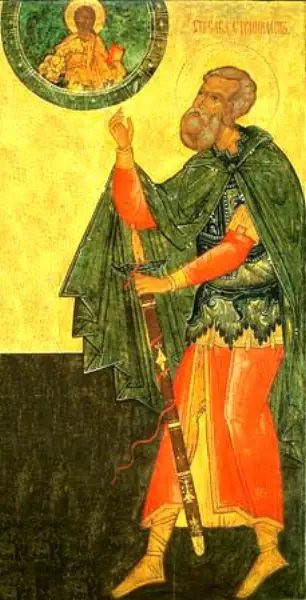
Overview
Sabbas Stratelates, remembered in the Christian East as Sava Stratilat, served as a general in the army of Emperor Aurelian in the third century. Of Gothic descent, he rose through military ranks yet remained from youth a committed Christian, known for charity toward the poor and for seeking out imprisoned believers. Tradition credits him with gifts of healing and exorcism worked in the name of Christ. When Aurelian learned of his faith, he demanded that the general renounce it. Sabbas answered by casting down his military belt, the emblem of his rank, declaring that he would never abandon his Lord. Torturers beat him, burned him with torches, and plunged him into a cauldron of boiling tar, yet he emerged unharmed, and seventy of the soldiers watching came to faith and were beheaded for it. After a night in prison, during which Christ appeared to strengthen him, Sabbas endured further torments and was drowned in the Tiber River in 272. He is venerated by the Eastern Orthodox and Catholic Churches, his feast kept on April 24 in the new calendar and on May 7 among the Russian, Ukrainian, and Serbian churches that follow the old calendar. He is often paired with Saint Sabbas the Goth.
The Complete Life
A Gothic Warrior in Imperial Service
The man the Church remembers as Sabbas Stratelates came from the Gothic peoples who pressed against the Roman frontier in the third century. His tribal origin did not keep him from a career at the heart of the empire: under Emperor Aurelian, who reigned from 270 to 275, he rose to the rank of stratelates, a military commander entrusted with real authority. Yet the title by which he is chiefly known, the General of Rome, describes only one half of his life. From his earliest years he had been a devout Christian, shaped by the teachings of Christ rather than by the ambitions of a soldier's trade. His faith was never a private preference. He gave openly to those in need, sought out believers held in prison, and made no secret of the God he served. In an army and a court still colored by the old paganism, such openness carried real risk, and Aurelian's government was hostile to Christians who would not conform. That Sabbas advanced so far while confessing Christ says much about his character: a man of discipline and bravery in both callings, whose final act of fidelity would outweigh every honor the emperor could grant.
§ Saint Sabbas Stratelates
Mercy Before the Mantle of Command
The memory of the Church treats Sabbas not only as a soldier but as a wonderworker. The sources of his cult relate that he healed the sick and expelled demons in the name of Christ, exercising a gift of grace that drew attention well beyond his garrison. These works of power were joined to works of mercy. He relieved the poor, and he went to visit Christians languishing in prison, a dangerous ministry at a time when aiding confessors could itself invite punishment. His spirituality, as it comes down to us, joined the soldier's steadiness to the disciple's compassion: prayer expressed through courage, and courage expressed through care for the suffering members of the Church. The pairing is instructive. In later iconography he appears in full military dress, the officer and the Christian indistinguishable, because in him neither identity canceled the other. He did not abandon the army in order to become holy, nor did he compromise the faith to keep his command. When trial came, the same constancy that had made him a reliable officer made him immovable before the emperor's demand: the belt of Roman rank could be surrendered, but the belt of faith could not.
§ Saint Sabbas Stratelates
The Belt Cast Down
The crisis broke when Aurelian learned that his general was a Christian. Summoned before him, Sabbas was ordered to apostatize and so keep his life and rank. His answer was a gesture as eloquent as any speech: he threw down his military belt, renouncing the command he would not trade for Christ. What followed was a graduated spectacle of cruelty. He was beaten; burning torches were applied to his body; he was lowered into a cauldron filled with tar, yet, as the account records, the martyr remained unharmed. The spectacle produced its own harvest. Seventy soldiers, watching a man survive what should have killed him, came to believe in Christ, and for that confession they were beheaded by the sword. Sabbas himself was thrown into prison. At midnight, while he prayed, Christ appeared to him, making the cell radiant with his glory and commanding him to lay aside all dread and endure. Heartened by that appearance, he met the morning's renewed torments with composure. The sentence was finally carried out by water rather than steel: in 272 the martyr was drowned in the Tiber, in the city whose general he had been, dying within sight of the empire he had served but never worshiped.
§ Martyrdom
Seventy Witnesses and Two Feasts
Sabbas Stratelates entered the calendar of both East and West. The Eastern Orthodox Church keeps his memory on April 24 in the revised calendar, while the Russian, Ukrainian, and Serbian churches that follow the old calendar honor him on May 7; the Catholic Church likewise venerates him among its early martyrs. In the tradition he is often paired with Saint Sabbas the Goth, the fourth-century martyr of the same name whose own passion unfolded among the Gothic tribes, a pairing that joins the two most celebrated martyrs of Gothic origin. His witness was understood from the first as fruitful: the seventy soldiers who died for Christ after watching his torments were counted as the firstfruits of his martyrdom, a whole company converted by one man's fidelity. For later generations of soldiers, his story carried a double lesson, that military service and Christian confession could be reconciled only so long as the sword remained subordinate to conscience, and that when the two finally conflicted, the believer's first allegiance was already decided. Russian iconography portrays him in full military outfit, the belt and armor of a stratelates, holding the palm that tells what his endurance won.
§ Memory
Timeline
- 270
Rose to the rank of stratelates, commander of Roman forces, under Emperor Aurelian.
§ Saint Sabbas Stratelates
- 272
Threw down his military belt before Aurelian rather than renounce Christ, beginning his passion.
§ Martyrdom
- 272
Drowned in the Tiber River at Rome after surviving beatings, fire, and a cauldron of tar.
§ Martyrdom
The Record
- Canonization
- Pre-congregation martyr; venerated since the early Church by the Eastern Orthodox and Catholic Churches
Prayer
Bibliography
Show 3 sources
- Serbian Orthodox Church: The Holy Martyr Sabbas Stratelates (April 24)
- OCA: Lives of all saints commemorated on April 24: Martyr Sava Stratelates "the General" of Rome
- Catholic saints: St. Sabas
Profile text adapted from the Wikipedia article, licensed CC BY-SA 4.0.
Pray with this saint every day
Save St. Sabbas Stratelates to your favorites, read the full profile, and get feast-day reminders in the Saints app.
Get the Saints AppFree on the App Store for iPhone and iPad