
334 – 372·Feast April 12
St. Sabbas the Goth
Gothic martyr of the Buzău river valley
Overview
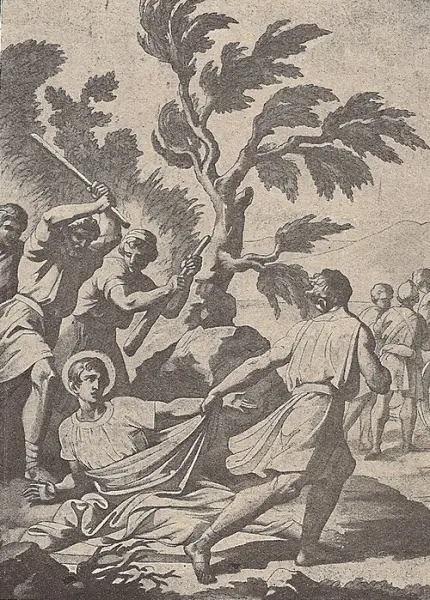
Sabbas the Goth was a fourth-century Christian martyr of the Gothic lands north of the Danube. Born in 334 in a village of the Buzău river valley, in what is now Romania, he converted to Christianity in his youth and served his village church as a cantor or reader. When the Tervingian king Athanaric moved against the Christians in his territory around 369, Sabbas refused even the evasive compromises his pagan neighbors offered, publicly declaring himself a Christian when questioned. On April 12, 372, three days after Easter, he was arrested with the priest Sansalas, tortured, and, by order of the prince Atharid, drowned in the river Musaeus, praising God as he was led to death. His fellow believers recovered and hid his remains; they were later received by Bishop Ascholius of Thessalonica and then sent on to Basil of Caesarea, who praised him in letters as an athlete of Christ and a martyr for the truth. The account of his passion, the Passio of Sabbas, is prized by historians as a rare witness to Gothic village life, social structure, and government. He is venerated in the Eastern Orthodox, Oriental Orthodox, and Roman Catholic churches, with his feast kept on April 12 in the West and April 24 in the East.
The Complete Life
Born on the Gothic Frontier
Sabbas was born in 334 in a village in the valley of the Buzău river, in what is now Wallachia, Romania: Gothic country north of the Danube, where the Tervingi ruled and Christian communities had taken root along the routes of trade with the empire. By race he was a Goth, a member of the people whose relations with Rome swung between alliance and war, and whose kings guarded their ancestral customs jealously. The Christian faith had reached the Goths earlier in the fourth century through captives and clergy crossing the river, and in Sabbas's village it had gathered a small flock with worship of its own. He converted in his youth, joining a community for which belief in Christ set a villager visibly apart from his neighbors and from the religious customs of the tribe. The account of his life suggests he served that flock as a cantor or a reader, offices that put him at the heart of the village's liturgical life and made his Christianity a matter of public knowledge. From his earliest years, then, his identity was fixed and visible: a Gothic villager whose first loyalty belonged to Christ, in a society beginning to regard that loyalty as treason.
§ Life and persecution
Reader in a Persecuted Church
Within his village church Sabbas took up the humble liturgical ministry of cantor or reader, standing among those who sang the psalms and read the scriptures for the assembled faithful. The office was modest, but in a threatened community it carried weight: the reader stood in the front rank of those the authorities would identify as Christian. Sabbas accepted that visibility. When the persecution came, it found him not hiding among the anonymous villagers but already marked out by his service at the altar. His vocation was lived in an atmosphere of mounting danger. King Athanaric of the Tervingi, convinced that Christianity would dissolve Gothic culture and loyalty, had begun to move against the church in his lands around 369, and the suppression filtered down to local nobles charged with driving out the faith. In that setting the village reader's duties became acts of quiet resistance: every psalm sung and every lesson read declared where he stood. The narrative that survives never shows Sabbas seeking ordination or prominence; what it shows instead is a lay liturgical minister whose fidelity in small, public duties prepared him for the extraordinary confession that would end his life.
§ Life and persecution
No Oath on My Behalf
The persecution reached Sabbas's village when a Gothic nobleman sent agents to force the villagers to consume meat offered in sacrifice to the Gothic deities. Many of the pagan inhabitants, in a gesture of quiet solidarity, quietly swapped the forbidden food for meat on which no offering had been made, sparing their Christian neighbors. Sabbas refused the arrangement: he made a conspicuous show of rejecting the sacrifice altogether, unwilling that his faith be even inadvertently hidden behind his neighbors' kindness. The village exiled him for the disturbance, though after a while he was permitted to return. When the noble came again and asked whether any Christians remained, Sabbas stepped forward and declared that no one should swear an oath on his behalf, for he was a Christian. His neighbors insisted he was a nobody of no consequence, and the nobleman brushed him aside, remarking that this fellow could neither help them nor hurt them. The episode reveals the shape of Sabbas's mission: not preaching, not writing, but public and deliberate self-disclosure at the very moments when silence would have been safe. He had learned to spend his reputation, his comfort, and his standing in the village for the name he refused to disown.
§ Life and persecution
Seeing What Others Could Not
The passion narrative shows a man sustained by prayer and by an unusual clarity about what was happening to him. Arrested with the priest Sansalas after the Easter of 372, he endured being dragged naked through thorn bushes, racked to a wagon wheel, and whipped, torments he met without recantation. When his captors offered him sacrificial meat once more the following day, he answered with defiant composure, telling them they might as well kill him. One of Atharid's retinue, enraged by the rebuke of his prince, seized a mortar pestle and hurled it like a spear with such violence that bystanders took Sabbas for dead, yet it left him without a wound. On the road to his death he never ceased glorifying God, reproaching the idolatry of the men who held him, so that his escort, taking him for a fool or a man out of his mind, began to weigh a quiet release, supposing the prince would never learn of it. He would have none of it, pressing them to carry out their orders and telling them he could see what they could not: the saints standing in glory on the other side, come to receive him. His courage was not stoic indifference but vision, the certainty of an invisible world.
§ Martyrdom and translation of relics
The River Musaeus
The priest Sansalas kept the Easter solemnity of 372 in Sabbas's company. Three days on, Atharid, a son of Athanaric's sub-king Rothesteus, came to the village to seize the priest, and Sabbas was taken with him. He was dragged naked through thorn bushes and racked to a wagon wheel, where he was whipped; the next day the ordeal of the sacrificial meat was renewed, and he remained unmoved. The Gothic prince Atharid then sentenced him to death, ordering that he be thrown into the river Musaeus, a tributary of the Danube. As the soldiers led him away he praised God without ceasing, denouncing idolatry until his escort began to waver; considering him insane, they reasoned that the prince would never learn of a quiet release. Sabbas would not allow it, telling them to do what they had been commanded, for he saw the saints waiting to receive him. At his words they pressed him beneath the water with a branch held against his neck, and he was drowned on April 12, 372, during the reign of the emperors Valentinian and Valens. The Christians of the region retrieved his body and hid it until it could be sent across the river for safekeeping.
§ Martyrdom and translation of relics
An Athlete of Christ
Veneration of Sabbas followed immediately upon his death. His remains, hidden by the Christians of the Buzău country, were first received within the Roman Empire by Bishop Ascholius of Thessalonica. When Junius Soranus, the military commander of Scythia Minor, requested relics of the saints on behalf of Basil of Caesarea, the Dacian priests sent Sabbas's body to Caesarea in Cappadocia in 373 or 374, accompanied by a Greek letter known as the Epistle of the Church of God in Gothia, addressed to the church in Cappadocia and to all the local churches; it may have been written by Bretannio of Tomis. Basil answered with two letters to Ascholius in which he extolled the new martyr, calling him an athlete of Christ and a martyr for the Truth, words that fixed his cult at the center of fourth-century Christianity. The Eastern Orthodox Church ranks him among its great-martyrs and hails him in liturgy as holy, glorious, and right-victorious; it keeps his feast on April 24, while Western churches observe April 12, the date of his martyrdom recorded in the Roman Martyrology. He is thus honored across the Orthodox, Oriental Orthodox, and Catholic traditions, one of the earliest Gothic witnesses to be formally venerated.
§ Martyrdom and translation of relics
A Window into the Gothic World
The document that carried Sabbas's story to posterity, his Passio, proved to matter far beyond devotion. Historians value it as a rare window into Gothic village life and social structure in the fourth century: it shows how authority operated from the sub-king and his sons, through local nobles, down to the agents of a single village; how Christians and pagans lived side by side; and how far a community's solidarity could stretch in protecting its minority of believers. It preserves, too, one of the earliest pieces of correspondence between a Gothic church and the hierarchy of the empire. Sabbas's own afterlife has been equally durable. He is venerated in the Eastern Orthodox, Oriental Orthodox, and Roman Catholic churches; his feast is kept on April 12 in the West and April 24 in the East; and in Romania, the land of the Buzău valley where he was born and died, he is remembered as Sava Gotul, the Goth. His memory stands beside that of Nicetas the Goth and the other fourth-century witnesses of the Danube lands, and his story continues to be read both as hagiography and as history.
§ Significance
Timeline
- 334
Born in a village of the Buzău river valley in what is now Romania, among the Gothic Tervingi.
§ Life and persecution
- 369
King Athanaric of the Tervingi began a persecution of Christians in Gothic territory, which reached Sabbas's village.
§ Life and persecution
- Apr 372
After celebrating Easter with the priest Sansalas, he was arrested, dragged through thorn bushes, racked, and whipped.
§ Life and persecution
- 12 Apr 372
Drowned in the river Musaeus on the order of Prince Atharid, urging the soldiers to carry out their duty.
§ Martyrdom and translation of relics
- 373
His relics were sent from Gothia to Basil of Caesarea, accompanied by the Epistle of the Church of God in Gothia.
§ Martyrdom and translation of relics
In Their Own Words
Let no-one swear an oath on my behalf. I am a Christian.
Why do you waste time talking nonsense and not do what you were told to? For I see what you cannot see: over there on the other side, standing in glory, the saints who have come to receive me
The Record
- Canonization
- Pre-congregation martyr; venerated as a great-martyr in the Eastern Orthodox Church and as a saint in the Catholic Church
Prayer
Bibliography
Show 6 sources
- Butler, Alban (1866). The Lives of the Fathers, Martyrs and Other Principal Saints, vol. 4. James Duffy, Dublin.
- Halsall, Guy (2007). Barbarian Migrations and the Roman West, 376–568. Cambridge University Press, Cambridge.
- Heather, Peter (1991). Goths and Romans, 332–489. Oxford University Press, Oxford.
- Heather, Peter and Matthews, John (1991). Goths in the Fourth Century. Liverpool University Press, Liverpool, pp. 102–113.
- Passio S. Sabae, in H. Delehaye, "Saints de Thrace et de Mesie", Analecta Bollandiana 31 (1912), pp. 161–300.
- Wolfram, Herwig (1988). History of the Goths, trans. T. J. Dunlap. University of California Press, Berkeley.
Profile text adapted from the Wikipedia article, licensed CC BY-SA 4.0.
Pray with this saint every day
Save St. Sabbas the Goth to your favorites, read the full profile, and get feast-day reminders in the Saints app.
Get the Saints AppFree on the App Store for iPhone and iPad