
439 – 532·Feast December 5
St. Sabbas the Sanctified
Founder of the Great Lavra of Mar Saba
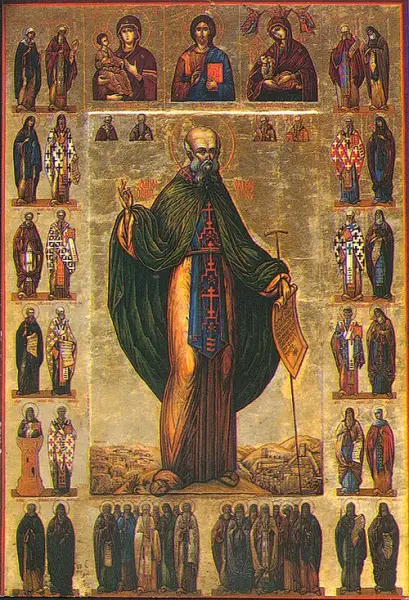
Overview
Sabbas the Sanctified (439–532) was a Cappadocian Greek monk, priest, and founder whose Great Lavra in Palestine became the most influential monastery of the Byzantine East. Born at Moutalaske near Caesarea of Cappadocia to a military family, he entered monastic life as a child and refused his parents' plan that he marry. Sent toward the Holy Land, he was formed under Euthymius the Great and Abba Theoctistus, alternating cenobitic obedience with ever deeper solitude in the Judaean caves. After Euthymius's death around 473 he settled near the Jordan, and disciples gathered around him; from this company grew the Great Lavra, founded in the Kidron Valley in 484 and known today as Mar Saba. Sabbas organized Palestinian monasticism itself: the patriarch appointed him archimandrite of the desert's anchorites around 491, he founded several further houses, and he compiled the Jerusalem Typikon, the first monastic rule of church services, which guided Byzantine monasteries for centuries. A steadfast supporter of the Chalcedonian creed, he personally petitioned Emperor Anastasios I in 511 and Emperor Justinian I in 531. He died on December 5, 532. His relics, carried to Venice by Crusaders, were returned to Mar Saba by Pope Paul VI in 1965.
The Complete Life
A Child of Cappadocia
Sabbas was born in 439 at Moutalaske, a village near Caesarea of Cappadocia, to a family of standing: his father John was a military commander and his mother was named Sophia. The village's name, without a known meaning in Greek, carries in Aramaic the sense of Village of Victory, an irony for a boy whose earliest years were marked by separation rather than triumph. His parents, bound for Alexandria on military business, entrusted their boy of five to an uncle's keeping. At eight years old he entered the neighboring house of Bishop Flavian of Antioch, where the precocious boy soon mastered reading and gained an unusually deep command of Scripture. His parents' hopes eventually turned homeward: they urged their son to come back to the world, take a wife, and carry on the family line. He refused. The pressure of family, normally the strongest claim on a Cappadocian boy of good birth, could not outweigh what he had found in the monastery's discipline and prayer. At seventeen he received the monastic tonsure, and he remained ten further years in Flavian's house, completing a formation that joined him to monastic life permanently before he had reached his thirtieth year.
§ Early life
Apprenticeship in the Holy Land
Leaving Cappadocia as a young monk, Sabbas reached Jerusalem and then passed into the circle of Euthymius the Great, whose laura stood at the head of Palestinian monasticism. Judging that the newcomer needed formation rather than freedom, Euthymius directed him to Abba Theoctistus, whose nearby house observed a strict common-life rule. There Sabbas lived in obedience until the age of thirty, submitting his considerable gifts to the ordinary round of communal life. Only after the death of the Elder Theoctistus did his path turn toward solitude. His successor blessed Sabbas to withdraw into a cave, though he still came down each Saturday for the divine services and the common meal; in time he received permission to remain in the hermitage entirely, and he lived five years in unbroken isolation. Euthymius watched over him throughout, directing the young monk's life with a father's attention. He began taking Sabbas with him into the wilderness each January 14, remaining out until Palm Sunday, and he called his disciple a child-elder, a boy in years with the gravity of age, encouraging him to grow in the monastic virtues. Under two such masters, Sabbas's vocation took its definitive double shape: cenobitic obedience and desert solitude.
§ Holy Land: apprenticeship
Founder and Archimandrite of the Desert
When Euthymius died around 473, Sabbas withdrew from the lavra and settled in a cave near the monastery of Saint Gerasimus of the Jordan. Disciples gradually gathered around the solitary, seeking the monastic life under his guidance, and as their numbers increased the settlement became the Great Lavra, its founding in the Kidron Valley south of Jerusalem traditionally dated to 484. The foundation embodied his distinctive vision of communal structure: in his lavras the young monks lived a fully cenobitic life, while the elders followed a semi-eremitical discipline, dwelling in separate huts inside the enclosure and coming together only for the principal acts of worship. Opposition to this arrangement eventually drove him to withdraw and build a second house, the New Lavra near Thekoa. His standing in the Palestinian desert received institutional form once Marcian, the region's archimandrite, had died (around 491–492): the desert monks went to Patriarch Salustius of Jerusalem asking that Sabbas be placed over the anchorites and cave-dwellers, while Theodosius was charged with all who lived the common life. He founded several further monasteries, and his responsibilities came to include the defense of the faith itself: as a strenuous supporter of the Chalcedonian creed and opponent of the Monophysites and Origenists, he personally urged the emperors to act against them.
§ Hermit, founder of monasteries, Church leader
Solitude, Wonders, and a Rule of Prayer
Contemporaries saw in Sabbas a rare union of the active and contemplative gifts. The tradition recounts many miracles worked through his prayers: a spring of water welled up at the lavra, abundant rain fell during a time of drought, and the sick and the possessed were healed. Yet the center of his spirituality remained the disciplines of the desert: long stretches of solitude in his cave, the weekly rhythm of returning to his brethren for worship and the common table, and the annual descent with Euthymius into the deeper wilderness from mid-January until Palm Sunday. His genius was organizational as much as mystical. The liturgical order he composed for his communities became the Jerusalem Typikon, the first monastic rule of church services, written for the guidance of all the Byzantine monasteries and still felt in Orthodox worship. In him the roles of hermit, abbot, and legislator of prayer coincided: the man who could keep five years of near-total silence was the same man who could govern a federation of lavras and speak with emperors. His iconography compresses the story into a single attribute, an apple held in his hand, a token of the simple, fruitful concreteness of his sanctity.
§ Hermit, founder of monasteries, Church leader
Pilgrim to Emperors
Sabbas's last decades were spent in unbroken labor for the church of the Holy Land. In 511 he traveled to Constantinople to plead the Chalcedonian cause before Emperor Anastasios I, and in 531, near the end of his life, he called personally on Justinian I in the same interest. Between these journeys he continued to govern his lavras, receive disciples, and compile the liturgical legislation that became the Jerusalem Typikon. He died in 532, on December 5, the date his feast has kept ever since, at Jerusalem in Palaestina Prima, an old man whose monastery had become the most influential spiritual house in the region. The account of his life was written by his disciple Cyril of Scythopolis, whose biographies of the Palestinian monks preserved his memory in vivid detail, and the chief modern studies from Ehrhard onward have drawn on that source. His burial place was the Great Lavra itself, and his body remained an object of pilgrimage through the following centuries. By his death he had held, for four decades, the office of archimandrite of the desert's anchorites, shaped the worship of the Byzantine East, and given the wilderness of Judaea an institutional form that would endure for a thousand years.
§ Hermit, founder of monasteries, Church leader
Relics of the Holy Elder
Sabbas passed directly into the Church's veneration, honored in both the Eastern Orthodox and Catholic traditions with his feast on December 5, the day of his death. His cult centered on the Great Lavra, known after him as the monastery of Mar Saba, where his relics remain the community's most sacred possession. Their history is turbulent. Crusaders seized the relics in the twelfth century in the course of the War of Saint Sabas and carried them to Italy, where they rested in the church of Saint Anthony in Venice for hundreds of years. In 1965 Pope Paul VI returned them to Mar Saba as a gesture of goodwill toward the Orthodox, restoring the saint to the lavra he had founded. The medieval West also claimed him in stone: the church of San Saba in Rome is dedicated to his name, one of the churches dedicated to Greek saints and enriched with their relics. In the iconography of both churches he appears as an elderly abbot holding an apple, an emblem drawn from the emblem books and from his recorded wonders. He is remembered among the great fathers of Palestinian monasticism, alongside Euthymius, Gerasimus, Chariton, and Theodosius, whose houses made the Judaean desert a second Egypt.
§ Relics
From the Kidron Valley to Texas
The Great Lavra of Mar Saba long remained the most influential monastery in the Palestinian desert, and its productivity matched its reputation: from it came Saint John of Damascus, the foremost hymnographer and theologian of the Greek East, formed in the rule Sabbas had written. That rule, the Jerusalem Typikon, shaped the liturgical life of Byzantine monasteries everywhere and through them the worship of the Orthodox Church as a whole. The monastery itself still clings to the cliffs of the Kidron Valley, continuing a monastic presence on the site since 484. Sabbas's name also traveled to places he never imagined. When Juan Antonio Bustillo y Ceballos came upon a river in Spanish Texas on December 5, 1732, the saint's feast day, he christened it the Río de San Sabá de las Nueces, the River of Saint Sabbas of the Walnuts, and the San Saba River and neighboring features in Texas preserve the name today. In Rome, the church of San Saba and the quarter that grew around it carry his memory in the heart of the old city. Few founders have left marks at once so institutional, so liturgical, and so unexpectedly geographic.
§ Legacy
Timeline
- 439
Born at Moutalaske near Caesarea of Cappadocia, son of the military commander John and his wife Sophia.
§ Early life
- 447
Entered the nearby monastery of Bishop Flavian of Antioch at the age of eight, left in an uncle's care.
§ Early life
- 456
Received monastic tonsure at seventeen, refusing his parents' plea that he come home, wed, and carry on the family line.
§ Early life
- 466
Departed for the Holy Land; Euthymius the Great sent him to the strict cenobitic monastery of Abba Theoctistus.
§ Holy Land: apprenticeship
- 469
Having lived in obedience until the age of thirty, he was blessed to withdraw to a cave in seclusion.
§ Holy Land: apprenticeship
- 473
Euthymius the Great died; Sabbas withdrew from the lavra to a cave near the monastery of St Gerasimus of the Jordan.
§ Hermit, founder of monasteries, Church leader
- 484
Founded the Great Lavra in the Kidron Valley south of Jerusalem as disciples gathered around him.
§ Hermit, founder of monasteries, Church leader
- 491
Appointed archimandrite of the anchorites and cave-dwellers of the Jerusalem wilderness by Patriarch Salustius.
§ Hermit, founder of monasteries, Church leader
- 511
Traveled to Constantinople to urge Emperor Anastasios I against the Monophysites and Origenists.
§ Hermit, founder of monasteries, Church leader
- 531
Called personally on Emperor Justinian I in defense of the Chalcedonian creed.
§ Hermit, founder of monasteries, Church leader
- 5 Dec 532
Died at Jerusalem; his feast has been kept ever since on December 5, the day of his death.
§ Hermit, founder of monasteries, Church leader
- 1965
Pope Paul VI returned his relics from the church of Saint Anthony in Venice to the monastery of Mar Saba.
§ Relics
The Record
- Major works
- Jerusalem Typikon (first monastic rule of church services)·Great Lavra of Mar Saba (founded 484)·New Lavra near Thekoa
- Symbols
- an apple in his hand
- Canonization
- Pre-congregation; venerated since antiquity by the Eastern Orthodox and Catholic Churches
Prayer
Bibliography
Show 6 sources
- Patrich, Joseph (1995). Sabas, Leader of Palestinian Monasticism: A Comparative Study in Eastern Monasticism, Fourth to Seventh Centuries. Dumbarton Oaks Studies 32. Dumbarton Oaks.
- Jotischky, Andrew (2011). A Hermit's Cookbook: Monks, Food and Fasting in the Middle Ages. Continuum, London and New York.
- Speake, Graham (2021). Encyclopedia of Greece and the Hellenic Tradition. Routledge, p. 1697.
- "St. Sabbas", Catholic Encyclopedia.
- Husenbeth, Frederik Charles (1860). Emblems of Saints: By which They are Distinguished in Works of Art. Longman, Green, Longman, and Roberts, p. 147.
- Chisholm, Hugh, ed. (1911). "Sabas, St", Encyclopædia Britannica, vol. 23 (11th ed.). Cambridge University Press.
Profile text adapted from the Wikipedia article, licensed CC BY-SA 4.0.
Pray with this saint every day
Save St. Sabbas the Sanctified to your favorites, read the full profile, and get feast-day reminders in the Saints app.
Get the Saints AppFree on the App Store for iPhone and iPad