
died 1435·Feast September 27
St. Sabbatius of Solovki
Co-founder of the Solovetsky Monastery
Overview
Sabbatius of Solovki (Savvaty Solovetsky) was a Russian monk who became one of the founders of the Solovetsky Monastery in the White Sea. He began his monastic life at the Kirillo-Belozersky Monastery, but restless for complete solitude and silent prayer, he set out for the far north, and by 1429 he was living beside a chapel on the Vyg River. There he came to know a solitary of the surrounding woods named German, who consented to go with him across the sea to the deserted island of Solovki. The two erected a cross and a hermit's cell some thirteen kilometers from the site of the future monastery, the founding gesture of what would become one of the greatest spiritual centers of the Russian North. Sabbatius died on the island on September 27, 1435, before the community was established; after his death, newly arrived monks began building the monastery that bears the island's name, and his companion German linked the founding generation to its future. The Russian Orthodox Church canonized him in 1547. His feast is kept on September 27, and on August 8 he shares a commemoration with Saint Zosimas of Solovki, for in 1566 the remains of both founders were moved to a church dedicated to the two of them.
The Complete Life
The Search for Deeper Silence
Sabbatius began his monastic life at the Kirillo-Belozersky Monastery, the great house on the northern frontier that ranked among the most rigorous spiritual centers of medieval Russia. Even within its walls he was searching for more. The accounts of his life describe a monk restless for complete solitude and silent prayer, who learned of a large deserted island in the White Sea where such a life might be possible. Before acting on that longing he tested another tradition: he heard of the Valaam Monastery on Lake Ladoga, whose monks were famed for an austere way of life, and their example confirmed the direction of his desires. In 1429 he left the established houses behind and moved to the White Sea coast, settling near a chapel on the Vyg River. There providence supplied him with a companion, a monk named German, who had lived for years in the forest in solitude and agreed to join him. The two formed one of the great spiritual partnerships of northern Russian monasticism: the searcher and the seasoned solitary, preparing together for a journey to an island where no one had yet built anything for God.
§ Life
A Cross on an Empty Shore
The voyage of Sabbatius and German across the waters of the White Sea brought them to the desolate island of Solovki, where they erected a cross and raised a hermit's cell about thirteen kilometers from the site of the future monastery. That act, a cross planted on an empty shore and two monks left alone with prayer and cold, was the founding gesture of Solovetsky Monastery. Sabbatius did not live to see the house grow. He died on September 27, 1435, after six years on the island, leaving German as the link between the founding generation and the community that followed. Only after his passing did monks newly arrived on the island start to build the house that took the name of Solovetsky, which grew into one of the greatest spiritual, economic, and missionary centers of the Russian North, famed for its severity, its learning, and its endurance through siege and hardship. Sabbatius shares the honor of its founding with Saint Zosimas of Solovki, the organizer of the later community, and with German, who survived them both and carried their memory forward. The three co-founders are commemorated together in Russian iconography and prayer.
§ Life
Venerable Wonderworker of Solovki
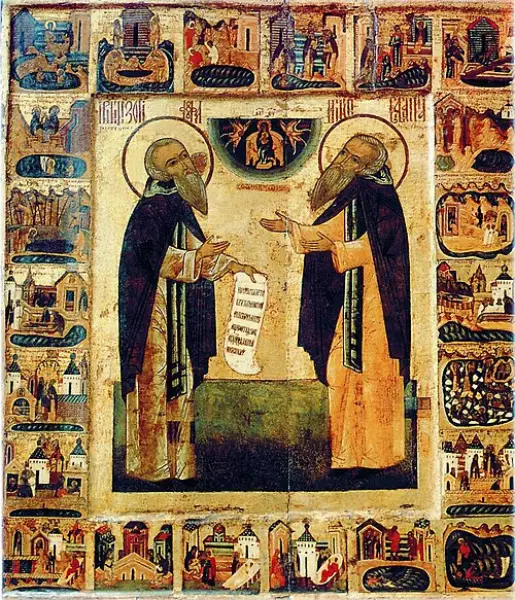
The Russian Orthodox Church glorified Sabbatius in 1547, and since that year he has been venerated as a saint both in Russia and in the wider Eastern Orthodox Church, honored as the Venerable Wonderworker of Solovki. His principal feast falls on September 27, the day of his death, and a second commemoration on August 8 recalls the translation of his relics together with those of Saint Zosimas in 1566, when the remains of the two founders were placed in a church dedicated to their names. The pairing of the two saints in feast and icon has kept Sabbatius's memory inseparable from the monastery he never saw completed. Sixteenth-century icons portray Zosimas and Sabbatius side by side with scenes from their lives, images that hung in churches across Russia and fixed the founding story in the imagination of the faithful. Pilgrims to the Solovetsky archipelago for centuries began their journey by asking the prayers of the monk who first crossed to the island with a cross and a cell. Through political upheaval and the monastery's many transformations, his cult has endured as a symbol of the northern desert: silence sought for God, and fruitfulness beyond all expectation.
§ Veneration
Timeline
- 1429
Left the settled monasteries for the far north, settling near a chapel on the Vyg River before sailing to the island of Solovki.
§ Life
- 27 Sep 1435
Died on the island of Solovki, some six years after settling there with the monk German.
§ Life
- 1547
Canonized by the Russian Orthodox Church.
§ Veneration
- 8 Aug 1566
His relics were translated together with those of St Zosimas into a church named in their honor.
§ Veneration
The Record
- Major works
- Solovetsky Monastery (co-founder, with Sts Zosimas and German)
- Canonization
- Canonized in 1547 by the Russian Orthodox Church
Prayer
Bibliography
Show 4 sources
- Преподобный Савватий Соловецкий, Orthodox calendar, Pravoslavie.Ru
- Основатели Соловецкой обители, Solovki Monastery
- "Venerable Sabbatius, Wonderworker of Solovki", www.oca.org (retrieved 2024-08-12)
- "SOLOVKI - Holy Isles of Monks and Martyrs", www.pravmir.com (retrieved 2024-08-12)
Profile text adapted from the Wikipedia article, licensed CC BY-SA 4.0.
Pray with this saint every day
Save St. Sabbatius of Solovki to your favorites, read the full profile, and get feast-day reminders in the Saints app.
Get the Saints AppFree on the App Store for iPhone and iPad