
died c. 126·Feast August 29
St. Sabina
Roman widow, martyr, and namesake of the Aventine basilica
Overview
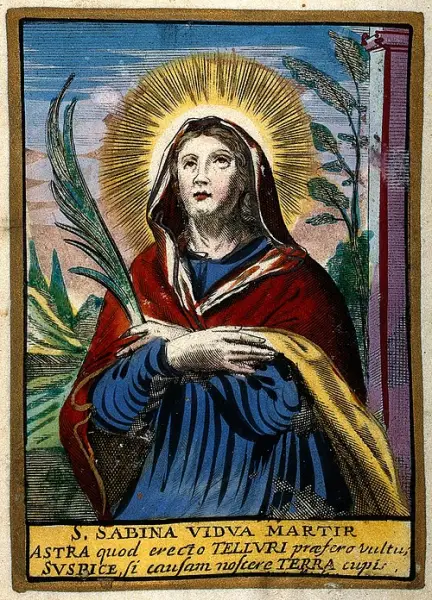
Sabina of Rome, sometimes called Sabina the Roman, was a Christian widow martyred in the city of her birth around AD 126, though some traditions date her death closer to 119. She came from a family of means: her father was Herod Metallarius, the metalworker, and her husband was Senator Valentinus, whose family origin lay in Avezzano in the Abruzzo. Her conversion came through the witness of her Syrian slave Serapia, whose example drew the matron to the Christian faith. After Serapia was denounced and beheaded at Vindena in Umbria, Sabina recovered her relics and laid them in the family mausoleum, the place where she herself expected to rest. Sabina in turn was denounced to Elpidio the Prefect and put to death for the faith in Rome. She is honored as a saint by both the Catholic Church and the Eastern Orthodox Church, with her feast on August 29. In 430 her relics were translated to the newly built Aventine basilica that bears her name, Santa Sabina, raised on the site of her Roman house; a reliquary of the saint is also venerated at Ascona in Switzerland.
The Complete Life
A Daughter of the Roman Aristocracy
Sabina belonged by birth and marriage to the comfortable upper ranks of Roman society. Her father, Herod Metallarius — the name recalls his trade as a metalworker — was a man of substance, and her husband, Senator Valentinus, came of a family rooted in Avezzano among the uplands of the Abruzzo. As the widow of a senator, Sabina would have kept a town house on the Aventine Hill, country estates, and household slaves, the ordinary furniture of a wealthy Roman life at the turn of the second century. The sources say nothing of children or of the years of her marriage; what they preserve is the turning of that life. In a household of means, faith arrived not through public preaching but through the witness of a slave — Serapia, a Syrian woman in Sabina's service, whose quiet, practiced Christianity persuaded her mistress that the God of the Christians was real. The great Roman lady became the disciple of the captive Syrian, an inversion of every social expectation of her class.
§ Biography
Conversion and Good Works
Once converted, Sabina did not treat Christianity as a private taste to be concealed behind her rank. She retired from the city to a rural estate of hers with a handful of like-minded Christian companions, and gave her days to works of charity — a form of religious life that early Christian Rome recognized in its wealthy widows, who funded the church out of their households and their purse. Her servant and teacher Serapia remained close to her in this new life, and it was Serapia whom the authorities seized first. Denounced as a Christian, the Syrian woman was taken to Vindena in Umbrian territory and there beheaded. Sabina's response was an act of audacious public piety: she recovered the relics of the martyr and interred them in the family mausoleum, deliberately claiming for Serapia the burial place Sabina had reserved for herself. In doing so she bound her own destiny to her friend's, joining her name to the martyr's in a single cult that the oldest Roman church calendars would later honor together.
§ Biography
Denunciation and Martyrdom
The example of Serapia's death made Sabina conspicuous, and the machinery of persecution soon turned on the widow herself. Elpidio, the Prefect of Rome, denounced her and formally accused her of being a Christian. Sabina made no recorded defense beyond the faith for which she had already arranged her household; condemned for the name she bore, she was put to death in her native city, in the persecutions that tradition places around AD 126, though some accounts prefer the year 119. The accounts of her trial and passion that circulated in later centuries are, as the Catholic Encyclopedia's Klemens Löffler observed, of no historical value in their details — they are devotional romances of a later age. But the bare fact they decorate is old and certain: a Roman matron of the Aventine died for Christ, and the community that gathered at her house kept her memory with the palm and crown of a martyr. The church that rose there would take her name, and through it her obscure second-century fidelity entered the permanent memory of the city.
§ Biography
The Basilica on the Aventine
Sabina's memory took permanent architectural form in the fifth century. In the year 430 the martyr's remains were moved to the Aventine and enshrined in the basilica just then rising there under her own name, on the very ground where her Roman house had stood beside a temple of Juno. Her home, like many dwellings of wealthy early Christians, may already have served as a titular church — a private hall opened for the worship of the neighborhood community. The new basilica was at first dedicated to both Sabina and Serapia, honoring together the martyr and the slave whose witness had converted her. Modern historians read the story with a critical eye: Maya Maskarinec suggests that Sabina was most plausibly the donor who gave the Aventine property for the titulus, and that her passio, taking shape between the sixth and eighth centuries, fastened onto the recollection of a wealthy benefactor of the later fourth or early fifth century — one of the many donors of titular churches who in time were transformed into the patron saints of their congregations. Whichever way the history is weighed, her relics remain beneath the lights of the Aventine, and her feast of August 29 is kept in East and West alike.
§ Commentary
Timeline
- 126
Sabina is denounced as a Christian by the Prefect Elpidio and martyred in Rome.
§ Biography
- 430
Sabina's relics are translated to the newly erected Aventine basilica of Santa Sabina, built on the site of her house.
§ Relics
The Record
- Patron of
- patron of the Aventine Hill and the basilica of Santa Sabina, Rome
- Symbols
- book·palm·crown
- Canonization
- Pre-congregation; venerated as a martyr since antiquity in the Catholic and Orthodox Churches
Prayer
Bibliography
Show 6 sources
- "St. Sabine", Vatican News
- "Relics of Saint Sabina the Roman at Bigorski Monastery". Retrieved 17 August 2025.
- "St. Sabina, Martyr, at Rome", Antiochian Orthodox Christian Archdiocese
- Roth, Leland M. (1993). Understanding Architecture: Its Elements, History and Meaning (First ed.). Boulder, CO: Westview Press. pp. 245. ISBN 978-0-06-430158-9.
- "CATHOLIC ENCYCLOPEDIA: St. Sabina". www.newadvent.org. Retrieved 17 August 2025.
- Maskarinec, Maya (10 April 2018). City of Saints: Rebuilding Rome in the Early Middle Ages. University of Pennsylvania Press. ISBN 978-0-8122-5008-4.
Profile text adapted from the Wikipedia article, licensed CC BY-SA 4.0.
Pray with this saint every day
Save St. Sabina to your favorites, read the full profile, and get feast-day reminders in the Saints app.
Get the Saints AppFree on the App Store for iPhone and iPad