
died c. 303·Feast December 30
St. Sabinus of Spoleto
Bishop of Spoleto martyred under Diocletian with his deacons
Overview
Sabinus, bishop of Spoleto, died around 303 as a victim of the last great persecution of the Roman empire. When Diocletian's edict demanded that every Christian sacrifice to the gods or forfeit life and estate, Venustian, the governor of Etruria and Umbria, arrested Sabinus and his deacons at Assisi. Before the tribunal the bishop confessed that Christ had risen from the dead on the third day; the governor mockingly invited him to do the same. His deacons, encouraged by their leader, were torn to death with iron hooks, and Sabinus himself had his hands cut off before being cast into prison. There a woman named Serena cared for him, and there he cured a man who had been blind from birth. When Venustian heard of the miracle, he asked the bishop to heal his own eyes; Sabinus restored his sight and won him to the Christian faith, and the converted governor sheltered his prisoner. Hearing of this, Maximianus Herculius sent the tribune Lucius, who beheaded Venustian, his wife, and his two sons at Assisi, and at Spoleto beat Sabinus until he died. Both the Catholic and Orthodox churches keep his feast on December 30.
The Complete Life
A Bishop Before the Tribunal
Sabinus led the church of Spoleto as its bishop in the closing years of the third century, when Diocletian's edicts demanded that every Christian offer sacrifice to the Roman gods or die, their estates confiscated for the state. The order reached Umbria in the person of Venustian, who governed Etruria and Umbria and made the bishop and his deacons his first targets, arresting them at Assisi. Before the tribunal the governor poured contempt on the Christian faith, charging that Sabinus was leading the people after a dead man. The bishop answered with the heart of the gospel: Christ, he said, had risen again on the third day. Venustian answered with sarcasm, inviting the bishop to rise in like manner, but the challenge did not shake the prisoner's composure. His deacons, however courageous by disposition, trembled at what awaited them; it was Sabinus who steadied them, urging them to hold to the faith they had preached. The scene is an early portrait of what a bishop was for: not an administrator shielded by office, but a shepherd whose steadiness was meant to carry his whole flock across the brink of death.
§ Traditional narrative
Light from a Prison Cell
Prison changed the terms of Sabinus's ministry. Robbed of his hands by the governor's order and shut away to await his end, he received an unexpected congregation: the sick, and first among them a man who had been blind from birth. The bishop healed him, and word of the cure ran through the city until it reached Venustian himself. The governor, whose eyes were diseased, set aside his dignity as judge and sought healing from the prisoner he had condemned, and Sabinus, far from refusing his persecutor, restored his sight. The miracle did what argument had not: Venustian believed, embraced the Christian faith, and turned his own house into a shelter for the bishop he had tortured. A woman named Serena tended the maimed prisoner through those same days, and her service passed into the record beside the governor's conversion as proof that kindness to the suffering counts among the works of the saints. The story the tradition preserves is pointed: the hands that had been cut off continued, through prayer alone, to give light to the blind and healing to the very man who had ordered their mutilation.
§ Traditional narrative
The End at Spoleto
The conversion of Venustian brought the persecution to a darker turn. Maximianus Herculius, hearing that the governor had become a Christian and was protecting the bishop, dispatched the tribune Lucius to settle the matter by force. Lucius carried out his commission with particular cruelty: Venustian, together with his wife and his two sons, was beheaded at Assisi, so that the household converted through Sabinus's ministry followed him in the witness of blood. At Spoleto the tribune turned on the bishop himself. The old confessor, already deprived of his hands, was beaten until he died, and the city of his see became the place of his crown. The tradition dates his passion to about the year 303, in the first wave of the Great Persecution. In the economy of the story nothing is wasted: the bishop who had encouraged his deacons not to fear the tormentor endured the loss of his hands without surrendering his work; the governor who had mocked the resurrection died professing the risen Christ; and the tribune's cruelty, meant to end the matter, fixed it forever in the memory of the Umbrian church.
§ Traditional narrative
Raised by the Acclamation of the Churches
The churches never forgot him. Sabinus was raised to the altar by the acclamation of the Christian communities of Umbria, in the age before formal canonization, and his cult passed intact into the two great traditions of the West and the East. The Roman Martyrology of the Catholic Church enters him on December 30, and the Eastern Orthodox Church keeps the same day, so that bishop and deacons are commemorated together across the old division of Christendom. Catholic communities may, according to their particular calendars and customs, transfer the observance to another day, but the Martyrology's date stands. He is numbered among the martyrs who are saints of the Catholic Church, his cause committed to no process of investigation because his witness was public from the first. That a bishop who suffered in a provincial persecution should hold a fixed place in both the Roman and the Byzantine calendars is a measure of how deeply the story took hold: the record of his passion, with its conversions and its cruelties, was read and copied wherever the martyrs of the Diocletianic era were honored.
§ Veneration
In Paint, in Stone, and Among His Namesakes
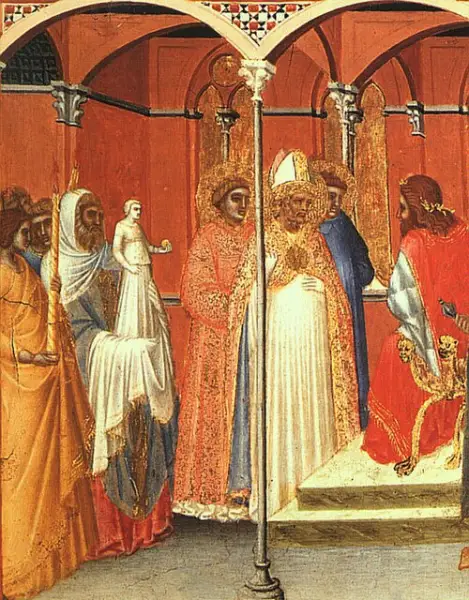
Art took up his story early. The Maestà of Duccio, painted for Siena's cathedral at the beginning of the fourteenth century, includes Sabinus among the saints; and Pietro Lorenzetti gave the Umbrian church its most vivid image of him in the panel of Saint Sabinus preaching the gospel before Venustian, the confrontation before the tribunal rendered as teaching, the captive bishop mid-sermon. At Spoleto itself a church dedicated to him, San Sabino, still stands outside the walls, one of the early sanctuaries of the Umbrian plain. His name is kept distinct from those of the other saints who bore it: the Roman Martyrology lists six men named Sabinus, three of them bishops, and tradition takes care not to confuse the bishop of Spoleto with Sabinus of Canosa, who died about 566 and is commemorated on February 9, or with Sabinus of Piacenza, who died in the late fourth century and whose feast falls on December 11. The distinction is itself a tribute: a saint sufficiently celebrated to require careful sorting from his namesakes, and sufficiently loved that the churches of Spoleto and Assisi never let his December feast lapse.
§ Veneration
Timeline
- 303
Arrested at Assisi with his deacons on the order of Venustian, who governed Etruria and Umbria, under Diocletian's edict
§ Traditional narrative
- 303
Steadied his frightened deacons to hold to the faith; they were torn to death with iron hooks
§ Traditional narrative
- 303
Had his hands cut off on Venustian's order and was thrown into prison
§ Traditional narrative
- 303
Tended in prison by a woman named Serena and healed a man who had been blind from birth
§ Traditional narrative
- 303
Restored the sight of Venustian, who believed, converted to Christianity, and sheltered him
§ Traditional narrative
- 303
The tribune Lucius, dispatched by Maximianus Herculius, put the converted governor Venustian, his spouse, and both sons to the sword at Assisi
§ Traditional narrative
- 303
Beaten until he died at Spoleto, the city of his episcopal see
§ Traditional narrative
The Record
- Canonization
- Pre-congregation; venerated in Catholicism and Eastern Orthodoxy
Prayer
Bibliography
Show 6 sources
- Hutchison-Hall, John (Ellsworth) (2012), "30th December – Sabinus, Exuperantius, Marcellus, Venustian and Companions", Orthodox Saints of the Pre-Schism See of Rome, retrieved 18 January 2023
- Second Vatican Council, Decree on the Pastoral Office of Bishops in the Church Christus Dominus, 11
- Martyrologium Romanum (Editio typica ed.). Città del Vaticano: Typis Vaticanis. 2004. ISBN 88-209-7210-7.
- "Saint Sabinus of Spoleto and Companions". Catholic Current. Washington, DC: United States Conference of Catholic Bishops. 2021. Retrieved 18 January 2023.
- "St. Sabinus - Saints & Angels". Catholic Online. Retrieved 18 January 2023.
- Englebert, Omer. "The Lives of the Saints." Anne and Christopher Fremantle, trans. Nihil obstat 1954. New York: Barnes & Noble, 1994, p. 494-495
Profile text adapted from the Wikipedia article, licensed CC BY-SA 4.0.
Pray with this saint every day
Save St. Sabinus of Spoleto to your favorites, read the full profile, and get feast-day reminders in the Saints app.
Get the Saints AppFree on the App Store for iPhone and iPad