
670 – c. 720·Feast May 4
St. Sacerdos of Limoges
Monk, abbot of Calviac, and bishop of Limoges and Sigüenza
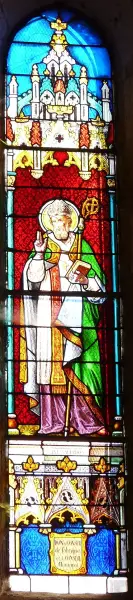
Overview
Sacerdos of Limoges, whose name survives in the forms Sardot, Sadroc, Sardou, Serdon, and Serdot, was born around 670 near Sarlat and gave his life to the monastic and episcopal service of the medieval French church. He embraced the monastic habit and, in his native region, founded Calviac Abbey, over which he ruled as first abbot. His gifts did not long remain hidden in the cloister: he was raised to the episcopate as bishop of Limoges, and in a striking extension of responsibility his care was later appointed to the see of Sigüenza as well. He died around 720. Devotion to him took early root in the country of his birth, where Sarlat Cathedral was dedicated to his memory and still bears his name. His family was marked by holiness before him, for his mother, Modane, is herself honored as a saint, so that mother and son belong together to the spiritual patrimony of the region that reared them both. The brevity of his surviving record contrasts with the permanence of the institutions he left behind: an abbey he planted, two sees he governed, and a cathedral that keeps his dedication to this day.
The Complete Life
From Sarlat to the Cloister
In the region of Sarlat, Sacerdos was born around the year 670 into a family already familiar with sanctity, for his mother, Modane, would be honored as a saint in her own right. As a young man he left the world for the monastery, embracing a life whose rule of prayer and labor shaped everything that followed. But Sacerdos was not content merely to inhabit an existing community: on ground of his own he founded a new house, Calviac Abbey, and served it as its first abbot. To found a monastery in that age was to plant both a church and a small economy in the countryside, to clear land, order worship, receive novices, and stand as a father to a growing family of monks. In governing Calviac, Sacerdos showed the gift for spiritual administration that would soon draw him into wider service. The abbot's discipline, learned within the cloister walls, proved the preparation for the larger charge that the church of his region would shortly place upon his shoulders, and the abbey he planted outlived him as the first and most personal of his foundations.
§ Introduction
Bishop of Two Sees
The monastic founder became a bishop. Sacerdos was appointed to the see of Limoges, one of the ancient churches of the Frankish lands, and led it as its chief pastor. His episcopal service then took a remarkable extension: from Limoges he was appointed bishop also of Sigüenza, the Spanish see whose memory is preserved in the Catholic Encyclopedia's entry for that city, a second charge lying far from the region that had reared him. Such a double appointment, reaching across the lands of France and Spain, was a rare thing, and it speaks to the reputation Sacerdos had acquired as a churchman who could be trusted with the most demanding pastoral trusts. He governed in an age when episcopal authority reached into every corner of civic life, for the bishop was judge, patron, reconciler of feuds, and father of the poor, and nothing in his later cult suggests that he exercised that authority otherwise than he had lived at Calviac, in humility and labor. He died about the year 720, closing a career that had carried him from the cloister to two cathedrals.
§ Introduction
The Cathedral That Bears His Name
The memory of Sacerdos settled most deeply where his life began. At Sarlat, the town near which he was born, the cathedral church bears his dedication, a striking honor for a figure about whom so little was written down, and a daily witness to the esteem in which the region held him. His family's holiness ran through more than one generation: his mother, Modane, is venerated as a saint, so that mother and son belong together to the company of the honored dead of the southern French church. His name reached the medieval world in a variety of shapes, Sardot, Sadroc, Sardou, Serdon, and Serdot, a sign that devotion to him was alive in many places and spoken in many mouths before the forms of his cult were ever standardized. The multiplicity of forms is itself a kind of testimony: saints whom the surviving books barely mention were sometimes those whom the people kept most faithfully, and the cathedral of Sarlat still preaches, in stone, the sanctity of the monk who founded Calviac and shepherded two distant sees before his death around 720.
§ Introduction
Timeline
- 670
Born near Sarlat, in a family already marked by sanctity through his mother, Modane
§ Introduction
- 720
Died after serving as founder-abbot of Calviac and as bishop of Limoges and then of Sigüenza
§ Introduction
The Record
- Major works
- Calviac Abbey
- Canonization
- Pre-congregation; honored as a saint in the Catholic Church
Prayer
Bibliography
Show 2 sources
Profile text adapted from the Wikipedia article, licensed CC BY-SA 4.0.
Pray with this saint every day
Save St. Sacerdos of Limoges to your favorites, read the full profile, and get feast-day reminders in the Saints app.
Get the Saints AppFree on the App Store for iPhone and iPad