
487 – 552·Feast September 12
St. Sacerdos of Lyon
Archbishop of Lyon and counselor of King Childebert
Overview
Sacerdos of Lyon (487–552) occupied the archiepiscopal throne of Lyon from 544 until his death and left his mark on the church of Gaul as council father, builder, and head of a family that produced saints across two generations. He was the son of Rusticus, his own predecessor as archbishop, so that the see passed directly from father to son. His archiepiscopate is remembered above all for one act of governance and one of construction: in 549 he presided over the Fifth Council of Orléans, and tradition credits him with building the church of Saint Paul at Lyon and the church of Saint Eulalia, which the centuries later rededicated to Saint George. He stood high in the favor of the Merovingian court, and when he died at Paris in 552, King Childebert, whose counselor he had been, assisted at his deathbed. His remains were conveyed back to Lyon for burial in what was then the church of the Apostles, a sanctuary afterward renamed for Saint Nicholas. His son Aurelianus became archbishop of Arles, and his nephew Nicetius succeeded him at Lyon, making his family one of the great ecclesiastical dynasties of sixth-century Gaul.
The Complete Life
A Son of the See of Lyon
Sacerdos was born in 487, a child of the episcopal household of Lyon: his father was Rusticus, who shepherded the same see as its archbishop. The church of Lyon was among the oldest of Gaul, and by the late fifth century its archbishops stood among the principal figures of the Christian west. To be born an archbishop's son in that setting was to be born into an ecclesiastical dynasty of the kind the age knew well, in which the service of a great see passed from father to son and bound a family's fortunes to a city's. The arrangement that followed, Sacerdos succeeding his father on the same throne decades later, shows how deliberately that continuity was cultivated. The family's religious productivity did not stop with him: his son would govern Arles, his nephew Lyon itself, and the names of two more of his descendants appear on the calendars of the saints. Whatever his earliest years held, they were years in which the church of the Rhône valley was governed, taught, and led by men of his own blood, and he inherited from them both a tradition and an expectation of office.
§ Life
Successor to His Father's Throne
Sacerdos's elevation to the see of his father came in 544, when he succeeded Archbishop Licontius and took up the government of Lyon. The archbishopric was one of the chief thrones of Gaul, and its occupant stood close to the Frankish court; Sacerdos would exercise the office through the better part of a decade, long enough to leave his mark on the city's worship and its stones. Nothing in the record suggests a reluctant elevation: everything he afterward did, presiding over councils, raising churches, advising kings, presupposes a man formed for rule within the church. His family's place in the episcopal succession gave him a rare inheritance, for he governed the flock his father had governed and would hand it on, at his death, to a nephew of the same line. In an age when an archbishop's household was also an instrument of policy, educating the sons of the nobility, distributing patronage, and keeping peace between kings, Sacerdos's vocation embraced all of it. He was, in the fullest sixth-century sense, a bishop: shepherd, judge, builder, and counselor of princes, every one of these offices joined in a single governing hand.
§ Life
Council Father and Builder of Churches
The chief recorded act of his archiepiscopate belongs to the church's great assemblies: in 549 Sacerdos presided over the Fifth Council of Orléans, the gathering of the bishops of the Frankish kingdoms that legislated for the discipline of clergy and laity alike. To preside was to speak for the church of the southeast, and it placed Lyon at the center of the conciliar movement by which Merovingian Christendom ordered its common life. His second great work was built rather than spoken. Tradition assigns him the construction of the church of Saint Paul at Lyon, and of a church in honor of Saint Eulalia that later centuries rededicated to Saint George; both foundations changed the shape of the city and left their names on its map. A bishop who raised churches in stone was doing more than erecting shelters: he was fixing Christian worship into the daily movement of an urban population, giving the faithful places of assembly, baptism, and the memory of the saints embodied in masonry. Council chamber and building site together show an archbishop at home in every instrument by which the sixth-century church shaped society.
§ Life
Death at Paris and Burial at Lyon
Sacerdos died at Paris in 552, and the circumstances of his death reveal how high he stood in the confidence of the Frankish court. King Childebert, whose counselor he had long been, was present at his deathbed, a king attending a bishop's dying hours, a scene that belongs among the marks of the archbishop's public stature. The body did not remain in the northern capital. His remains were carried back to Lyon, the city of his charge, and laid to rest in the church of the Apostles, the sanctuary later known as that of Saint Nicholas. The journey of a bishop's body home to his own city was itself a rite of the age, a final assertion that a pastor belonged to the flock he had governed. The grave in the church of the Apostles joined him to the apostolic title under which the faithful of Lyon prayed, and made his tomb a place where the memory of his office and the devotion of the city could meet. There, in the soil of the diocese he had ruled, the archbishop who had counseled kings finished his course among his own people.
§ Life
A Cult That Never Lapsed
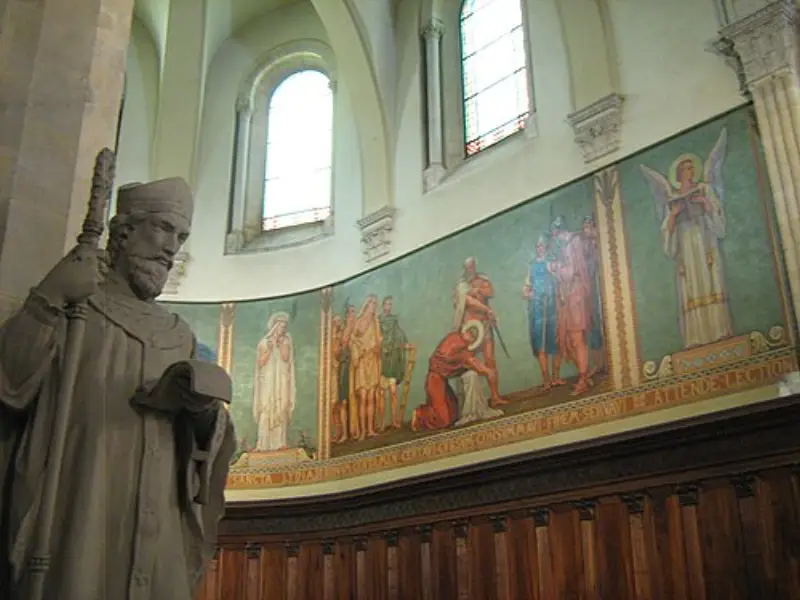
Sacerdos was never canonized in the modern manner; he belongs to the bishops of Gaul whose sanctity the devotional memory of their own cities settled beyond question. The Catholic Church numbers him among its saints, and his feast is kept on September 12. The continuity of his cult at Lyon is written into the topography of the city itself: his portrait appears in the church of Saint Paul, the very foundation tradition assigns to him, so that the building and the memory of its founder speak together. To the medieval faithful his tomb in the church of the Apostles made him one of the city's own intercessors, an archbishop of the first rank of the Frankish church who had prayed for Lyon in life and was believed to do so still. The survival of his feast across the centuries, noted in martyrologies and in the records of the archdiocese, shows a cult that never had to be revived, because it never lapsed from the memory of the church that honored him. Few sons of Lyon have been so continuously present to their city's prayer.
§ Introduction
A Family of Archbishops and Saints
Few bishops of the sixth century founded so durable a spiritual family. His son Aurelianus rose to the archbishopric of Arles, the great see of the lower Rhône, and is himself honored as a saint; his nephew Nicetius, known to history as Nizier, succeeded him at Lyon and became one of the commanding churchmen of his generation. Thus a single family held two metropolitan thrones in direct succession, father and son at Lyon, son and nephew across the sees of Gaul, a pattern that made the episcopate in practice a sacred aristocracy. The archdiocese's own records keep the sequence of that succession: Licontius, Sacerdos, Nicetius, each named in the lists of those who have occupied the throne. His buildings endured in the daily life of Lyon; his counsel reached the Frankish king; his blood produced saints into the next generation. Whatever else the sixth century was, in Lyon it was also this: an archbishop who governed well, built permanently, counseled kings, and left behind him a church governed by his own kin and consecrated by their holiness, a family monument in living stone.
§ Life
Timeline
- 487
Born to Rusticus, who served as archbishop of Lyon, and to his wife
§ Life
- 544
Became Archbishop of Lyon, succeeding Archbishop Licontius
§ Life
- 549
Presided over the Fifth Council of Orléans
§ Life
- 552
Died at Paris, with King Childebert, whose counselor he had been, assisting at his deathbed
§ Life
- 552
Remains carried back to Lyon for burial in what was then the church of the Apostles, a sanctuary afterward renamed for Saint Nicholas
§ Life
The Record
- Major works
- Église Saint-Paul, Lyon·Church of Saint-Eulalia (later Église Saint-Georges), Lyon
- Canonization
- Pre-congregation; venerated as a saint in the Catholic Church
Prayer
Bibliography
Show 6 sources
- Christian Settipani, Les ancêtres de Charlemagne, 1989
- Heinzelmann, Martin. Gregory of Tours: History and Society in the Sixth Century. United Kingdom, Cambridge University Press, 2001. p. 21. ISBN 9780521631747
- Bernard Berthod, Jacqueline Boucher, Bruno Galland, Régis Ladous and André Pelletier, Archevêques de Lyon, Lyon, Éditions lyonnaises d'art et d'histoire, 2012, 191 p. (ISBN 9782841472284)
- Emmanuel Bernot, Clémence Mège, Émilie Robert, Céline Cadieu-Dumont et Audrey Baradat, Rapport de fouilles archéologiques préventives « La cure de Saint-Georges » : vol. 1 : Texte, Service archéologique de la ville de Lyon - Direction des affaires culturelles, juillet 2007.
- "L'église Saint Paul" (in French). Vieux Lyon. Retrieved 19 May 2010.
- Monks of Ramsgate. "Sacerdos". Book of Saints, 1921. CatholicSaints.Info. 11 September 2016
Profile text adapted from the Wikipedia article, licensed CC BY-SA 4.0.
Pray with this saint every day
Save St. Sacerdos of Lyon to your favorites, read the full profile, and get feast-day reminders in the Saints app.
Get the Saints AppFree on the App Store for iPhone and iPad