
early 7th century – 655·Feast September 22
St. Sadalberga
Abbess and foundress of the Abbey of St. John at Laon
Overview
Sadalberga, who died on September 22, 655, was a Frankish noblewoman who became an abbess and the founder of one of the great double monasteries of seventh-century Gaul. Born in the early 600s to the family of Gundoin, duke of Alsace and counselor of King Dagobert I, she was consecrated to God as a child by Eustasius of Luxeuil, who healed her blindness, yet she was twice married at the insistence of her father and the king before she could claim the religious life for her own. Her first husband died after two months; her second, the courtier Blandius, joined her in a household of hospitality and almsgiving in which five children were born, among them the saints Anstrudis and Baldwin. When the children were grown, husband and wife separated by mutual consent and entered the monastic state. On her inherited lands Sadalberga built a monastery, soon moved for safety to Laon, where the Abbey of St. John rose under her rule and came to shelter some three hundred nuns. Her biographer records miracles and visions, a foreknowledge of her own death, and a final reconciliation with her family over the abbey's endowments before she died at Laon.
The Complete Life
A Duke's Blind Daughter
Her birth came in the first decades of the seventh century, in a village near Langres in the northeast of present-day France, on ground where much of her father's property lay. Her father, Gundoin, was duke of Alsace and a close counselor of King Dagobert I; her mother was Saretude, and her brothers were Leuduin and Fulculf, with two sisters, Aba and Saretrude, about whom little is recorded. Her house belonged to the class of noble families that sponsored the Christianizing of the rural Franks by way of the Irish monastic order, and among her contemporaries was the great abbess Burgundofara, whose path ran in many ways parallel to her own. The decisive episode of her childhood came through that Irish connection. Eustasius of Luxeuil, successor of Columbanus, was returning from a journey to correct a heresy when he stayed at Gundoin's villa near the river Meuse. Asked about his children, the duke produced two sons; pressed further, he admitted a daughter as well, Sadalberga, who was blind. Eustasius discerned sanctity in the girl and asked whether she wished for the religious life. When she said yes, he fasted two days, poured benediction oil into her eyes, and restored her sight; the vita adds that he healed her likewise of a flow of blood that had weakened her body.
§ Early life
Two Marriages Against Her Consecration
The consecration of her childhood did not spare Sadalberga the collisions of noble family life. Historians of the period observe that the Christian practices she wanted could be carried out fully only within a monastery, yet her family had other designs for a daughter of Gundoin. When she reached maturity her parents compelled her to marry Richramnus, a nobleman her biographer calls a mighty man of excellent character. Two months later he died, and Sadalberga, freed so unexpectedly, resolved not to lose her chance again: she took up residence in her own house as a consecrated widow; even that compromise left her restless, and she entered the double monastery at Remiremont. King Dagobert I opposed the move and had her removed, and she was married a second time, to Blandius, a wily courtier and royal favorite who had counseled the king against letting her withdraw from the world. Only as a noble widow did she possess the standing to petition the crown in person rather than through her bishop, and the petition had gone too far. Twice married against her will, Sadalberga did not renounce the consecration of her childhood; she carried it through the marriages, waiting for the liberty to fulfill it.
§ Career
Hospitality, Motherhood, and a Founding
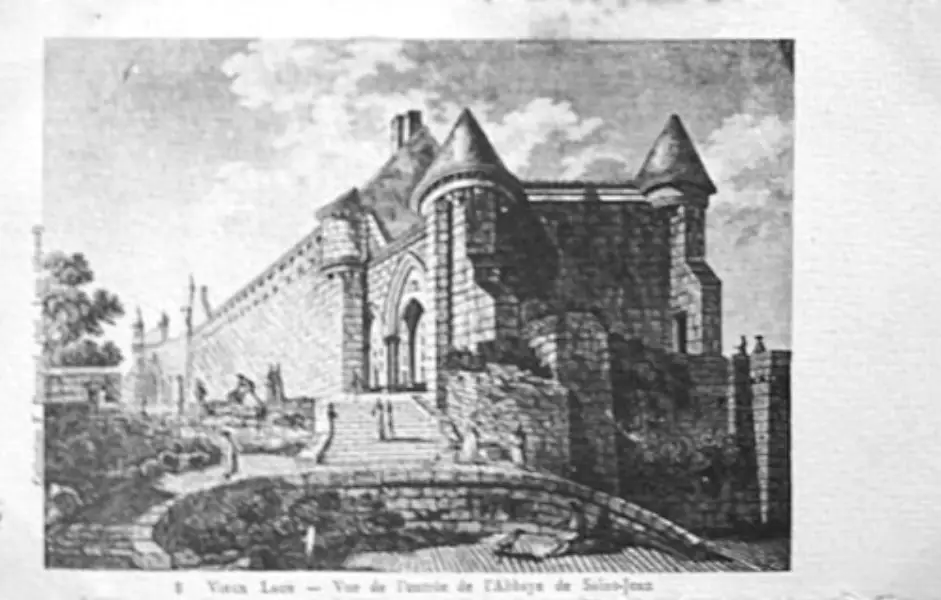
The second marriage became a school of charity rather than a prison. According to her biographer, Sadalberga and Blandius performed Christian works together and kept themselves in remarkable purity, practicing hospitality, almsgiving, and standing as sponsors for candidates for baptism. At the basilica of Saint Remigius she prayed for children, vowing them to the religious life, and five were born: Saretude, named for her grandmother; Ebana; Anstrudis, who would be honored as a saint; a son Eustasius, named for her spiritual guide, who died in infancy; and a youngest son, Baldwin, likewise a saint. When the children were grown, Sadalberga persuaded her husband to let her return to the monastic calling; they separated by mutual consent, Blandius becoming an anchorite, and both took part in raising a monastery on her paternal inheritance, sited near the Austrasian frontier yet inside Burgundy. A vision warned her of danger before the house was finished, and about 639 she moved the community north to Laon, where the new Abbey of St. John rose behind strong natural defenses. Historians suspect the first site lay in ground contested by warring aristocratic factions. At Laon the abbey sheltered three hundred nuns, more than a hundred of them noblewomen, and the abbess herself cooked a weekly meal and did whatever the household needed.
§ Career
Signs Wrought Through Humble Service
The vita credits Sadalberga with many miracles and visions, and even its homeliest scenes carry the mark of the extraordinary. She healed a nun of epilepsy after a seizure during vespers. When the abbey lacked wine for a visit from her friend and supporter Waldebert, she ordered beer, and when even that proved insufficient, her prayer supplied the want. Her intercession was credited with saving the abbey from a fire. A voice summoned Archbishop Basinus three times to watch her cook the meal she prepared each week, and he arrived in time to buy a great fish that fed the sisters. Most curious of all is the incident her modern readers find hardest to forget: walking outside the walls on a summer day, Sadalberga ordered lettuce from her gardener across the distance of half a mile, mouthing the words, and the monk heard the rebuke as though she stood beside him, though he was stealing from the nuns' garden at the time. Her biographer, one scholar notes, defended her sanctity precisely through such practices of humility, generosity, and prayer, virtues open to any believer; the visions multiplied toward the end of her life, preparing her and her community for her death.
§ Career
Reconciliation and a Foreseen Death
A year and a half before she died, Sadalberga fell into a grave illness and lost her speech; when the sisters asked how she had recovered, she told them of a vision in which she sprouted wings and flew, shielded by them from any worse attack. Then came the foreknowledge that ordered her last months: a hundred days before the end, she saw her death approaching, summoned the nuns, and charged them to complete the psalter in the time remaining. From that day, her biographer writes, she gave herself more fully to vigils, fasting, psalms, and prayer. Family business, too, demanded settling. Her brother Fulculf was holding properties she had meant to endow the abbey with, disputing her management of the monastic estate; the quarrel cooled once his share in the monastery and its remaining holdings received formal acknowledgment, and only her illness, the vita says, moved him to the meeting at which differences were reconciled. Her brother Leudinus, hearing of her approaching death, left the family estates he managed and promised that the convent would endure. Twenty days before the end she collapsed and took to her bed, received the Last Rites from the priest Italus, and died at the Abbey of St. John on September 22.
§ Death
Remembered by the Churches
Sadalberga belongs to the saints raised up by the common verdict of the church before any formal process existed. She is venerated in the Roman Catholic Church and the Eastern Orthodox Church, and her feast is kept on September 22, the day of her death at Laon. The instrument of her recognition was the life written about her: first a place in Jonas of Bobbio's account of the Irish missionary Columbanus and his successors, through whom her healing and consecration were preserved, and then, within a generation of her death, the anonymous Vita Sadalbergae composed around 680 at the request of her own daughter. Burial in the main monastery church of the abbey she founded gave her cult a center, and the community of three hundred women she had gathered became the first guardians of her memory. In the Frankish pattern, sanctity was argued from a life of proven charity, visions, and miracles, all of which her biographer set out in detail; the churches' continuing commemoration shows that the argument persuaded them, and the abbess of Laon has remained on the calendars of East and West alike for some thirteen centuries.
§ Introduction
An Heiress Who Built a Dynasty of Holiness
The abbey passed at her death to her daughter Anstrudis, and with it the family's religious project entered its second generation. Anstrudis, reared neither by her mother nor by her father but handed over to remoter relatives, had been pressed toward marriage; she insisted instead on the monastery her mother had founded, and as abbess she kept her inheritance intact and joined it to the vast estates of the house over which she now presided. In this the mother's design reached fulfillment: land that might have been scattered among noble heirs remained a single endowment for prayer. Sadalberga's wider family carried the same impulse across the region. Her brother Leuduin, who became bishop of Toul in the 660s, erected Bonmoutier Abbey because his daughter Teutberga asked it, installing her there as its abbess; her children Anstrudis and Baldwin were honored as saints in their turn. Two written lives, Jonas of Bobbio's account of Columbanus and the anonymous Vita Sadalbergae, secured her story for the centuries that followed, making the abbess who was twice married and never defeated one of the best-documented women of seventh-century Gaul and a standing witness to the part noblewomen played in the evangelization of the Frankish countryside.
§ Death
Timeline
- 639
Warned by a vision of danger, moved her nearly finished monastery from the Austrasian border to Laon, founding the Abbey of St. John
§ Career
- 655
Received a vision foretelling her death a hundred days ahead; the sisters were summoned to complete the psalter
§ Death
- 655
Collapsed and became bedridden twenty days before her end; received the Last Rites from the priest Italus
§ Death
- 22 Sep 655
Died at the Abbey of St. John in Laon, after the fate of the abbey and its estates had been secured
§ Death
- 655
Laid to rest in the abbey's principal church; her daughter Anstrudis took up the office of abbess
§ Death
- 680
An anonymous writer completed the Vita Sadalbergae at the request of her daughter and successor
§ Introduction
In Their Own Words
force her into marriage, but only after two marriages, at her father's and the king's insistence
they both performed Christian works and most devoutly kept themselves in baptismal purity
The Record
- Major works
- Abbey of St. John, Laon (Saint-Jean-de-Laon)
- Canonization
- Pre-congregation; venerated in the Roman Catholic and Eastern Orthodox churches
Prayer
Bibliography
Show 5 sources
- Fox, Yaniv (2014). Power and Religion in Merovingian Gaul: Columbanian Monasticism and the Formation of the Frankish Aristocracy. Cambridge, U.K.: Cambridge University Press. ISBN 978-1-107-06459-1.
- Hochstetler, David (1992). A Conflict of Traditions: Women in Religion in the Early Middle Ages 500-840. Lanham, Maryland: University Press. ISBN 0-8191-8609-0.
- Kreiner, Jamie (2020). "Merovingian Hagiography". In Effros, Bonnie; Moreira, Isabel (eds.). The Oxford Handbook of the Merovingian World. New York: Oxford University Press. pp. 508-530. ISBN 9780190234188.
- Le Jan, Régine (2001). "Convents, Violence, and Competition for Power in Seventh-Century Francia". In de Jong, Mayke; Theuws, Frans (eds.). Topographies of Power in the Early Middle Ages. Leiden, Netherlands: Brill. pp. 243-269. ISBN 90-04-11734-2.
- McNamara, Jo Ann; Halborg, John E.; Whatley, E. Gordon (1996). "Sadalberga, Abbess of Leon". In Sainted Women of the Dark Ages. Duke University Press. pp. 176-194. ISBN 0-8223-1200-X.
Profile text adapted from the Wikipedia article, licensed CC BY-SA 4.0.
Pray with this saint every day
Save St. Sadalberga to your favorites, read the full profile, and get feast-day reminders in the Saints app.
Get the Saints AppFree on the App Store for iPhone and iPad