
1st century AD·Feast 3 August
St. Salome
Myrrhbearer and follower of Jesus at the tomb
Overview
Among the women around Jesus, Salome surfaces briefly in the four gospels yet looms far larger in the early Christian literature beyond them. Mark records her among the women who watched the crucifixion from a distance, women who had followed and ministered to Jesus in Galilee, and again among the Myrrhbearers who brought spices to the tomb at the first light after the sabbath and found the stone rolled away. Later readers most commonly equated her with Zebedee's wife, mother of the apostles James and John, and at times with the unnamed sister of Jesus's mother whom John's Gospel mentions — a reading that would give her the Lord's own auntship. The apocryphal literature gave her a larger role: the Gospel of Thomas counts her among the disciples, the Greek Gospel of the Egyptians lets her question Jesus about death, the Secret Gospel of Mark places her at Jericho, and the second-century pagan critic Celsus knew of Christian sects that traced their origin to her. In the Protevangelium of James a Salome first refuses to credit the virgin birth and then confirms it; readers from the High Middle Ages forward fused this woman with the disciple and set her at the Nativity as midwife. She is venerated across the Orthodox, Catholic, Episcopal and Lutheran traditions, her emblems the vase of ointment and the thurible.
The Complete Life
A Name That Means Peace
Everything about Salome's origins must be inferred from her name and her associations. Salome is likely the Hellenized form of a Hebrew name drawn from the root shalom, meaning peace, a meaning that later preachers found fitting for the woman who stood at the cross and the tomb. The name was a common one in her world: besides the dancing daughter of Herodias with whom she is constantly confused, both a sister and a daughter of Herod the Great bore it, as did Queen Salome Alexandra, who died in 67 BC as the last independent ruler of Judea. The gospels attach her to Galilee, for Mark says that she had followed Jesus and ministered to him there, among the many women who came up with him to Jerusalem. If, as most interpreters believe, she is the wife of Zebedee, her home lay by the lake of Gennesaret, in a household prosperous enough to leave hired servants, and her sons James and John belonged to the inner circle of the Twelve. If instead she is the sister of Jesus's mother named in John, she was born into the family of Nazareth itself. Either way, she belonged to the generation of Galilean women whose means supported the ministry of the Lord.
§ Name
Follower and Minister of the Lord
Mark names Salome among the women present at the crucifixion, women who had followed Jesus and served him since his Galilean days, and Matthew's parallel list of the same scene names in her place the mother of Zebedee's children, which is why the Catholic Encyclopedia of 1913 judged the two probably identical. If that identification holds, her voice is heard again in Matthew's gospel, where the mother of the sons of Zebedee asks Jesus to grant that her two sons may sit at his right hand and his left in his kingdom. At the cross, John's gospel lists three — perhaps four — women: his mother, his mother's sister, Mary of Cleophas, and Mary Magdalene; one widespread reading takes that unnamed sister to be Salome, giving her the rank of the Lord's aunt. The canonical gospels never use the word disciple of her, and mainstream writers have therefore called her a follower, though critics have argued that the tradition habitually underplays the significance of Jesus's female supporters. Curiously, the ancient Diatessaron treated them as separate persons, enumerating both Salome and the mother of Zebedee's sons among the women at the cross.
§ In the canonical gospels
The First Morning of the Week
Salome's chief honor in the Gospel record is her place among the Myrrhbearers. Mark tells that when the sabbath was past, Mary Magdalene, Mary the mother of James, and Salome bought sweet spices so that they might come and anoint the body of Jesus. Their errand was one of love and mourning, performed before any hope of reward, and it carried them to the sepulchre at the hour when the world was overturned: there the massive stone stood rolled aside, and a white-robed young man proclaimed Jesus risen, charging them to bring word to his disciples that he would go before them into Galilee. In Matthew's account of the same morning two women are named, Mary Magdalene and the other Mary, but the Church of the East kept all three of Mark's women in its memory and its liturgy, honoring the Myrrhbearers on the third Sunday after Pascha. Later apocrypha remembered her at the tomb as well: the Coptic Book of the Resurrection of Christ, ascribed to the apostle Bartholomew, catalogues the tomb's female visitors and counts, alongside Mary Magdalene and her companions, Salome who tempted him.
§ In the canonical gospels
Disciple in the Apocryphal Gospels
Beyond the canon, Salome emerges as a questioning, confessing disciple. The Gospel of Thomas found at Nag Hammadi names her among the disciples of Jesus alongside Mary, and preserves a dialogue in which Jesus reclines on her couch and eats at her table; when she asks who he is that has taken his place there, he answers that he is he who is from the One, to whom the things of the Father have been given, and when she declares herself his disciple, he teaches that the united disciple will be filled with light, the divided one with darkness. The Greek Gospel of the Egyptians, written in the second century, gives her a prophetic exchange about the reign of death, and from it scholars infer an early tradition that Salome was childless and perhaps unmarried, a woman disciple set free for the kingdom's sake. The controversial Secret Gospel of Mark, quoted in the Mar Saba letter ascribed to Clement of Alexandria, places her at Jericho with the mother of the young man whom Jesus loved. Most striking of all, the critic Celsus, writing around 178, reported that among the many Christian sects of his day there were Harpocratian Christians who traced their very origin to Salome, evidence that her name carried authority in parts of the early movement.
§ In non-canonical works
Feasts of the Myrrhbearer
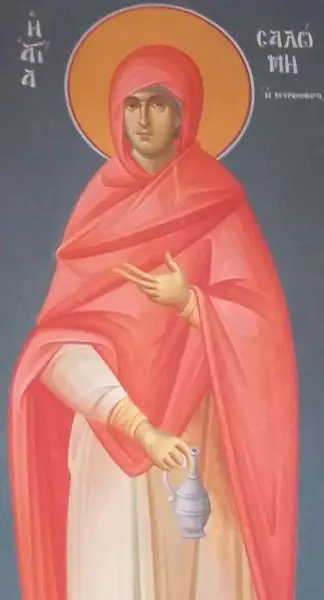
Salome has been honored as a saint from the age of the undivided Church, and her liturgical memory spread across almost every Christian communion. The Eastern Orthodox Church keeps her twice: on the Sunday of the Myrrhbearers, the third Sunday of Pascha, when the women who came to the tomb are commemorated together, and again on the third of August, a date kept also by some Eastern Catholic churches, by the Episcopal Church — whose 2022 calendar of Lesser Feasts and Fasts remembers Joanna, Mary, and Salome together as myrrh-bearing women — and by the Lutheran Church–Missouri Synod, whose calendar pairs her that day with Joanna and Mary the mother of James. In the Latin liturgical rites of the Catholic Church her feast falls on the twenty-fourth of April, recorded in the Martyrologium Romanum. Painters of the Holy Kinship set her beside the Holy Family, and artists place a thurible in her hands, an emblem of the sacrifice and faith with which she followed Christ; the vase of ointment serves as her customary attribute, recalling the dawn errand to the sepulchre. Greek frescoes and Russian icons alike show her with the two Marys before the empty tomb.
§ Sainthood
Midwife at the Nativity, Kinswoman of the King
Two medieval traditions gave Salome a second life in the imagination of Christendom. The first made her the midwife of Bethlehem: the Protevangelium of James tells how a Salome, meeting the midwife who had attended Mary, refused to believe that a virgin had brought forth until she had tested it, and how her hand withered at the touch and was healed only when she took the infant; being the first after the midwife to witness the miraculous birth and to recognize the child, this Salome came to be identified with the disciple from the High Middle Ages onward, and she appears bathing the infant Christ in Nativity icons from the Cappella Palatina in Palermo to Cappadocia, Padua, Siena and Duccio's Maesta. The second, proposed by Haymo of Auxerre in the mid-ninth century, held that Saint Anne bore three daughters named Mary by different husbands, making Salome, styled Mary Salome, the half-sister of the Virgin. Carried by the Golden Legend, painted into the Holy Kinship altarpieces of Germany and the Low Countries, and put into French verse by Jean de Venette, the legend drew Protestant repudiation at the Reformation and Catholic censure at Trent, yet the old identification of Salome — sister of the Virgin, wife of Zebedee, mother of apostles — long stood as the received view.
§ Legend of Saint Anne's three husbands
Timeline
- 178
The pagan philosopher Celsus, writing his attack on Christianity, described sects that traced themselves to Salome.
§ In non-canonical works
- 1150
The mosaics of the Cappella Palatina in Palermo, dated about this year, depicted Salome bathing the infant Jesus in the Nativity.
§ Salome as midwife
- 1260
Jacobus de Voragine included the legend of Saint Anne's three daughters, among them Mary Salome, in the Golden Legend.
§ Legend of Saint Anne's three husbands
- 1357
Jean de Venette composed a long rhymed French poem on the legend of Saint Anne's three husbands.
§ Legend of Saint Anne's three husbands
In Their Own Words
There were also women looking on afar off: among whom was Mary Magdalene, and Mary the mother of James and of Joses; and Salome who also followed Him and ministered to Him when he was in Galilee.
So long as women bring forth, for I come to end the works of the female. ... Then I have done well in not bringing forth.
But I am your disciple.
The Record
- Symbols
- Vase of ointment·Thurible
- Canonization
- Pre-congregation; venerated as a saint since the earliest Church, with feasts in the Eastern Orthodox, Catholic, Episcopal and Lutheran calendars
Prayer
Bibliography
Show 7 sources
- Husenbeth, Frederik Charles. Emblems of Saints: By which They are Distinguished in Works of Art, Longman, Green, Longman, and Roberts, 1860, p. 147.
- Herbermann, Charles, ed. (1913). "Salome". Catholic Encyclopedia. New York: Robert Appleton Company.
- King, Karen L. (2003). The Gospel of Mary of Magdala: Jesus and the first woman apostle. Santa Rosa, CA: Polebridge Press. ISBN 978-0-944344-58-3.
- Marjanen, Antti (2000). "Women Disciples in the Gospel of Thomas". In Uro, Risto (ed.). Thomas at the Crossroads: Essays on the Gospel of Thomas. London: Bloomsbury Publishing. p. 90.
- Schiller, G. Iconography of Christian Art, Vol. I, 1971 (English translation from German), Lund Humphries, London, p. 62. ISBN 0-85331-270-2.
- Lesser Feasts and Fasts. New York: Church Publishing. 2022. ISBN 9781640656277.
- Martyrologium Romanum. Libreria Editrice Vaticana 2001. ISBN 88-209-7210-7.
Profile text adapted from the Wikipedia article, licensed CC BY-SA 4.0.
Pray with this saint every day
Save St. Salome to your favorites, read the full profile, and get feast-day reminders in the Saints app.
Get the Saints AppFree on the App Store for iPhone and iPad