
December 1520 – 18 March 1567·Feast March 18
St. Salvador of Horta
Franciscan lay brother and wonderworker of Catalonia
Overview
Salvador of Horta, born Salvador Pladevall i Bien, was a Spanish Franciscan lay brother celebrated during his lifetime as a miracle worker. Born in December 1520 in the hospital of Santa Coloma de Farners in Catalonia, where his parents worked as servants, he was orphaned at fourteen and supported himself and his sister as a shoemaker in Barcelona. When his sister married, he pursued the religious calling he had long felt, first testing life at the Benedictine Abbey of Montserrat before entering the Observant Franciscans as a lay brother in 1541. Sent to serve as cook, beggar, and porter at Tortosa, he acquired a reputation as a healer that drew crowds of the sick to the friary and aroused the suspicion of his superiors, who transferred him repeatedly, to Bellpuig, Lleida, Horta de Sant Joan, Reus, Madrid, and Barcelona, and finally to Cagliari in Sardinia. The Inquisition examined him in 1560 but took no action. Death came to him at Cagliari on 18 March 1567. King Philip II of Spain asked that he be raised to the altars; beatification followed in 1606, and Pope Pius XI declared him a saint in 1938. His relics rest today in the Church of St. Rosalie in Cagliari.
The Complete Life
An Orphan of the Girona Hospital
During December 1520, in the hospital of the Catalan town of Santa Coloma de Farners in the province of Girona, Salvador Pladevall i Bien came into the world. His parents worked there as servants, and the child's first world was one of the sick, the poor, and those who cared for them. He was orphaned at the age of fourteen, a loss that might have left him destitute had he not taken his younger sister Blasa with him to Barcelona. There he learned the trade of a shoemaker and labored at it to support them both, living the ordinary life of a working boy in the capital of Catalonia. The experience formed habits of diligence and self-denial that would mark the rest of his days. Throughout these years he carried within him a religious calling that he could not yet follow; his obligations to his sister came first. Only when Blasa married and had a household of her own did he consider himself free to seek the cloister, and the poor shoemaker's apprentice began the path that would lead him to the Franciscans and, in time, to the altars of the Church.
§ Life
From Montserrat to the Friars Minor
When he was at last free to follow his vocation, Salvador first tested it at the famed Benedictine Abbey of Santa Maria de Montserrat, the great mountain sanctuary near Barcelona. Monastic life there apparently did not draw him, for he desired a more humble way of living than the abbey offered. On 3 May 1541 he sought admission as a lay brother to the novitiate of the Barcelona house of the Observant Franciscans, taking the lowest rank in an order built on poverty. His vows were professed in 1542. Among the friars he soon became known for two qualities that would define his life: asceticism, the strict discipline he imposed on his own body, and humility, the refusal to claim any standing above the meanest task. As a lay brother he would never preach or govern; his work was the work of the kitchen, the gate, and the street. His superiors sent him to the friary at Tortosa, where he was appointed cook, designated beggar, and porter, offices that placed him in daily contact with the poor who came seeking bread.
§ Life
Healer and Pilgrim Magnet at Tortosa and Horta
At Tortosa Salvador's hidden life ended in an unexpected way. Word spread that the lay brother could obtain cures, and soon the friary drew sick pilgrims from all the country round about. Observers estimated that visitors to the friary numbered some two thousand people in a week, a crowd that transformed a quiet house of friars into a place of constant pilgrimage. Rather than rejoicing, his superiors grew suspicious of the lay brother at the center of it all, a suspicion that shadowed him for the rest of his life. They began moving him from friary to friary, first to Bellpuig, then to Lleida, and then to the remote village of Horta de Sant Joan, where he resided from 1547 to 1559 in the Friary of Our Lady of the Angels and where he remains most firmly rooted in popular memory. From Horta he was moved to Reus and again to Madrid, where King Philip II of Spain came to see him, and then to Barcelona. The moves failed to stop the cures reported at his intercession; they only carried his reputation across Catalonia and Castile.
§ Life
Humility Under Suspicion
The pattern of Salvador's sanctity was humiliation accepted quietly. A lay brother with no office and no learning, he drew multitudes by the cures attributed to his prayers, and the very fame that drew the crowds made his own religious superiors distrust him. He answered their suspicion not with argument but with obedience, going where he was sent and beginning again as cook and porter in each new house. In 1560, while he resided in Barcelona, the affair assumed a graver shape: the Spanish Inquisition received a denunciation of him over the many marvels credited to his prayers. The tribunal examined the charges, then concluded its inquiries without proceeding against him. The episode revealed the shape of his spirit. He made no defense of himself and sought no vindication beyond what the Church judged; when the authorities were satisfied, he simply continued his life of prayer and service. His asceticism was known to the friars from his novitiate onward, and those who watched him at the gate of the friary saw in the unlettered brother the same humility that had first sent him to the Franciscans in search of the lowest place.
§ Life
Cagliari and a Quiet Death
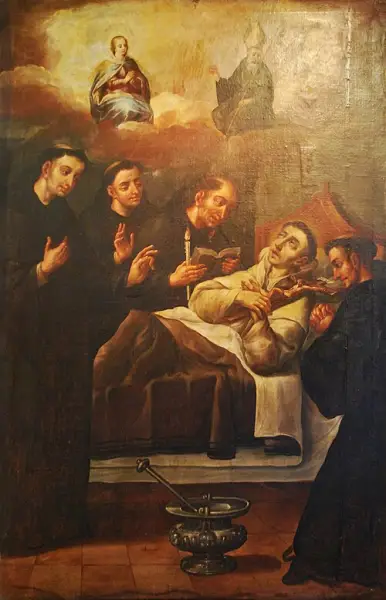
His final posting came in 1565, to the Friary of St. Mary of Jesus at Cagliari on Sardinia, an island then governed from Spain. He went as he had gone everywhere else, to serve the community as its cook. He was forty-five years old, worn by two decades of crowds, interrogations, and transfers, but the work was the same as at Tortosa thirty years before, and he took it up without complaint. In Cagliari the cures continued to take place at his intercession, so that the island, like Catalonia, learned to bring its sick to the Franciscan lay brother. He died there on 18 March 1567, at the age of forty-six, having spent his last two years in the kitchen of the friary where he would be buried. He had lived exactly as he had entered religion: a brother without office, honored by the crowds and unesteemed by the powerful, obedient to the end. The friars buried him in the Church of St. Mary of Jesus attached to their friary, and the veneration of the people of Cagliari began at his grave almost immediately.
§ Veneration
From Beatification to the Altars
Recognition came first through the throne and then through the papacy. The crown set the cause in motion: on the petition of King Philip II of Spain, Pope Paul V permitted public veneration of Salvador as Blessed on 5 February 1606, within forty years of the friar's passing, and Pope Clement XI renewed that judgment on 29 January 1711. His cult took root in his native Catalonia and in Calabria as well, a region long tied to Spain, carried wherever Franciscan preaching and Spanish administration reached. Three centuries after his death, the Church raised him to the full honors of the altar: the canonization decree came from Pope Pius XI on 17 April 1938. For the Friars Minor his feast falls on 17 April, the day that decree was issued, while the universal calendar keeps 18 March, the date of his death. His cause thus spanned more than three hundred and thirty years, from the crowds at the gate of the Tortosa friary to the canonization decree, and it rested throughout on the same witness: the countless cures reported at his intercession and the humility of the life behind them.
§ Veneration
The Shrine of St. Rosalie
The story of Salvador's relics is a long one. Burial was first given him in the Church of St. Mary of Jesus beside the friary of his death. In 1606 his grave was opened so that his heart could be given to the Franciscans at Silke, near Sassari, and those who opened it found the body uncorrupted, a discovery that only deepened the faithful's devotion. When the demolition of St. Mary of Jesus came in 1718, the relics passed to another Franciscan church in the city, and then, in 1758, found their lasting home in a glass coffin beneath the high altar of Cagliari's Church of St. Rosalie. There his shrine stands, and pilgrims venerate him there still. His memory lives on two shores of the western Mediterranean: in Horta de Sant Joan, where the remains of the friary cloister still recall the twelve years he spent there, and in Catalonia, his native land, as well as in Calabria, where his feast has long been kept.
§ Veneration
Timeline
- Dec 1520
Born in the hospital of Santa Coloma de Farners, in the Catalan Province of Girona, where his parents served.
§ Life
- 3 May 1541
Entered the novitiate of the Observant Franciscans in Barcelona as a lay brother, after a period at Montserrat.
§ Life
- 1542
Made his profession of vows, already known among the friars for asceticism and humility.
§ Life
- 1547
Sent to the friary at Horta de Sant Joan, the village forever after linked with his name.
§ Life
- 1559
Left Horta de Sant Joan after twelve years, transferred onward to Reus and later Madrid, where King Philip II visited him.
§ Life
- 1560
Denounced to the Spanish Inquisition for the miracles attributed to his intercession; after investigation, no action was taken.
§ Life
- 1565
Assigned to the Friary of St. Mary of Jesus in Cagliari, Sardinia, where he continued to serve as cook.
§ Life
- 18 Mar 1567
Died at Cagliari at the age of forty-six.
§ Life
- 5 Feb 1606
Beatified by Pope Paul V at the request of King Philip II of Spain.
§ Veneration
- 29 Jan 1711
His beatification was confirmed by Pope Clement XI.
§ Veneration
- 1718
The Church of St. Mary of Jesus in Cagliari was demolished and his remains were moved to another church of the Order.
§ Veneration
- 1758
His relics were laid to rest beneath the high altar of Cagliari's Church of St. Rosalie, sealed in a glass coffin.
§ Veneration
- 17 Apr 1938
Canonized by Pope Pius XI.
§ Veneration
The Record
- Major works
- Service as cook, designated beggar, and porter at the Franciscan friaries of Tortosa, Horta de Sant Joan, and Cagliari
- Symbols
- Franciscan habit
- Canonization
- Beatified 5 February 1606 by Pope Paul V; canonized 17 April 1938 by Pope Pius XI.
Prayer
Bibliography
Show 7 sources
- "Salvador d'Horta". Enciclopèdia.cat (in Catalan). Retrieved 20 March 2012
- Antonio Borelli. "San Salvatore da Horta". Santi e Beati (in Italian). Retrieved 20 March 2012
- "Saint of the Day "St. Salvator of Horta""
- Francesco Putzu, Salvatore da Horta: taumaturgo francescano, Roma, Pia società San Paolo, stampa 1938
- Salvatore Vitale, La vita del B. Salvatore da Horta, 1640
- Alberto Cogoni. San Salvatore da Horta. La grandezza dei piccoli. Cagliari, Edizioni della Torre, 2002
- Giancarlo Sorgia, San Salvatore da Horta, Horta, 1991
Profile text adapted from the Wikipedia article, licensed CC BY-SA 4.0.
Pray with this saint every day
Save St. Salvador of Horta to your favorites, read the full profile, and get feast-day reminders in the Saints app.
Get the Saints AppFree on the App Store for iPhone and iPad