
died 584·Feast September 10
St. Salvius of Albi
Bishop of Albi who served his flock through plague
Overview
Salvius, also called Salvi or Sauve, held the see of Albi in the Frankish kingdom from 574 until his death in 584, and the church of later ages enrolled him among her saints. Albi, his birthplace, was also the home of a powerful ecclesiastical family that kept supplying the churches of southern France with bishops right through the last centuries and final collapse of Roman rule; Gregory of Tours, who set down the story of his life, counted him among his distant kin, and St Didier of Cahors was a kinsman as well. Educated in law and the humanities, he practiced first as a lawyer in Albi before abandoning the profession for the monastic life, becoming a monk and a hermit. In 574 he was made bishop of Albi. As bishop he showed courage before the powerful, intervening with King Chilperic I on behalf of his people, and when famine and a plague epidemic struck his diocese he refused to abandon it, remaining in Albi to care for his flock. He caught the plague and died of it in 584. His remains were eventually translated to the church of Saint-Salvi in Albi, which became the center of his cult.
The Complete Life
Born into a Family of Bishops
Salvius belonged to one of those Christian senatorial families of southern Gaul from which the Church drew its bishops for generations. The line of his kindred ran back through the last centuries and collapse of Roman dominion: his house had given many bishops to the churches of the south of France, and it counted among its members some of the great names of Merovingian sanctity. He was a distant relation of Gregory of Tours, the historian of the Franks, who would one day write about Salvius's own life; and he was related as well to St Didier of Cahors, another of the saintly bishops of the region. Salvius himself was born at Albi, on the River Tarn, the city whose see he would eventually occupy. For a young man of such a family, the expected course was learning and public standing. He was educated accordingly in law and the humanities, the two disciplines that prepared the governing class of Gaul, and he entered upon the career of an advocate in his native city, pleading in the courts of Albi as a lawyer before any thought of the cloister had taken hold of him.
§ Family
From the Bar to the Hermitage and the See
Salvius turned from the practice of law to a life of religion, and the change was decisive. He became a monk, and then withdrew further into the eremitical life, seeking the solitude in which the Merovingian church found so many of its future bishops. The reputation for holiness that such a withdrawal earned was not allowed to remain hidden: in 574 Salvius was made bishop of Albi, raised from the hermit's cell to the government of the diocese that had born him. The episcopate of sixth-century Gaul was no quiet dignity. Its bishops stood between their cities and the violence of Frankish princes, administered relief in famine, and answered with their lives when epidemic came. Salvius accepted the burden, and the ten years that followed placed him among the bishop-saints whom Gregory of Tours described from personal knowledge of the age. The lawyer of Albi had traded the courtroom for the cathedral, but the training in law was not wasted; a bishop in that age needed every instrument of advocacy, for he was advocate now for the whole people entrusted to him.
§ Life
Before Chilperic, and in the Time of Plague
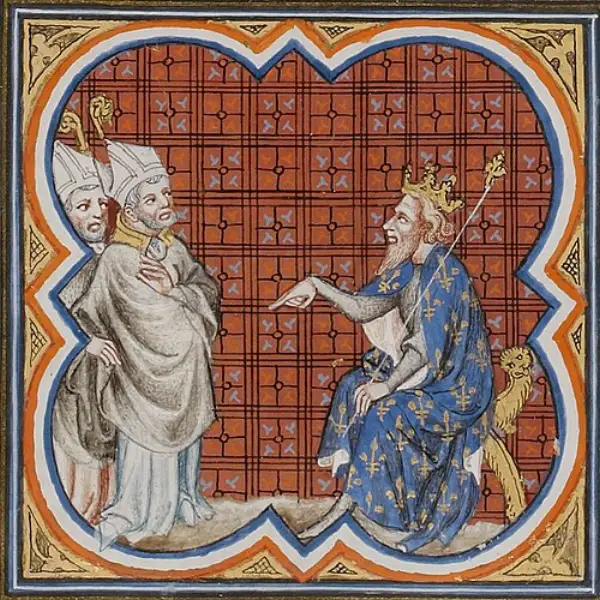
Two episodes defined Salvius's episcopate. The first was his boldness before the throne. Chilperic I, the Neustrian king whose reign Gregory of Tours recorded in unflattering detail, was among the most feared rulers of the divided Frankish kingdoms, and few men willingly crossed him. Salvius intervened with the king on behalf of the interests of his people, an act of courage that Gregory of Tours preserved and that medieval artists later remembered in scenes showing the bishop standing before Chilperic alongside Gregory himself. The second episode was darker. Famine struck the region of Albi, and with it came an epidemic of plague, the recurring terror of the sixth century. Salvius refused the logic of flight. He remained in the city to take care of his flock, organizing what relief a bishop could and staying at his post while the sickness spread. His fidelity carried the cost he must have foreseen: he contracted the plague himself, and in 584 he died of the disease he had stayed to serve. He had been bishop of Albi for a decade, and he ended it as a pastor who had out-stayed the danger among the people who could not leave.
§ Life
The Church of Saint-Salvi
Salvius was buried in his monastery, but his cult did not remain at the tomb. In later times his relics were carried to Albi's church of Saint-Salvi, a collegiate church bearing his name and stood for centuries at the heart of the city he had served, one of the principal monuments of Albi beside the great cathedral of Sainte-Cécile. There his memory was venerated by the citizens, and it was in his city and through this continuing devotion that he came to be declared a saint. The precise resting place of his remains, however, was eventually lost: renovations carried out in the church in the eighteenth century disturbed the site, and the exact location of the saint's relics can no longer be identified. The loss of the tomb has not extinguished the memory. His feast is kept on 10 September in both the Catholic and the Eastern Orthodox churches, and the name Saint-Salvi still marks the quarter of Albi where his cult flourished, a lasting witness to the bishop who stayed in his plague-stricken city and died among his people.
§ Life
Timeline
- 574
Made bishop of Albi after a career as a lawyer and a period as monk and hermit.
§ Life
- 584
Died of the plague epidemic he had stayed in Albi to face, after a decade of episcopal service.
§ Life
The Record
- Patron of
- Albi
- Symbols
- shown with Gregory of Tours before King Chilperic I
- Canonization
- Pre-congregation; venerated in the city of Albi after his death and later declared a saint.
Prayer
Bibliography
Show 4 sources
- Clément Compayré, Études historiques et documents inédits sur l'Albigeois, le Castrais, et l'ancien diocèse de Lavaur (Albi, 1841)
- Martirologio Romano (PDF). Libreria Editrice Vaticana. 2004. p. 510. Retrieved 2 April 2024
- Gregory of Tours, Historia Francorum, Book V, 44 and 50; Book VI, 29; Book VII, 1; and Book VIII, 22
- "Saint-Salvi". Site de la cité épiscopale d'Albi. Retrieved 12 February 2016
Profile text adapted from the Wikipedia article, licensed CC BY-SA 4.0.
Pray with this saint every day
Save St. Salvius of Albi to your favorites, read the full profile, and get feast-day reminders in the Saints app.
Get the Saints AppFree on the App Store for iPhone and iPad