
died c. 615·Feast October 28
St. Salvius of Amiens
Bishop of Amiens and finder of St Firmin's relics
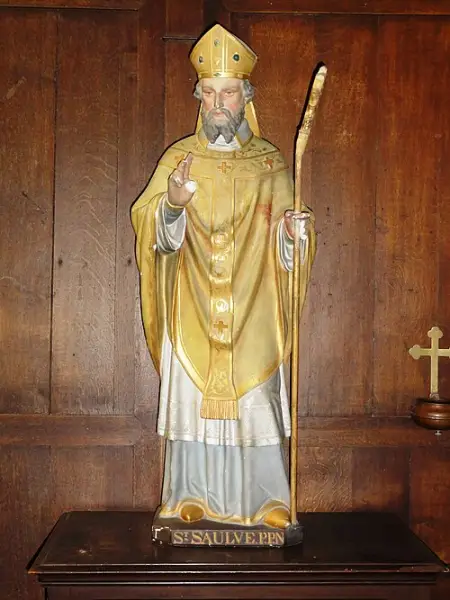
Overview
Salvius of Amiens, also called Sauve, Salin, Salve, Salvinus, Saulve, or Sauvre, was a seventh-century bishop of Amiens who died around 615. Tradition makes him the child of a rich house in that city; divine study occupied him from boyhood, and his manner of living was exceptionally pure. He founded a monastery dedicated to the Virgin Mary at Montreuil, became a monk and then its abbot, and longed for a hermit's cell, yet found himself placed over the diocese of Amiens instead. As bishop he traveled his diocese tirelessly, preaching the Gospel and uprooting the last remnants of paganism from the hearts of his people, and the first cathedral of the city center rose under his direction. Catholic tradition credits him with discovering the remains of the martyr Fermin at Abladène on the outskirts of Amiens and translating them to the cathedral, miracles attending the translation. He was famous for miracles and for a gift of supernatural prayer, and is said to have died in an ecstasy, his cell filled with brilliant light. His body was later translated to Montreuil, in the Diocese of Arras, where it is still venerated, and the town of Saint-Saulve near Valenciennes bears his name.
The Complete Life
A Son of Amiens' Leading Family
Amiens, among the chief cities of the old province of Picardy, was the home of a wealthy family from which Salvius was said to have sprung. The place of his birth in a Christian household of standing shaped the course that followed: he studied divinity from his youth, turning his considerable advantages toward sacred learning rather than toward the world in which his family moved. The sources dwell on the character of his early life, recording that he led a very pure life even in those years, a reputation that set him apart before he had taken on any office in the Church. Medieval writers caution that the story of the bishop's career is not easy to weigh: Jean-Baptiste de Sachy judged that the Life of Salvius is full of anachronisms and contradictions, with reason to believe that parts of it were falsified, and the later accounts of his episcopate differ on dates and even on which bishop he succeeded. Yet on the outline all the traditions agree, a noble-born youth of Amiens formed in the study of divinity, marked early by purity of conduct, and drawn toward the monastic rather than the worldly life.
§ Life and legacy
Monk and Abbot at Montreuil
Rather than remaining at home in comfort, Salvius founded a monastery dedicated to the Virgin Mary at Montreuil, and there he became a monk, exchanging the prospects of a rich family for the discipline of the cloister. In time the community chose him as its abbot, placing him at the head of the house he had built for the Mother of God. His longing, though, pointed toward deeper seclusion still: solitude drew him, and he wished to withdraw into a hermit's cell and close his days there, far from the government of men. Providence, in the telling of his biographers, had other designs: instead of the cell he was given a diocese, for he was placed at the head of the church of Amiens. Later hagiographers place the succession differently, some naming St Honoratus as his predecessor and one account naming Ado, but all agree that the reluctant solitary became bishop. The pattern was a familiar one in the Merovingian church, where abbots of contemplative spirit were repeatedly dragged from their monasteries to govern sees; Salvius yielded to the summons and carried the disciplines of Montreuil with him to the cathedral city.
§ Life and legacy
Bishop, Preacher, and Builder
As bishop, at the end of the sixth century, Salvius threw himself into the visitation of his enormous rural diocese. He made constant rounds of it, announcing to everyone the word of eternal life; his preaching aimed at more than teaching, for he labored to tear out of his people's hearts whatever paganism still lingered there, finishing in Amiens the conversion that generations of missionaries had begun. To anchor the Christian city he built the first cathedral in its center, raising in stone the church that preceded the great Gothic cathedral of Notre-Dame. His name became joined, in Catholic tradition, with the founding relic of the see, the body of the martyr Fermin. Salvius was said to have discovered the remains of the martyr at Abladène, on the outskirts of Amiens, and to have had them transferred in honor to the city's cathedral. The choir sculptures of Notre-Dame d'Amiens still narrate that story scene by scene: the bishop preaching from the pulpit as he calls on the faithful to search out Firmin's body, the unearthing of the relics at Abladène beside the road to Noyon, and the body's journey into the city, working cures on the crippled and putting fresh leaves on bare trees as it went.
§ Life and legacy
A Gift of Supernatural Prayer
The traditions that reached the hagiographers of later centuries agree in describing Salvius as a man of prayer rather than of administration. Fame for miracles and a gift of prayer that seemed supernatural — these, as the monks of St Augustine's Abbey, Ramsgate, set down, were what the people knew him by, the twin marks of a holy bishop in the early Frankish church. Alban Butler confirms the reputation, calling him famous for miracles, though he admits that little or nothing certain is known of his acts, since his biography survives in an anonymous life of uncertain authority. What the tradition preserved above all was the manner of his death. According to Baring-Gould's account, the bishop died in an ecstasy: a brilliant light was said to illuminate his cell as the end approached, and he was found praying with extended arms, in the posture of the crucified, as he surrendered his soul. The image fixed his cult, the shepherd dying as he had lived, at prayer, his last breath offered with arms stretched out to God, and his departure from the world marked by the light that hagiography reserved for the passing of the saints.
§ Baring-Gould's account
Death of the Bishop
The date of Salvius's death is the most contested fact in his story, and the sources give three different answers. The Roman Martyrology and Baring-Gould place it about 615. The monks of Ramsgate wrote that he died in the year 695, but their account carries the article's own caution: this must be a typo, since his predecessor Honoratus had already died around 600, and Baring-Gould's date of about 615 is more plausible. Butler, on a different line of tradition, has him succeed Ado as late as 672 and flourish in the reign of King Theodoric III. Behind the conflicting figures stands the consensus that he ruled Amiens as its bishop into the seventh century and died in the odor of sanctity, leaving a diocese that was Christian in its customs, a cathedral in its center, and the relics of its founding martyr at its heart. His feast of 28 October is taken to be the day of his death, while the older observance of 11 January, kept before the reform of the calendar in 1969, seems to mark the day of his translation.
§ Butler's account
Cult Approved by Centuries of Devotion
Salvius was never the subject of a formal canonical process; he belongs to the great company of bishops whose sanctity was declared by the acclamation of the church that knew them, and he is honored as canonized in pre-congregation times. His cult was established first at Amiens and then at Montreuil, where his relics became the treasure of the Benedictine abbey that came to bear his name. Butler records that Canterbury cathedral once treasured a relic of this saint, honoring it devoutly — proof that his fame had crossed the Channel, for the history of that church makes mention of it. The hagiographers of the seventeenth to twentieth centuries kept his memory in their collections, though they consistently warned their readers not to confound him with the other saints of his name, the bishop of Albi or the African martyr on whose festival Augustine preached. His observance passed through the reform of the liturgical calendar: kept on 11 January for many centuries, it was moved to 28 October in the Roman Martyrology of 2004's reckoning, following the calendar reform of 1969.
§ Butler's account
Montreuil, Saint-Saulve, and the Cathedral Choir
The memory of Salvius settled most durably not in Amiens but in the places shaped by his monastery and his relics. His body was transported several years after his death to Montreuil, in the Diocese of Arras, translated from the cathedral of Amiens as his anonymous life relates, and there it is still venerated in the Benedictine abbey that bears his name. Saint-Saulve, a town on Valenciennes' northern edge, owes its very name to him; its parish church keeps a triptych in his honor, honoring him as guardian of herds and harvests, a patronage that ties the cathedral bishop to the farming country of Flanders and Picardy. In Amiens itself his memory lives in the stone of the cathedral: in the St Firminius portal, where his statue stands among the saints of the diocese, and above all in the sculptures of the choir enclosure, which narrate his greatest act, the finding of Fermin's body at Abladène. There the bishop is shown at the pulpit summoning the faithful to search for the martyr, and the procession of the relics that healed the crippled and quickened the bare trees as it passed into the city.
§ Life and legacy
Timeline
- 615
Died as Bishop of Amiens, around this year, reportedly in an ecstasy with a brilliant light illuminating his cell.
§ Baring-Gould's account
- 1970
His feast, formerly kept on 11 January, came to be observed on 28 October following the liturgical calendar reform of 1969.
§ Life and legacy
In Their Own Words
As he died in an ecstasy, a brilliant light is said to have illuminated his cell, and praying with extended arms, he surrendered his soul.
The Record
- Major works
- Founding of the monastery dedicated to the Virgin Mary at Montreuil·Construction of the first cathedral in the center of Amiens·Discovery and translation of the relics of St Firmin at Abladène
- Patron of
- protector of cattle and crops·Saint-Saulve, Nord
- Symbols
- bishop with a casket of relics of Saint Firminus of Amiens
- Canonization
- Pre-congregation; venerated as a bishop and confessor since the early medieval church.
Prayer
Bibliography
Show 6 sources
- Baring-Gould, S. (1897), The Lives Of The Saints: Volume 01, January, London: J. C. Nimmo, retrieved 2021-09-02
- Butler, Alban (1812), The Lives of the Fathers, Martyrs, and Other Principal Saints, vol. 1, J. Murphy, retrieved 2021-09-02
- Cathédrale Notre-Dame d'Amiens, sculptures de la clôture du chœur
- Sachy, Jean-Baptiste Maurice de (1770), Histoire des évesques d'Amiens, Abbeville: Veuve de Vérité Libraire
- "Saint Saulve", Nominis, archived from the original on 2021-09-02, retrieved 2021-09-02
- St. Augustine's Abbey, Ramsgate (1921), The Book of saints: a dictionary of servants of God canonized by the Catholic Church, London: A. & C. Black, ltd., retrieved 2021-09-02
Profile text adapted from the Wikipedia article, licensed CC BY-SA 4.0.
Pray with this saint every day
Save St. Salvius of Amiens to your favorites, read the full profile, and get feast-day reminders in the Saints app.
Get the Saints AppFree on the App Store for iPhone and iPad