
died c. 67·Feast February 26
St. Photini, the Samaritan Woman
Woman at the well made equal to the apostles
Overview
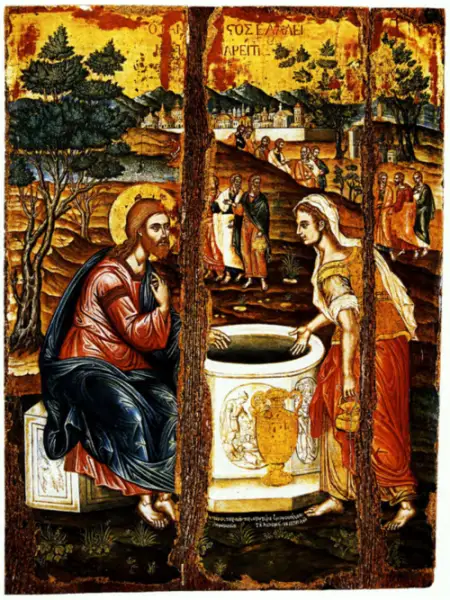
The Samaritan woman at the well, honored in Eastern tradition as Photini, is the figure of the Gospel of John whose conversation with Jesus at Jacob's Well near Sychar became one of the most celebrated encounters in Scripture. Coming to draw water at noon, she met a tired traveler who asked her for a drink and then offered her living water welling up to eternal life. He revealed knowledge of her life, with its five husbands, and answered her question about the place of worship with the declaration that true worshipers adore the Father in spirit and truth, and finally told her plainly, 'I am he', that he is the Messiah. She left her water jar, told the people of the city, and through her word many Samaritans came to believe. Eastern Christian tradition holds that she was baptized by the Apostles under the name Photini, meaning the luminous one, and that her witness brought so many to the faith that she is styled equal to the apostles. Emperor Nero took notice of her; hauled into his presence, she was put to many tortures and won the martyr's crown when her tormentors cast her down a dry well, about the year 67.
The Complete Life
A Woman of Samaria at Noon
The Gospel introduces her simply as a woman of Samaria who came to Jacob's Well at about the sixth hour, the heat of the day, to draw water. The hour itself suggests her position in the little city of Sychar, near the ground Jacob gave to Joseph: most women came to the well in company and in the cool of morning, while she came alone at noon. Jesus' knowledge of her household laid it bare before the reader, for he told her that she had had five husbands and that the man she now had was not her husband, and she acknowledged, in wonder rather than resentment, that he must be a prophet. Her life, whatever its sorrows and irregularities, became the very material of her encounter with grace, since the stranger at the well proved to know all of it and did not turn away. She belonged to a people divided from the Jews by centuries of estrangement after the exile, a division centered on worship, for where the Jewish scriptures fixed the holy mountain on Mount Zion, the Samaritan Pentateuch set it on Mount Gerizim — a divergence she brought up herself when the conversation turned to worship.
§ Biblical account
Living Water at Jacob's Well
Her vocation began with a request and ended with a revelation. Jesus, tired from his journey, asked her for a drink, and when she wondered that a Jew would ask anything of a Samaritan woman, he turned the request around: were she aware of God's gift and of who was speaking to her, she would be the one asking — and he would give her living water. The dialogue rose step by step, from the deep well of Jacob to the water that springs up to eternal life, from her disordered household to worship in spirit and truth, and at last to the confession she had been waiting for. When she said that she knew the Messiah was coming and would declare all things, Jesus told her plainly that the Messiah she awaited was himself, the very one speaking to her. She had arrived at the well a doubtful woman and rose from it the first person in the Gospel of John to hear the plain declaration of his identity. What she had carried to the well in her jar she now carried home in her heart, and the Water of Life Discourse that John preserves in her memory became, for the church, the complement of the Bread of Life Discourse and a paradigm for the soul's engagement with truth.
§ Biblical account
A City Convinced by Her Word
The Gospel records what she did next, and tradition built its estimate of her upon it. She left her water jar behind and went into the city, telling the people, and as John recounts in the verses that follow the dialogue, she lost no time telling everyone about her encounter with Jesus. At her word the Samaritans came out of the city to find him, and through her testimony many came to believe; the evangelist notes that they urged him to stay, and that many more believed because of his own word, telling the woman that now they believed not merely on her report, for they had heard him themselves. Eastern Christian tradition holds that she was baptized by the Apostles with the name Photini, the luminous one, a name that marked her enlightenment at the well. So many converts, tradition says, were won by her unceasing testimony that the church bestowed on her a title few women have ever received: equal to the apostles. The first missionary to the Samaritans, she had turned a noonday errand into a harvest, and the city that had known her shame heard the Gospel first from her lips.
§ Veneration
The Water of Life Discourse
The conversation at the well has instructed the church ever since. The passages of John 4:10-26 are known as the Water of Life Discourse, in which the image of the well becomes an image of salvation rather than of the fertility that wells carry in the older betrothal stories of Scripture. Scholars have long observed that the scene is modeled on the betrothal type-scenes of Hebrew narrative, above all Jacob at the well in Genesis, and that John's readers would have recognized the convention; others, such as Dorothy A. Lee, note how deliberately the evangelist breaks the pattern, for no betrothal takes place, Jesus appears not as a bridegroom but as the giver of living water, and the woman is not a young virgin but a battered five-times married woman who becomes the bearer of revelation. Roman commentators drew from the same dialogue the doctrine of grace: Roger Baxter meditated on the living water as Divine grace, which quenches forever the thirst of the soul for the pleasures of this world and becomes a fountain of good springing up to everlasting life. The Roman Curia has called the episode a paradigm for engagement with truth, presenting Christ as the bearer of the water of life.
§ Interpretations
Martyrdom in Nero's Rome
Tradition follows Photini far beyond the borders of Samaria, to the city and the emperor where the apostolic age was sealed in blood. Her preaching was said to have drawn the attention of Nero, and she was hauled before him to give account of her faith. Tortures of many kinds were inflicted on her, and the manner of her death echoed the well where her story had begun: her tormentors threw her down a dry well, and there she died. The Episcopal Church's calendar, which keeps her Lesser Feast, gives the year of her death as circa 67, within a generation of the crucifixion and in the same persecution that took the chief apostles of Rome. In older printings of the Roman Martyrology, a martyr called Photina of Samaria appears under March 20, and commentators take her to be the woman of the well, so that her passion was commemorated in the West as well as the East. The woman who had come alone to draw water in the heat of the day ended her life at the bottom of a well that held no water, refusing to deny the one who had told her, at that well, who he was.
§ Veneration
Feasts of the Samaritan Woman
The Samaritan woman is venerated across the divided churches of Christianity, each with its own calendar of her memory. Eastern Orthodoxy numbers her among the saints under the name Photini, and dedicates the Fourth Sunday after Pascha to her memory as the Sunday of the Samaritan Woman, the day on which the Gospel of her encounter is read each year; the Greek tradition keeps her feast on February 26 and the Slavic tradition on March 20. She is honored as a martyr and as equal to the apostles, among the highest titles the church bestows. In the Roman Catholic tradition, older editions of the Roman Martyrology commemorated the martyr Photina of Samaria on March 20, and she is venerated in the Eastern Catholic Churches in communion with Rome. In the West, the Episcopal Church in the United States honors Photini, the Samaritan Woman, with a Lesser Feast on February 26, giving the year of her death as circa 67. In Oaxaca, Mexico, a popular celebration takes place on the fourth Friday of Lent, when churches, schools, and businesses give away fruit drinks to passers-by in memory of the woman who met the Lord by the well.
§ Veneration
The Well in Art, Music, and Story
Few Gospel figures have left so deep a mark on the imagination of Christendom. A painting of Christ and the Samaritan woman drawing water in the Catacomb of Callistus in Rome, made in the second century, is among the earliest Christian works of art in existence, evidence that her scene with Jesus was painted almost as soon as Christians could paint at all. The subject never left the artists' hands: Duccio, Lucas Cranach the Elder, Guercino, Jan Joest van Kalkar, Stefano Erardi, Carl Heinrich Bloch, and Henryk Siemiradzki all painted the encounter, Gervais Drouet carved it in stone in 1651, and the Water of Life Discourse was set on canvas by Angelika Kauffmann. Musicians told her story in the gospel songs Jesus Met the Woman at the Well and Lift Him Up That's All, in Sam Cooke's Jesus gave me Water of 1951, and in William Sterndale Bennett's sacred cantata The Woman of Samaria of 1867; the old ballad The Maid and the Palmer carried the well into folk tradition. On screen she has been played by Nancy Palk in The Gospel of John and by Vanessa DeSilvio in The Chosen, whose first season closes at her well.
§ Cultural references
In Their Own Words
Everyone who drinks of this water will thirst again, but whoever drinks of the water that I will give him will never thirst again; but the water that I will give him will become in him a well of water springing up to eternal life.
I am he, the one who speaks to you.
Give me this water, that I may not thirst.
The Record
- Major works
- Witness to the Samaritans of Sychar, through whom many came to believe in Jesus·Missionary preaching that won so many converts that she was styled equal to the apostles
- Symbols
- a well·water jar
- Canonization
- Pre-congregation; venerated as a martyr and Equal to the Apostles in Eastern Christianity.
Prayer
Bibliography
Show 9 sources
- Barrett, C. K. (1978). The Gospel According to St. John: An Introduction with Commentary and Notes on the Greek Text (2nd ed.). Westminster John Knox Press. ISBN 978-0-664-22180-5
- Bourgel, Jonathan (2018). "John 4:4-42: Defining A Modus Vivendi Between Jews And The Samaritans". The Journal of Theological Studies. 69 (1): 39-65. doi:10.1093/jts/flx215. ISSN 0022-5185
- Brant, Jo-Ann A. (1996). "Husband Hunting: Characterization and Narrative Art in the Gospel of John". Biblical Interpretation. 4 (2): 205-223. doi:10.1163/156851596X00194
- Pontifical Council for Culture; Pontifical Council for Interreligious Dialogue (March 2, 2003). Jesus Christ the Bearer of the Water of Life: A Christian reflection on the "New Age". Vatican City: Internet Office of the Holy See
- Baxter, Roger (1823). "Conversions and Cures#423". Meditations For Every Day In The Year. New York: Benziger Brothers
- The Roman Breviary Translated Into English. Vol. 2. Translated by John, Marquess of Bute. Edinburgh and London: William Blackwood and Sons. 1908. p. 766. Retrieved February 12, 2023
- Lee, Dorothy A. (1994). The Symbolic Narratives of the Fourth Gospel: The Interplay of Form and Meaning. Sheffield: Sheffield Academic Press. ISBN 978-1-85075-468-8
- Lincoln, Andrew T. (2005). The Gospel According to Saint John. Hendrickson Publishers. ISBN 978-1-56563-401-5
- Samkutty, V. J. (2006). The Samaritan Mission in Acts. A&C Black. ISBN 978-0-567-04464-8
Profile text adapted from the Wikipedia article, licensed CC BY-SA 4.0.
Pray with this saint every day
Save St. Photini, the Samaritan Woman to your favorites, read the full profile, and get feast-day reminders in the Saints app.
Get the Saints AppFree on the App Store for iPhone and iPad