
c. 486 – 565·Feast July 28
St. Samson of Dol
Welsh abbot-bishop and founder saint of Brittany
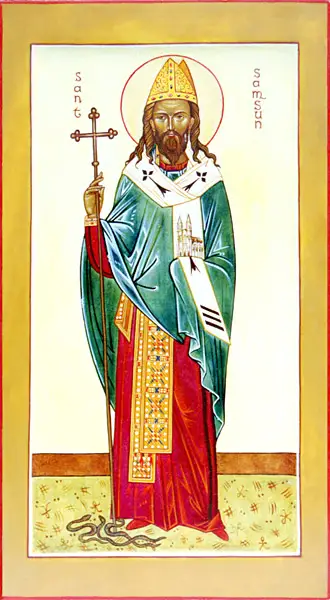
Overview
Samson of Dol was a Welsh monk and bishop who became one of the seven founder saints of Brittany. Born in southern Wales around the close of the fifth century to the noble couple Amon of Demetia and Anna of Gwent, he was entrusted as a boy to Illtud, Abbot of Llantwit Fawr, on account of a prophecy made at his birth. Seeking a stricter rule than his school offered, he moved to the island monastery of Caldey, where he eventually served as abbot, and later traveled to Ireland, where he founded or revived a monastery. In 521 he was ordained bishop by Dubricius on the Feast of the Chair of Saint Peter. From there his missionary path ran through Cornwall and the Scilly Isles to Guernsey and finally into Brittany, where at Dol he raised the abbey over which he ruled as bishop. He preached across the Channel lands, organized the excommunication of the tyrant King Conomor, and pleaded before the Merovingian ruler Childebert I for the sake of Conomor's estranged son. He attended a church council in Paris in his old age and died at Dol-de-Bretagne around 565, where he was buried in the cathedral beside his cousin Magloire.
The Complete Life
A Prophecy and a Noble Birth
Samson was born in southern Wales in the late fifth century, the son of Amon of Demetia and Anna of Gwent, into a family whose faith shaped his destiny from the beginning. A prophecy concerning the child moved his parents to place him under the care of Illtud, Abbot of Llantwit Fawr, the great monastic school of Wales, and there he was raised and educated. The ties of his family were unusually entangled: his father's brother had wed his mother's sister, making their son Maglor his kinsman through both parents at once, a bond that would matter at the end of his life when the two were buried side by side. He was also the nephew of Athrwys ap Meurig, a link into the princely houses of the age. Even as a schoolboy at Llantwit, however, Samson showed that he wanted more than the ordinary monastic formation. The primary source for his life, the Vita Sancti Samsonis, written between 610 and 820 from earlier materials, records his growing desire for austerity, a hunger that would soon carry him from the finest school in Wales to a bare island in the Irish Sea.
§ Life
Caldey Island and the Steadfast Abbot
Seeking a greater austerity than Llantwit provided, Samson transferred to Caldey, an island monastery lying off the Dyfed shore and a daughter house of his old school. There the shadow of his predecessor gave his abbacy its character. Pyr, the previous abbot, had drowned after tumbling into a well in a drunken stupor, and Samson's own complete abstinence from alcohol stood as a quiet rebuke to that death and a discipline he kept for the rest of his days. At Caldey he lived first as a cenobitic monk among the community and later as a hermit, embracing the eremitic life on the island's edge. In time the community made him abbot. His ambition, though, was not office but renunciation, and from Caldey he crossed the sea to Ireland, where the tradition credits him with founding or reviving a monastery. These years made him a double witness: a organizer of common monastic life and a solitary given to prayer. The combination, rare in any age, prepared him for the wider mission ahead, in which he would plant monasteries across Cornwall, the Channel Islands, and Brittany while never ceasing to live as a monk himself.
§ Life
Bishop, Founder, and Scourge of Conomor
The one firmly dated event of Samson's life came in 521, when Bishop Dubricius ordained him a bishop on the Feast of the Chair of Saint Peter at the beginning of Lent, at about thirty-five years of age. His episcopal ministry became a march of foundations through the Celtic West. He traveled to Cornwall, where he established a community at either South Hill or Golant; to the Scilly Isles, where the island of Samson still bears his name; to Guernsey, of which he is the patron saint; and at last into Brittany, where at Dol he raised the abbey that became his episcopal seat. His authority was moral as much as jurisdictional. He organized the excommunication of King Conomor, a Breton ruler notorious in the lives of the saints, and successfully pleaded the cause of Judael, the king's estranged son, before the Merovingian monarch Childebert I around the years 540 to 560. He is recorded attending a council in Paris at some point between 556 and 573, an old man still laboring in the church's assemblies. The Vita Sancti Samsonis preserves these journeys as evidence of the living contacts between churchmen of Britain, Ireland, and Brittany in the sixth century, contacts that Samson himself embodied.
§ Life
Old Age and Burial at Dol
Samson's last years were spent at Dol, the Breton monastery and see that was the crowning foundation of his life. By the time of the Paris council, held at some point in the years between 556 and 573, the sources note that he would already have been old, yet his attendance shows a mind still engaged with the affairs of the Frankish church. He died at Dol-de-Bretagne around 565. His cousin Magloire, doubly kin through the interwoven marriages of their parents, was laid in the same grave at Dol's cathedral, so that the two boys raised in the same extended family ended side by side in the sanctuary of the church Samson had founded. His shrine there became the center of his cult, and in later centuries the monastery at Milton Abbas in Dorset would hold relics of the saint. The life that had run from a prophesied birth in Wales through the schools of Llantwit and the cells of Caldey to the episcopate of a Breton see closed where his greatest work had been planted, among the monks of Dol and the people of Domnonée.
§ Life
In the Roman Martyrology
Samson was never formally canonized, for his veneration predates the modern machinery of canonization, but his sanctity was confirmed by centuries of liturgical commemoration. The Roman Martyrology as revised in 2004 gives the Catholic Church's listing for him on July 28, marked by a summary of his career: the entry records his death at Dol in Brittany and recalls the abbot-bishop who, taught the Gospel and the monastic rule by Illtud in Wales, bore both of them into Domnonée. The entry captures in one line the shape of his career, from the school of Llantwit to the mission fields of Brittany. He is venerated in the Catholic Church and the Eastern Orthodox Church, and his major shrines are at Dol in Brittany and at Milton Abbas in Dorset, where the Anglo-Saxon King Athelstan deposited an arm bone and a crozier of the saint in the tenth century. Curiously, the long memory of the Martyrology has not carried into every modern calendar: the Roman Catholic national calendar celebrated each year in Wales makes no mention of him, even though his feast of July 28 remains recorded in the universal Martyrology.
§ Roman Martyrology
Pillars, Islands, and Legends
Samson's memory clings to the landscape of western Britain and Brittany. At St Illtud's Church in Llantwit stands the Samson Pillar, an inscribed cross shaft whose re-discovery was announced around 1789 by the antiquarian Iolo Morganwg, who claimed it had been erected by Samson himself. That attribution was discredited by later historians with better sources, but twentieth-century genealogical studies revived interest, and many scholars now rank the pillar among the earliest Christian inscribed monuments surviving anywhere in Britain. Local legend in Ceredigion tells a wilder tale: that Samson, threshing corn on the hillside of Pen Dinas above Penparcau, broke his flail, and the two pieces, hurled across the valley in fury, supplied the material for the three Celtic crosses now standing in the church of Llanbadarn Fawr. More solid memorials survive in geography: the island of Samson in the Scillies preserves his name, Guernsey honors him as its patron, and he numbers among Brittany's seven founding saints, in the company of Pol Aurelian, Tugdual, Brieuc, Malo, Patern, and Corentin. The Anglo-Saxon king Athelstan's acquisition of his relics for Milton Abbas shows how far his fame had traveled from the Breton coast.
§ Life
Timeline
- 486
Born in South Wales, the son of Amon of Demetia and Anna of Gwent, and placed under the care of Illtud of Llantwit Fawr.
§ Life
- 22 Feb 521
Ordained bishop by Bishop Dubricius on the Feast of the Chair of Saint Peter at the beginning of Lent.
§ Life
- 540
Organized the excommunication of King Conomor and successfully petitioned King Childebert I on behalf of Judael, Conomor's estranged son.
§ Life
- 556
Recorded as having attended a church council in Paris, by which time he was already old.
§ Life
- 565
Died at Dol-de-Bretagne in Brittany and was laid to rest beside his kinsman Magloire within the cathedral there.
§ Life
In Their Own Words
At Dol in Brittany (died) Samson, abbot and bishop, who having learned the Gospel and monastic discipline in Wales from Illtud, spread these in Domnonée.
The Record
- Major works
- The monastery of Dol in Brittany·A monastic community in Cornwall at South Hill or Golant·A monastery founded or revived in Ireland
- Patron of
- Guernsey
- Canonization
- Pre-congregation; venerated in the Catholic Church and the Eastern Orthodox Church since the early Middle Ages
Prayer
Bibliography
Show 10 sources
- "Samson (Sampson) July 28", Orthodox England
- Flobert, Pierre (tr. & ed.) (1997). La Vie ancienne de saint Samson de Dol. Paris: CNRS. ISBN 2-271-05386-2
- Huddleston, Gilbert. "St. Samson." The Catholic Encyclopedia. Vol. 13. New York: Robert Appleton Company, 1912
- "St Samson of Caldey Island in Wales & Dol Island in Brittany"
- "Iolo Morganwg: the Stonemason"
- "Iolo Morganwg: Vale of Glamorgan Trail", published by Vale of Glamorgan Council, n.d.
- John, Terry (1994). The Standing Stones of West Wales; Their History and Traditions. Gomer. p. 47. ISBN 9781859021279
- Farmer, David (2011). The Oxford Dictionary of Saints (5th ed.). Oxford University Press. p. 389. ISBN 9780199596607
- Martyrologium Romanum, 2004, Vatican Press (Typis Vaticanis), page 419
- "National Calendar for Wales", accessed 8 February 2012
Profile text adapted from the Wikipedia article, licensed CC BY-SA 4.0.
Pray with this saint every day
Save St. Samson of Dol to your favorites, read the full profile, and get feast-day reminders in the Saints app.
Get the Saints AppFree on the App Store for iPhone and iPad