
late 14th – early 15th century·Feast December 21
St. Samuel of Waldebba
Lion-taming Ethiopian ascetic and founder of Waldebba Monastery
Overview
Samuel of Waldebba was a late fourteenth and early fifteenth century saint of the Ethiopian Orthodox Church, remembered as the founder of Waldebba Monastery in the Tigray Region and numbered among Ethiopia's most prominent saints. According to the Gadle Samuel, the fifteenth-century hagiography preserved in both long and short versions, he was born in Axum and chose the monastic life early, refusing marriage after his mother left his father to become a nun. He became a monk at the monastery of Däbrä Bänkʷal, and after his father's death he embraced a still harsher vocation, living as a solitary in the wilderness among wild beasts. His hagiography credits him with taming lions, walking through water without wetting his book, and being carried through the air by Saint Michael to visit Jerusalem. His asceticism was extreme: he stood in prayer inside a pit for months on end, wrapped in sackcloth, and went forty days together without food. Tradition holds that he died at the age of one hundred. Stories about him also appear in the Ethiopian Miracles of Mary, and the monastery he founded at Waldebba remains a living center of Ethiopian monasticism.
The Complete Life
A Son of Axum Who Would Not Marry
Samuel was born in the late fourteenth century in Axum, the ancient holy city of the Ethiopian highlands. The Gadle Samuel, the hagiography written in the fifteenth century and preserved in both long and short recensions, records that he had a brother and that the shape of his vocation was set by his mother's example: she abandoned married life for the convent, and Samuel, taking her for his model, declined marriage altogether. In a society where family and lineage carried deep weight, the choice marked him out early for a life set apart. His father remained in the world, but the boy's direction was fixed toward the monastery. He went to Däbrä Bänkʷal, the monastery where he received the monastic habit and formation, and there he progressed from novice to monk. The hagiography presents his departure from ordinary family life not as rebellion but as obedience to a call his mother had already answered, making mother and son parallel witnesses of the same renunciation. Only after his father's death was Samuel released for the next stage, the harsher life of solitude for which the monastery had been his preparation.
§ Life
Into the Wilderness Among the Beasts
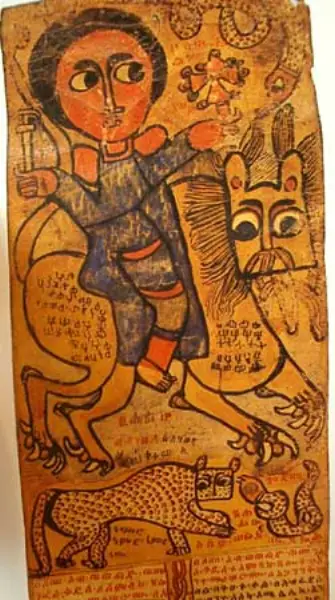
When his father died, Samuel passed from the ordered life of the coenobitic monastery into the solitary warfare of the wilderness. He took up residence alone in the wild country of Waldebba, in what is now the Tigray Region, living among the wild beasts. The hagiography clothes this transition in marvels: he is said to have tamed lions, so that the king of beasts became his companion, an image preserved in his iconography showing the saint riding a lion. He crossed waters without the book he carried suffering any damp, guarding the Scriptures that were his constant possession, and Saint Michael himself is said to have flown him through the air to visit Jerusalem, fulfilling in the spirit the pilgrimage that his desert life had made impossible in the flesh. These wonders belong to the literary language of Ethiopian sanctity, but they carry a consistent claim: the creation itself recognized the obedience of the man who had given up everything to pray in its midst. From this wilderness life came the community that gathered around him, which grew into Waldebba Monastery, the foundation with which his name has been inseparably joined ever since.
§ Life
Sackcloth, Pits, and Forty-Day Fasts
The hagiographical tradition is unambiguous about the severity of Samuel's asceticism. He prayed from inside a pit for months together, sackcloth rough against his skin, a practice that united him to the long line of Ethiopian desert dwellers who made their bodies the altar of their prayer. He fasted from food for forty days, taking on himself the number of Christ's fast in the wilderness. Such practices were not private eccentricities but the visible currency of Ethiopian monastic holiness, and Samuel carried them to their limit. The tradition also places him among the miracle-working fathers: stories about him appear in the Ethiopian Miracles of Mary, an honor showing that his intercession was sought alongside the Mother of God's own wonders. The combination of ferocious bodily discipline, intimacy with the beasts, and heavenly visitation made his life a mirror of the ancient desert fathers for Ethiopian readers. For fifteen hundred years the monks of Waldebba have looked back to him as the father who set their monastic order, and the pit, the sackcloth, and the forty days remain the pattern of the severe asceticism that the monastery's tradition has always demanded of its boldest spirits.
§ Life
Waldebba and the Memory of a Thousand Years
Samuel is remembered as the founder of Waldebba Monastery, set in the wilderness of the Tigray Region, and as one of Ethiopia's most prominent saints, a title confirmed by his place in the encyclopedias of Ethiopian hagiography and by his feast on December 21 in the church's calendar of saints. He is said to have died in the early fifteenth century at the age of one hundred, his long life spanning the centuries of record. His memory was committed to writing within generations: the Gadle Samuel was composed in the fifteenth century, and an earlier Latin-edited Vita Samuelis Valdebani preserves another strand of his legend, while Western scholarship from the twentieth-century Budge onward has kept his acts in circulation. The monastery itself endured for half a millennium and more, its monks tracing their rule to the father who tamed lions in their thorn bush country. Stories of his wonders entered the Ethiopian Miracles of Mary, binding him to the most beloved devotional literature of the Ethiopian Church. In iconography he rides the lion he subdued, an image instantly recognizable in Ethiopia and a summary of his whole life: the man whose obedience to God made the desert harmless.
§ Life
The Record
- Major works
- Waldebba Monastery, Tigray Region, Ethiopia
- Symbols
- Riding a lion
- Canonization
- Pre-congregation; venerated as one of Ethiopia's most prominent saints in the Ethiopian Orthodox Church
Prayer
Bibliography
Show 5 sources
- Nosnitsin, Denis (2010). "Samuˀel of Waldəbba". In Uhlig, Siegbert (ed.). Encyclopaedia Aethiopica. Vol. 4 (O-X). Wiesbaden: Harrassowitz. pp. 516-518.
- Turaiev, Borissus, ed. (1902). "Vita Samuelis Valdebani". Monumenta Aethiopiae Hagiologica – via HathiTrust.
- Raineri, Osvaldo (1998). "Samuele di Waldebba". In Cañellas, Juan Nadal; Virgulin, Stefano; Guaita, Giovanni (eds.). Biblioteca sanctorum orientalium: Enciclopedia dei Santi: Le Chiese Orientali. Vol. 2. Rome: Cittá Nuova. p. 934ff.
- "Abba Samuel: The Father who Set Monastic Order for 1500-Year Old Waldebba" – Ethiopian Orthodox Tewahdo Church Sunday School Department – Mahibere Kidusan. Retrieved 2020-12-11.
- Budge, Sir Ernest Alfred Wallis (1928). The Book of the Saints of the Ethiopian Church. The University Press.
Profile text adapted from the Wikipedia article, licensed CC BY-SA 4.0.
Pray with this saint every day
Save St. Samuel of Waldebba to your favorites, read the full profile, and get feast-day reminders in the Saints app.
Get the Saints AppFree on the App Store for iPhone and iPad