
597 – 695·Feast December 17
St. Samuel the Confessor
Coptic confessor who endured Byzantine torture and founded a desert monastery
Overview
Samuel the Confessor was a Coptic Orthodox saint whose long life spanned the last Byzantine decades of Egypt and the coming of Arab rule. Born in 597 in the city of Daklube to a non-Chalcedonian priest, he was formed from childhood for the monastic life and became a disciple of the aged ascetic Agathon at Scetis. His refusal to accept the Chalcedonian faith of the emperors cost him dearly: he tore the imperial Tome of Leo to pieces before its envoy, was flogged and tortured, and lost an eye to a blow of his interrogators. Hauled in chains before Cyrus of Alexandria, he answered the persecuting bishop with unbroken defiance and was beaten until his blood ran like water. Driven from the Nitrian Desert, he settled at Mount Qalamoun in Upper Egypt and founded the monastery that still bears his name. Captured later by sun-worshiping Berbers and held as a slave for three years, he refused their religion and their temptations until they released him. He endured torture for his faith without shedding his blood, and for that witness the church calls him confessor rather than martyr. He died at Mount Qalamoun on December 17, 695, at nearly one hundred years of age.
The Complete Life
A Priest's Son of Daklube
Samuel was born in 597 in the city of Daklube in the Nile Delta, into a family already marked by the non-Chalcedonian faith that his whole life would defend. His father was a priest of that confession, and the boy was given to the service of the church from childhood. The later hagiography, the Life of Samuel of Kalamoun attributed to Isaac the Presbyter, names his parents Silas and Kosmiane and fills out the picture of his early years: Samuel became a sub-deacon at the age of twelve and insisted from his earliest days on becoming a monk and living the ascetic life. His father's anxieties about the boy's harsh vocation were quieted, the account says, after an angel reassured him, and Silas responded by building a church and ordaining his son deacon of it. The home formation did not last into Samuel's manhood, for his mother Kosmiane died when he was eighteen and his father Silas followed when he was twenty-two. Freed of family bonds at an age when most men were only beginning them, Samuel set out for Scetis, the renowned center of enlightenment and monastic discipline in the desert, to find a master under whom he could learn the life he had chosen.
§ Biography
Formation at Scetis
At Scetis Samuel found the aged ascetic Agathou and placed himself under his direction, training for three years until the old man's death. The account of his formation presents him as receiving both the discipline and the spiritual power of his master, for after Agathou's death Samuel became a respected monk among the fathers of the desert, empowered by his teacher's spirit. The timing drew him into the central controversy of Egyptian Christianity. Cyrus of Alexandria arrived to take up the bishopric of the city, pursuing a policy of combining Miaphysite and Chalcedonian Christians into one communion, a policy the Coptic tradition regarded as betrayal of the faith of the Council's opponents. When a messenger of Cyrus came to Scetis carrying the theological document known as the Tome of Leo, Samuel asked to see the copy and tore it to shreds before the envoy's eyes. It was the act of a monk formed in the uncompromising tradition of the desert, where confession of the faith had always outweighed safety. The gesture set the course of the rest of his life: flogging, expulsion, and a career of endurance that would earn him the title of confessor.
§ Life of Samuel of Kalamoun
Torture and Witness Under the Byzantines
Samuel's resistance to the Chalcedonian settlement brought him before the machinery of imperial power. While he was at the Monastery of Saint Macarius, a Byzantine imperial envoy came to the desert to persuade the monks to confess the Chalcedonian faith; Samuel snatched the imperial letter and tore it to shreds with words of anathema against it. The enraged envoy ordered him beaten with pins and hanged up by his arms, his face struck until one of the blows put out one of his eyes, an injury he carried in his body for the rest of his life and in his iconography forever. Later, when Cyrus of Alexandria came to Faiyum, Samuel was marched into his presence manacled like a common criminal, going rejoicing and asking God to let him shed his blood that day for the name of Christ. The exchange between bishop and monk became one of the famous dialogues of Coptic hagiography, Samuel calling obedience to God and Archbishop Benjamin better than obedience to Cyrus and his doctrine. The soldiers struck him until his blood poured out like water, yet the governor of Faiyum snatched him from their hands, and Cyrus, frustrated, ordered him driven from the Nitrian Desert. With four loyal disciples Samuel went south, dwelling at a monastery near Fayyum before God's voice sent him into the wilderness of Kalamun.
§ Biography
Berber Captivity and the Monastery of Qalamoun
After leaving Scetes, Samuel dwelt at Mount Qalamoun in what is now the governorate of Beni Suef, and there he established the monastery that still bears his name to this day. His trials were not over. Sun-worshiping Berbers took him captive, and in captivity he befriended Youannis, Archpriest of Scetes, who had also been seized. When the Berbers failed to persuade him to worship the sun, they locked an iron shackle around his leg and fastened it to the leg of a young woman, setting the two to mind the camels, hoping she would seduce him into their religion; the Life adds that during a three-year captivity at Siwa he was pressed to abandon both his faith and his chastity and refused both, until God granted him power to work miracles and his captors released him with a gift of fine camels. Back at Kalamoun his community flourished, receiving donations from the Bishop Gregory of Koeis, from Mena the Eparch of Pelhip, and from a layman named Apollo who took over the monastery's finances and trade. Samuel lived at the monastery fifty-seven more years, dying on 8 Koiak 412 AM, December 17, 695, at nearly one hundred years of age, having outlived his persecutors and seen the Byzantine rule of Egypt pass away.
§ Biography
Confessor, Not Martyr
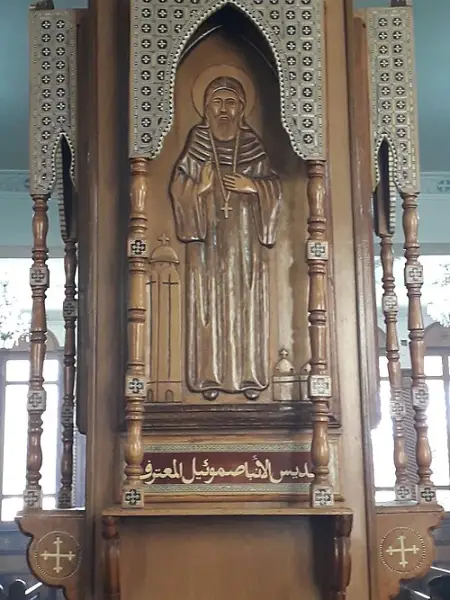
The church honors Samuel with the title confessor, a distinction of precise meaning in his case: the title was his because he suffered torture for his Christian confession yet was never put to death, his blood never shed for the faith. The sufferings that earned the title were formidable — the hanging by his arms and the loss of an eye under the imperial envoy, the floggings at Faiyum that left his blood flowing like water, the chains and captivity of the Berber years — yet he survived them all and died old in his own monastery. He is venerated in the Coptic Orthodox Church and in all the Oriental Orthodox Churches, whose common confession he had defended with his body. His feast falls on 8 Koiak in the Coptic calendar, corresponding to December 17, the day of his death in 695. His major shrine is the Monastery of Saint Samuel the Confessor at Mount Qalamoun, where his relics rest at the foundation he established more than thirteen centuries ago. In his iconography he is shown as a monk with one eye, the portrait of a man whose disfigurement was the receipt he carried for his confession.
§ Biography
The Life, the Apocalypse, and a Living Monastery
Samuel's memory reached posterity through remarkable literary channels. The most important surviving source on his life is the hagiography attributed to Isaac the Presbyter, a monk of the Monastery of Saint Samuel the Confessor of whom almost nothing else is known, who wrote four generations after the saint's death, at the end of the eighth or beginning of the ninth century. Four manuscripts carried the work into modern times: one copy in Sahidic Coptic, an Ethiopic rendering, and two fragmentary witnesses, one Sahidic and one Bohairic. A second text, the Apocalypse of Samuel of Kalamoun, gives his name as its author in its manuscripts, a work of apocalyptic literature that kept his voice alive in Coptic tradition. Most tangibly, the monastery he founded at Mount Qalamoun endures to the present day, still carrying his name and still housing a monastic community in the desert where he planted it. Academic literature knows him as Samuel of Kalamoun or Samuel of Qalamun, and his story — the torn Tome of Leo, the lost eye, the defiance of Cyrus, the Berber chains — remains one of the defining narratives of Coptic resistance and endurance in the century when Egypt passed from Byzantine to Arab rule.
§ Life of Samuel of Kalamoun
Timeline
- 597
Born at Daklube in Egypt to a priest of the non-Chalcedonian confession.
§ Biography
- 609
Became a sub-deacon at the age of twelve, according to the Life of Samuel of Kalamoun, having insisted from early childhood on the monastic life.
§ Life of Samuel of Kalamoun
- 615
His mother Kosmiane died when he was eighteen years old.
§ Life of Samuel of Kalamoun
- 619
His father Silas died when Samuel was twenty-two, and he set out for Scetis, where he trained under the aged ascetic Agathou.
§ Life of Samuel of Kalamoun
- 17 Dec 695
Died on 8 Koiak 412 AM at Mount Qalamoun, aged about ninety-eight.
§ Biography
In Their Own Words
Excommunicated is this tome and everyone who believes in it, and cursed is everyone who might change the Orthodox faith of our Holy Fathers.
It is good to obey God and His holy Archbishop Benjamin rather than obey you and your devilish doctrine, O son of Satan, Antichrist, Beguiler.
The Record
- Major works
- The Monastery of Saint Samuel the Confessor at Mount Qalamoun·The Apocalypse of Samuel of Kalamoun, attributed to him in its manuscripts
- Symbols
- Depicted as a monk with one eye
- Canonization
- Pre-congregation; venerated in the Coptic Orthodox Church and all Oriental Orthodox Churches
Prayer
Bibliography
Show 5 sources
- "St. Samuel the Confessor" (PDF). Saint Mary & Archangel Michael Coptic Orthodox Church. Retrieved June 17, 2025.
- "St. Abba Samuel the Confessor". Coptic Crew. Retrieved June 17, 2025.
- Butler, Albert J. (1903). The Arab Conquest of Egypt and the Last Thirty Years under Roman Dominion. Oxford University Press. p. 186. ISBN 1724498029.
- "The Story of St. Samuel the Confessor and his Ancient Monastery in Maghāgha". Dialogue Across Borders. Retrieved June 17, 2025.
- Isaac the Presbyter (1983) [8th or 9th century]. The Life of Samuel of Kalamoun. Translated by Alcock, Anthony. Aris & Phillips Ltd. ISBN 0-85668-219-5.
Profile text adapted from the Wikipedia article, licensed CC BY-SA 4.0.
Pray with this saint every day
Save St. Samuel the Confessor to your favorites, read the full profile, and get feast-day reminders in the Saints app.
Get the Saints AppFree on the App Store for iPhone and iPad